Advertise On EU-Digest

Annual Advertising Rates
Showing posts with label European Aircraft Industry. Show all posts

9/5/20

European Aircraft Industry: Airbus A380F: Which Airlines Ordered The Cargo Airbus A380?


Airbus announced its intention to develop a high capacity aircraft at the Farnborough Airshow in 1990. It would take on Boeing dominance of the market, promising a 15% lower operating cost than the Boeing 747.

The project was originally known as the A3XX. After consideration of several options (including one based on two A340 fuselages combined), a two-deck aircraft was chosen and became known as the A380.

Airbus proposed a passenger version and a freighter version, the A380 and the A380F. The freighter version would have used the same fuselage, wings (with additional internal strengthening), and engines as the passenger version. Capacity would have been up to 150 tonnes, and it would offer a range of 10,400 kilometers.

This would have made it the largest commercial cargo plane on offer, apart from the one-off giant Antonov An-225 aircraft. For comparison, the new 747-8F carries 137.7 tonnes with a range of 7,630 nautical miles.

Read more at:
Which Airlines Ordered The Cargo Airbus A380? - Simple Flying

6/25/20

European Aircraft Industry ; Netherlands agrees to contribute 3.4 billion euros to Air France-KLM bailout

The Dutch government has reached a deal with France to contribute 3.4 billion euros ($3.8 billion) to an Air France-KLM (AIRF.PA) bailout that had strained relations between the airline group’s state shareholders, sources told Reuters.

Read more at:
Netherlands agrees to contribute 3.4 billion euros to Air France-KLM bailout - Reuters

3/30/20

Airbus: Meet "Merkel One": The New German Air Force Airbus A350 - by Chris Loh

The Executive Transport Wing of the German Government (Flugbereitschaft) will soon have one of three Airbus A350s. These aircraft would be considered the German equivalents to Air Force One. According to FlugRevue, the first Airbus A350 has already been painted. Last week, the aircraft rolled out of the paint shop at the Airbus facility in Hamburg-Finkenwerder – only to fly back to Toulouse shortly after.

We reported just over a year ago that the government of Germany was ordering three Airbus A350 aircraft to replace its aging Airbus A340 aircraft. Reportedly, the German Government was trying to decide between the A330 and the A350.

Over a month ago, the first A350 ordered by the Flugbereitschaft took its maiden flight in Toulouse. At the time, however, it was without its distinctive governmental livery. Now we have a glimpse of the new aircraft “fully dressed” and it looks great! Below is some rare video of the new bird: (to view the video clich on the link below.

Read more at: Meet "Merkel One": The New German Air Force Airbus A350 - Simple Flying

3/23/20

European Aircraft Industry: Airbus cancels €1.5 billion in dividends over coronavirus

European planemaker Airbus is canceling a stakeholder payment to cope with the financial stress of the global coronavirus outbreak. The manufacturer called for federal support as it is hit by travel restrictions.

Read more at:
https://www.dw.com/en/airbus-cancels-15-billion-in-dividends-over-coronavirus/a-52884866

2/23/20

European Aircraft Industry: Airbus reveals futuristic blended wing aircraft design

The French aircraft maker Airbus rolled out a model of the small-scale, remote-controlled aircraft demonstrator it's been using to test the design at the Singapore Air Show 2020 on Tuesday.

This "blended wing body" demonstrator is called MAVERIC -- which stands for Model Aircraft for Validation and Experimentation of Robust Innovative Controls -- and is two meters long and 3.2 meters wide.

Testing has reportedly been underway since June 2019 but the project, which launched in 2017, was kept under wraps until this month.

According to Airbus, MAVERIC helps accelerate understanding of new aircraft configurations and matures the technology necessary to fly such a radically different aircraft.

What's so special about this aerodynamic "blended wing body"? In addition to the environmental benefit -- approximately 20% less fuel burn compared to current single-aisle models with the same engine -- Airbus says the plane's unusual and spacious configuration opens up new possibilities for cabin design.

To prove this point, it also released a series of design renderings showing what passengers onboard a blended wing aircraft might be in for. Noise would likely be reduced too, due to the plane's "shielded" engine, which is mounted above the central body.

Read more at: Airbus reveals futuristic blended wing aircraft design | CNN Tr

2/14/19

European Aircraft Industry: Airbus to scrap production of A380 superjumbo around 2021 - by Tim Hepher

Europe's Airbus announced plans to scrap production of the A380 superjumbo on Thursday, abandoning its dream of dominating the skies with a cruiseliner for the 21st century after years of lacklustre sales.

The world's largest airliner, with two decks of spacious cabins and room for 544 people in standard layout, was designed to challenge Boeing's legendary 747 but failed to take hold as airlines backed a new generation of smaller, more nimble jets.

Read more at: Airbus to scrap production of A380 superjumbo

8/14/17

European Aircraft Industry: Iran in talks to buy 48 Airbus helicopters

Airbus Helicopter
Iran is holding talks with European planemaker Airbus to buy 48 helicopters for civilian use, an Iranian official was on Saturday quoted as saying, as Iran continues its shopping spree of Western aircraft after the lifting of sanctions.

"The Health Ministry is planning to order 45 HEMS (Helicopter Emergency Medical Service) helicopters and the purchase is being negotiated by the Ministry of Roads and Urban Development," Iran's Financial Tribune daily quoted Deputy Minister Asghar Fakhrieh-Kashan as saying.
"Ports and Maritime Organization is also planning to hold a tender to purchase three search-and-rescue helicopters," he added. 

An Airbus Helicopters spokesman said: "We don't comment on discussions we may or may not be having with potential customers".

Read more: Iran in talks to buy 48 Airbus helicopters: report

6/18/17

European Aircraft Industry: Airbus A380 upgrade waits in the wings at Paris Airshow

The Airbus A-380
Airbus is preparing to roll out a novel A380 wingtip design to rally support for the world's largest passenger jet by improving its fuel efficiency, according to a prototype seen on Saturday.

A Reuters photographer got up close to the roughly three-meter-high split wingtip which has been installed on an A380 belonging to the Air and Space Museum at Le Bourget airport, where the Paris Airshow opens on Monday.

It confirms an upgrade reported by Reuters and Usine Nouvelle on Friday. Airbus declined comment.

Drag-reducing 'scimitar' split wingtips have been used on Boeing's medium-haul Boeing 737 MAX, but never on a jetliner the size of the A380, which has a 79.9-metre (262-foot) wingspan.

The aircraft sporting the prototype 'winglet' will be towed out to join others on display at the June 19-25 air show, giving airlines a glimpse of an improvement that Airbus hopes will turn around the present weak sales of its flagship double-decker

Read more: Airbus A380 upgrade waits in the wings at Paris Airshow | Reuters

11/25/16

Europe's largest passenger plane makes maiden flight

The Airbus A350-1000 is seeking to hog the limelight from Boeing’s popular 777.

It is a larger cousin to the new-generation A350-900, which entered service last year.

Both are built from similar materials to Boeing’s mid-sized 787 Dreamliner.

The lightweight, carbon-fibre A350-1000 is seven metres longer than the A350s already in service.

It has 366 seats and can carry 40 more people.

Read more: Europe's largest passenger plane makes maiden flight

11/6/16

European Aircraft Industry: Airbus building flying cars and taxis so that it can become the Uber of the skies - by Danielle Muoio

Airbus working on building flying car
Tech giants are starting to turn their attention to “flying cars.”

Uber released a 98-page white paper last week outlining its plans to bring “flying cars” to commuters by 2026. Google co-founder Larry Page is also funding a “flying car” project through a start-up named Zee.Aero, and its prototype was reportedly seen in action at Hollister Municipal Airport in October.

But Airbus, which offers a legacy of building civil aircrafts and working with the Federal Aviation Administration, is also developing its own “flying car” as part of its Project Vahana – and its aviation experience could give it an edge. Project Vahana is being run under Airbus’ Silicon Valley arm, named A³.

To get this out of the way early, all of these companies aren’t really interested in developing flying cars, hence the quotation marks. That would indicate they were trying to take the same route as Terrafugia, which is building a hybrid car that can drive on the road and also fly.

But A³, along with Uber and what we know of Zee.Aero, isn’t focused on the car portion of a flying car. All three are working on VTOL aircrafts, which is short for Vertical Take-Off and Landing. That means the aircrafts don’t need a runway to ascend, similar to a helicopter.

Read more: Airbus is building flying taxis so that it can become the Uber of the skies

10/10/16

Aircraft Industry: Dozens of Boeing and Airbus deliveries put back by Turkish Airlines

Airbus A-320
Turkish Airlines said it plans to postpone dozens of Airbus and Boeing narrow-body jets as it contends with a turbulent travel market following terror attacks in Istanbul and Europe.

The carrier is delaying deliveries of 39 of the upgraded single-aisle planes originally scheduled for 2018 to 2020, the company said in a filing at the weekend to Borsa Istanbul. Turkish is raising its 2022 deliveries for the workhorse jets to 30 from the six it had previously planned.

The company did not elaborate on the models that will be deferred, but it has ordered 92 Airbus A321neo, 65 of Boeing’s 737 Max 8 and 10 of the US plane maker’s Max 9 models. Turkish, based in Istanbul, said it was reducing flight frequencies and shifting to smaller planes on "demand-challenged routes" after posting a second-quarter loss of US$215 million in August.

Read more: European Aircraft Industry: Dozens of Boeing and Airbus deliveries put back by Turkish Airlines | The National

8/5/16

European Aircraft Industry: Iran expects Airbus deliveries before 2017

Iran says it expects the first deliveries of Airbus planes to be made by the end of 2016 provided that the United States provides the required authorizations for the deliveries.

“The first series of Airbus planes will probably arrive in Iran by the end of autumn provided that the Office of Foreign Assets Control (OFAC) [of the US Treasury Department] issues the required authorization to Airbus to do so,” said Iran’s Minister of Roads and Urban Development Abbas Akhoundi.

Akhoundi added that there is no reason that the deal with Airbus – as well as another with Boeing – will not proceed.

He emphasized that Iran is positive that OFAC will issue the authorizations for Airbus to deliver the plans that Iran has purchased from the company.

Akhoundi further said that the deal with Airbus is above 500 pages and contains many technicalities, adding that a majority of technical issues relating to the deal have already been finalized.

The Iranian minister also said that talks over the financial issues are in final stages.

In January, Iran signed a major contract with European aviation giant Airbus worth about $27 billion to buy 118 planes within the next few months. The contract was signed during the visit to Paris by Iran’s President Hassan Rouhani.

Iran also sealed a deal in June worth around $25 billion with the US aerospace heavyweight, Boeing, for the purchase of 100 passenger planes.

The deal with Boeing is still facing a possible ban by Congress in what many see as a result of the growing anti-Iran measures adopted by US lawmakers.

Iran is also working on a scheme to purchase planes from the aviation arm of Japan’s Mitsubishi Heavy Industries.  Officials in Tehran recently announced that Tokyo has agreed to fund Iran’s purchase of Mitsubishi planes.

Note EU-Digest:  Strange that Airbus, a European company needs the approval from the US Office of Foreign Assets Control (OFAC) - US Treasury Department to OK and finalize the deal. How Who gave the US the right to bypass European Sovereignty in this mega airplane sale ?

Read more: PressTV-Iran expects Airbus deliveries before 2017

3/28/16

Airbus A400M Atlas: Did you see it? Plane-spotters joy as new Airbus A400M Atlas makes appearance in Gloucestershire skies

Airbus A400M Atlas
Eyes were craned skyward in Gloucestershire as an Airbus A400M Atlas flew over Cheltenham and Gloucester on Thursday.

The aircraft was conducting a training exercise practicing landing at Gloucestershire Airport in Staverton.

And many people took videos and still images of the plane, including David Willis who took the picture below from Benhall Park in Cheltenham.

The aircraft has a much larger capacity compared with older models the cargo capacity has doubled. The Aircraft can do electrical surveillance and aerial refuelling as well as transport.

The aircraft's intended use is for short soft landing strips and for long-range flight for transporting cargo.

2/9/16

European Aircraft Industry: Airbus to Send Glider to the Edge of Space - by Meredith Carey

Airbus is at it again. For a company that files patents constantly for tech and specs that travel geeks and sci-fi fans can only dream of, you would think it would have run out of ideas by now. But this time, Airbus is aiming even higher (literally): The Airbus Perlan 2 glider, set to launch in June, will be the first engineless aircraft to fly at the edge of space.

The glider is on its way to become the highest-flying aircraft in history, with the team hoping to reach altitudes of up to 90,000 feet using nothing but wind, which would put 98 percent of the Earth's atmosphere beneath the Perlan 2. (For reference, a commercial plane typically cruises at 35,000 feet.) To get to that altitude, the Perlan 2 will be towed to several thousand feet, then cut loose to coast on Argentinian mountain waves, or air currents above mountain ranges that can push a flight into the stratosphere. Once there, the pilot and co-pilot will have to wear an oxygen re-breather system, similar to the one used by astronauts.

With an 84-foot wingspan, the Perlan 2 will also carry scientific instruments, life support, and two safety parachutes. It has the same weight as a 1967 Volkswagen Beetle.

The Perlan 2 is just the entry point for Airbus, which has its sights set on space. The company recently filed a patent for hypersonic passenger craft that will go to space and back, according to the Daily Mail,. This puts Airbus alongside SpaceX and Virgin Galactic in the latest iteration of the space race.

In the meantime, Airbus will have plenty to keep its engineers and designers busy. It recently filed a patent for a Concorde 2.0 to get travelers from New York to London in an hour. Earlier last year, the company also released plans to stack passengers in a highly efficient, but slightly terrifying pattern. And with its newest widebody plane, the A350, making its first flight in December followed by an upcoming revival of the longest flight in the world (19 hours, nonstop, if you were curious), Airbus is in full control of some of this year’s most innovative travel. And it’s only February.

Read more: Airbus Glider to the Edge of Space - Condé Nast Traveler

1/10/16

European Aircraft Industry: Airbus' New Technology Can Track and Disrupt Rogue Drones - by Saul Loeb

The next time pranksters decide to fly their drone too close to an airport and put airplanes carrying hundreds of passengers at risk, security personnel may be able to avert disaster by using an anti-drone defense system. All they would have to do is use technology to remotely lock onto the flying robot, take control, and safely steer it from danger.

New technology from European aerospace giant Airbus is intended to do just that. It is pitched as a way to keep restricted airspace free of drones without having to go to extreme measures like shooting them down.
Airbus showed off a new drone-monitoring system this week at the annual Consumer Electronics Show in Las Vegas. The technology scrambles the wireless communications between drones and their owners, so that the authorities can then take control.

The new drone system uses a combination of infrared cameras, radio technology, and radar to pinpoint the location of drones at ranges as far away as 6.2 miles, according to Airbus. It then determines whether the drones may be flying in restricted airspace in addition to determining the pilot’s location to help law enforcement track him or her down.

Read more: Airbus' New Technology Can Track and Disrupt Rogue Drones - Fortune

1/4/16

European Aircraft Industry: Airbus is flying into the future with some amazing concepts

From Paris to Tokyo in three hours
From supersonic jets to stacking passengers Airbus is always looking to the future in the rapidly changing aerospace sector.

In recent months the plane-making giant with a wing production plant in Broughton has submitted several patents that give a glimpse into the future of air travel.

How many of these finally make it into the skies will only become clear in decades to come.

Here we look at some of their most interesting proposals over the past year.

Airbus believes the jet would take just three hours to fly from Paris to San Francisco or Tokyo to Los Angeles.

They say it would travel twice the speed of Concorde and have a cruising altitude 20km higher than conventional aircraft.

The ultra rapid air vehicle has been dubbed the “son of Concorde”.

The plans show the plane would be propelled vertically by rocket engines to supersonic speeds and then hydrogen-powered wing mounted ramjets would take over and propel the aircraft to its destination.

Late in the year they also announced a deal with Aerion to take forward plans for the world’s first private supersonic jet in as little as six years.

The AS2 plane will be capable of supersonic travel - hitting speeds of 1,217mph.

Read more: Airbus is flying into the future with some amazing concepts - Chester Chronicle

10/29/15

European Aircraft Industry: China, Germany sign deal for A330 Airbus jets

China and Germany signed a deal on Thursday that will see Chinese airlines buy 30 A330 aeroplanes manufactured by Airbus Group.

The order, valued at 17 billion euros ($18.57 billion), was announced after Germany's Chancellor Angela Merkel met China's Premier Li Keqiang in Beijing.

Airbus is battling Boeing Co for dominance of the Chinese market, where Boeing estimates demand for new planes to reach $1 trillion over the next two decades.

China, Germany sign deal for A330 Airbus jets

7/15/15

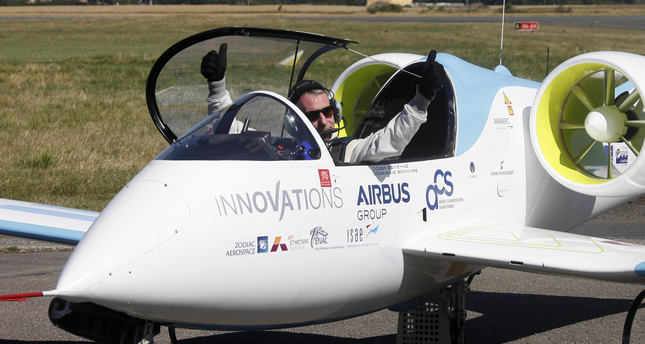
European Aircraft Industry: Airbus electric plane makes history by flying over English Channel

AP Photo
The E-fan electric plane of European planemaker Airbus has made history by being the first battery-operated electric plane to fly over the English Channel.

Flying from Lydd, England, to Calais, France, recently, the environmentally-friendly plane which operates on batteries only, uses no oil or water. Thanks to that feature the 20-foot long, 1300-pound jet releases absolutely no emissions.

Several companies in different countries are trying to develop electric planes in hopes of offering a fuel-free and emissions-free flight alternative for the future.

Earlier, pilot Hugues Duval flew from Dover, England, to Calais on a two-engine, one-seat Cricri plane, which weighs about 100 kilograms (220 pounds). He said reached 150 kilometers (90 miles) an hour on his 52-kilometer (31-mile) journey.

Duval told The Associated Press that his successful flight was a "relief" and an "important moment" after years of developing the plane and flying it over land.

Airbus' E-fan took its maiden voyage in March 2014, and has taken off 100 times since, its latest at Paris's International Air Show last month. Airbus aims to put the two-seater on the market in 2017, targeting sales at training facilities for entry-level pilots.

Read more: Airbus electric plane makes history by flying over English Channel - Daily Sabah

6/1/15

European Aircraft Industry: Airbus confirms software brought down A400M transport plane - by Richard Chirgwin

Airbus has confirmed the crash that stalled its A400M program was caused by engine control software.
However, according to Handelsblatt, the problem wasn't that the software is buggy. Rather, someone in the final assembly process installed the software incorrectly.

Marwan Lahoud, Airbus' chief strategy officer, told the German newspaper that the company already believed there had been no problem with the airframe: “The black boxes attest … that there are no structural defects, but we have a serious quality problem in the final assembly”.

Handelsblatt beats Google's translation with the sentence “Die Software für die Steuerung der Motoren sei bei der Endmontage falsch aufgespielt worden”*, but it seems to El Reg to suggest that the software was configured with incorrect parameters at installation.

The May 9 crash near Seville's San Pablo Airport killed four Airbus Defense and Space personnel when the A400M, designated MSN23, crashed just after takeoff on its first flight.

Airbus had already told A400M operators – Germany, Britain, Turkey and France – to check the planes' Engine Control Unit. The Royal Malaysian Air Force also has an A400M, delivered in March.

Last week, Airbus CEO Tom Enders had complained that the company needed the black box data, which was being withheld by Spanish agencies, to conduct its analysis of the crash.

While the results will be a relief – since a problem with the physical build quality would have been extremely expensive – Airbus will still need to satisfy customers that it can ensure that software installs don't go wrong in future.
Airbus confirms software brought down A400M transport plane • The Register

4/13/15

European Aircraft Industry: Airbus is planning a “budget economy” section with even narrower seats

Aircraft manufacturer Airbus is planning to roll out planes with even more tightly packed seats, in what it’s billing as a “budget economy” section.

The configuration would put nine slightly smaller seats in a row on the company’s popular A330 plane—in what it is also calling “max abreast” seating. Premium economy would have seven seats across, and today’s economy seats (which Airbus now calls “comfort” economy) would have eight across.

“Around 3 billion economy seats are sold every year,” Airbus spokeswoman Sara Ricci told Quartz. “We think there is room for choice in this market.”

In an interview with the aviation industry site Leeham News and Comment, Airbus marketing head Chris Emerson said the new, tightly-packed seating configuration was designed to appeal to customers—especially in China and southeast Asia—who are inclined to pay a cheaper fare in exchange for less in-flight real estate.

“They are completely agnostic to comfort,” he said. Much of the growth in the airline industry is expected to come from budget Asian airlines, although US airlines are also rumored to be considering “economy minus” seating configurations.

Airbus and its chief rival Boeing have often sparred over whose planes packs in passengers more tightly. Airbus has accused Boeing of cramming in 17-inch-wide (43-centimeter) seats that fall short of its own 18-inch standard (a claim Boeing denies). But “budget economy” seats could fall short of Airbus’ own professed standard.

Read more: Airbus is planning a “budget economy” section with even narrower seats - Quartz