Neurosurgeons and aerospace engineers are equally smart in different ways — but no smarter than the general population, a new study has found.
So it may be time to ditch the phrases "It's not exactly rocket science," and "It's not exactly brain surgery," say the researchers behind the findings.
Read more at:
Brain surgeons and rocket scientists are no smarter than the rest of us: study | CBC Radio
Showing posts with label Education. Show all posts
Showing posts with label Education. Show all posts
12/16/21


2/4/21
Self Motivation: Kids are sponges. We must take care of how we teach them now - by Emily Parnell
It’s true that the education system is in turmoil and many kids are struggling. Parents, too, are feeling the strain, now bearing an unexpected load of their kids’ educations. Teachers and schools bear the brunt of the burden, juggling their passion for education, fielding community pressures and personal safety concerns, while trying to reinvent the construct of brick and mortar schools.
The situation is less than ideal. Measures forced by circumstance are rarely ideal and tend to be riddled with hiccups and missteps. But this isn’t a simple crisis management exercise. As an added layer, there’s a baffling disconnect on what the crisis even is.
Read more at: Kids are sponges. We must take care of how we teach them now | The Kansas City Star
The situation is less than ideal. Measures forced by circumstance are rarely ideal and tend to be riddled with hiccups and missteps. But this isn’t a simple crisis management exercise. As an added layer, there’s a baffling disconnect on what the crisis even is.
Read more at: Kids are sponges. We must take care of how we teach them now | The Kansas City Star
11/26/19
USA-Student Loans In reality are bad for the Economy: Forgiving Student Debt Would Boost Economy, Economists Say - by Chris Arnold
The reason debt forgiveness could have a big impact on the overall
economy is that a generation of Americans is making major life decisions
differently because of student loans.
"Children, it's not about if you want them," says Laura Greenwood in Montpelier, Vt. "It's about can you afford them?"
Greenwood works for the state education agency. She's 30 years old and makes $63,000 a year. "I make probably a better salary than a lot of my peers."
But after paying for college and grad school, Greenwood owes $96,000 in student loans. And she says that's got her and her partner feeling frozen. "Yeah. It's always, we're interested in having kids, but just cost of living and all our other bills and then the student loans, it's just like the final straw." She says it makes starting a family feel impossible.
So if people like Greenwood suddenly had this millstone of debt lifted from their necks, it stands to reason that would unleash pent-up desires and spending that would be good for the economy. A lot more people would have kids, or start businesses, or buy houses.
"In the short term, it would be very positive for the housing market," says Lawrence Yun, the National Association of Realtors chief economist. He says his group's surveys show that student debt has people delaying homeownership by five to seven years.
He's not endorsing any particular plan, but he estimates that broad loan forgiveness would push up the number of home sales quite a bit. "Home sales could be, say, 300,000 higher annually if people were not saddled with large student debt." Yun says that would be "a boost to the housing sector as well as the economy."
The effects would go beyond the housing market. William Foster is a vice president with Moody's, which just did a report on student debt forgiveness.
"There've been some estimates that U.S. real GDP could be boosted on average by $86 billion to $108 billion per year," which is "quite a bit," he says. "That's if you had total loan forgiveness." Foster says it wouldn't have to be total forgiveness to see significant results. And he says it could also help address rising income inequality.
"Student loans are now contributing to what's perceived as lower economic prospects for younger Americans," Foster says. After all — millions of people are delaying homeownership. And that's the most powerful way for most working and middle class people to build wealth.
"A typical homeowner has net worth about $230,000, while a typical renter has only $5,000," Yun says.
But while the idea of loan forgiveness is enticing, it would not be free. And this is a big reason plenty of politicians and policy experts are not on board. This would be expensive. Foster says Americans owe a lot of money on those student loans. "About 1.5 trillion. And that's more than auto loans and credit cards. They're the second-biggest debt item for households."
Foster says most of these loans are from the federal government, and it could forgive them. But that would mean giving up the $85 billion in annual revenue it's currently collecting on these loans. And, he says, "That would result in a wider fiscal deficit."
Foster says there could also be what's called a moral hazard factor here for future students. "Those students might expect future loan forgiveness and therefore they'll take out even more money than they might have otherwise."
That could create even greater levels of student debt. So there are plenty of potential pitfalls in all this. But policymakers who are pushing for loan forgiveness say they have plans to make it both fair and good for the economy and to do it in a way to make education more affordable for future students so they wouldn't have to take on so much debt.
Note EU-Digest: Bottom line, education and healthcare, are not. and must never be seen as marketable commodities. They are a democratic right for everyone, poor and rich, and must be free and widely available to all citizens. The present privatized health and educational programs, applied by the US Government and several other Governments in the EU and around the world, are not only undemocratic, they are also proving to be a barrier in providing proper education and health care to every level of the population, benefiting the overall economy, in all those countries, which presently have turned these basic human rights, as to education and health, into marketable commodities.
Read more at: Forgiving Student Debt Would Boost Economy, Economists Say | Vermont Public Radio
"Children, it's not about if you want them," says Laura Greenwood in Montpelier, Vt. "It's about can you afford them?"
Greenwood works for the state education agency. She's 30 years old and makes $63,000 a year. "I make probably a better salary than a lot of my peers."
But after paying for college and grad school, Greenwood owes $96,000 in student loans. And she says that's got her and her partner feeling frozen. "Yeah. It's always, we're interested in having kids, but just cost of living and all our other bills and then the student loans, it's just like the final straw." She says it makes starting a family feel impossible.
So if people like Greenwood suddenly had this millstone of debt lifted from their necks, it stands to reason that would unleash pent-up desires and spending that would be good for the economy. A lot more people would have kids, or start businesses, or buy houses.
"In the short term, it would be very positive for the housing market," says Lawrence Yun, the National Association of Realtors chief economist. He says his group's surveys show that student debt has people delaying homeownership by five to seven years.
He's not endorsing any particular plan, but he estimates that broad loan forgiveness would push up the number of home sales quite a bit. "Home sales could be, say, 300,000 higher annually if people were not saddled with large student debt." Yun says that would be "a boost to the housing sector as well as the economy."
The effects would go beyond the housing market. William Foster is a vice president with Moody's, which just did a report on student debt forgiveness.
"There've been some estimates that U.S. real GDP could be boosted on average by $86 billion to $108 billion per year," which is "quite a bit," he says. "That's if you had total loan forgiveness." Foster says it wouldn't have to be total forgiveness to see significant results. And he says it could also help address rising income inequality.
"Student loans are now contributing to what's perceived as lower economic prospects for younger Americans," Foster says. After all — millions of people are delaying homeownership. And that's the most powerful way for most working and middle class people to build wealth.
"A typical homeowner has net worth about $230,000, while a typical renter has only $5,000," Yun says.
But while the idea of loan forgiveness is enticing, it would not be free. And this is a big reason plenty of politicians and policy experts are not on board. This would be expensive. Foster says Americans owe a lot of money on those student loans. "About 1.5 trillion. And that's more than auto loans and credit cards. They're the second-biggest debt item for households."
Foster says most of these loans are from the federal government, and it could forgive them. But that would mean giving up the $85 billion in annual revenue it's currently collecting on these loans. And, he says, "That would result in a wider fiscal deficit."
Foster says there could also be what's called a moral hazard factor here for future students. "Those students might expect future loan forgiveness and therefore they'll take out even more money than they might have otherwise."
That could create even greater levels of student debt. So there are plenty of potential pitfalls in all this. But policymakers who are pushing for loan forgiveness say they have plans to make it both fair and good for the economy and to do it in a way to make education more affordable for future students so they wouldn't have to take on so much debt.
Note EU-Digest: Bottom line, education and healthcare, are not. and must never be seen as marketable commodities. They are a democratic right for everyone, poor and rich, and must be free and widely available to all citizens. The present privatized health and educational programs, applied by the US Government and several other Governments in the EU and around the world, are not only undemocratic, they are also proving to be a barrier in providing proper education and health care to every level of the population, benefiting the overall economy, in all those countries, which presently have turned these basic human rights, as to education and health, into marketable commodities.
Read more at: Forgiving Student Debt Would Boost Economy, Economists Say | Vermont Public Radio
9/29/19
The Netherlands: Teachers to strike over educator shortages and increased Government budget for education - school closures expected - by Janene Pieters
Teachers in primary- and secondary education announced another
national strike. If the government does not respond to their demand to
allocate 423.5 million euros extra to education, they will strike on
Wednesday, November 6th, NOS reports.
According to the education unions, the government has made it clear that it does not want to invest in education. And that while classes are sent home every day because there are not enough teachers. On Thursday, an Amsterdam primary school announced that it has to close due to the teacher shortage.
"The children suffer if they do not get the attention they deserve", Liesbeth Verheggen of education union AOb said to the broadcaster. Jan de Vries of CNV added: "The level of students' knowledge is under pressure. This affects our entire society."
The trade unions and employers submitted the joint demand of 423.5 million euros to the government in July. According to the education sector, this amount will be needed next year to increase salary, reduce workload, and deal with the teacher shortage.
During the budget debate last week, Prime Minister Mark Rutte said that he is prepared to set aside an extra once-off amount to combat the teacher shortage in primary schools. But he did not mention any amounts, and he attached the condition that employers and employees in primary education must first conclude a collective bargaining agreement.
The unions gave the government an ultimatum to meet their demands by October 20th. If their demands are not met, primary- and secondary school teachers will strike on November 6th.
Teachers in the Netherlands also held a nationwide strike in March, also for higher salaries and lower workloads. Lecturers in higher education also participated in that strike.
Note EU-Digest: School teachers in the Netherlands might strike again, Wednesday, November 6th, if their demands are not met for an increase in the Governement budget for education. The obvious question is; when will governments, who make their citizens pay for education and healthcare understand, that "free education and healthcare are a right, not a privilege", and that they must include these funds, to cover those essential services in their annual budgets?
Read more: Teachers to strike over educator shortages, school closures | NL Times
According to the education unions, the government has made it clear that it does not want to invest in education. And that while classes are sent home every day because there are not enough teachers. On Thursday, an Amsterdam primary school announced that it has to close due to the teacher shortage.
"The children suffer if they do not get the attention they deserve", Liesbeth Verheggen of education union AOb said to the broadcaster. Jan de Vries of CNV added: "The level of students' knowledge is under pressure. This affects our entire society."
The trade unions and employers submitted the joint demand of 423.5 million euros to the government in July. According to the education sector, this amount will be needed next year to increase salary, reduce workload, and deal with the teacher shortage.
During the budget debate last week, Prime Minister Mark Rutte said that he is prepared to set aside an extra once-off amount to combat the teacher shortage in primary schools. But he did not mention any amounts, and he attached the condition that employers and employees in primary education must first conclude a collective bargaining agreement.
The unions gave the government an ultimatum to meet their demands by October 20th. If their demands are not met, primary- and secondary school teachers will strike on November 6th.
Teachers in the Netherlands also held a nationwide strike in March, also for higher salaries and lower workloads. Lecturers in higher education also participated in that strike.
Note EU-Digest: School teachers in the Netherlands might strike again, Wednesday, November 6th, if their demands are not met for an increase in the Governement budget for education. The obvious question is; when will governments, who make their citizens pay for education and healthcare understand, that "free education and healthcare are a right, not a privilege", and that they must include these funds, to cover those essential services in their annual budgets?
Read more: Teachers to strike over educator shortages, school closures | NL Times
4/29/19
12/3/18
Hungary: Central European University claims being forced out of Budapest
Central European University claims it’s being forced out of Budapest
9/26/18
EU students learning far more languages than their American Counter Parts
Via euronews: European students are learning more languages than their American counterparts
Read more at:
9/16/18
The Netherlands - Free Market Forces in Health-Care and Education not benefitting Netherlands consumers - by RM

Particularly, because when these decisions are announced, the Dutch Government gives little or often no clear explanation, about the nature or reasons for these decisions. Their catch words usually are, either to improve the economy or to cut costs.
One example is the Dutch Health-Care system, which was changed a few years ago from a government controlled Universal Health-Care program, to a "Market controlled version, now mainly controlled by Insurance companies.
According to a recently held opinion poll, however, a majority (more than 60%) of the Dutch population wants to return to the old system of Universal Health-Care, since the new system, now run by Insurance companies has steadily increased their costs for affordable Health-Care .
In the field of education, Dutch students, who used to be able to apply for a free scholarship, which they did not have to pay off, after they successfully had completed their educational program, now have to pay back their scholarship through a loan program, including interest.
Unfortunately, many Dutch politicians, and large companies have abused the concept of "market forces" to create the suggestion of freedom and honesty.
A truly free market offers advantages, but with economic "spins and gibberish", as it does now, it certainly does not.
Bottom - line, the Dutch citizen is now at the mercy of a few large suppliers - and the so-called benefits of the market forces do not end up being tangible economic benefits to them .
The Netherlands economy, unfortunately, is starting to look more and more like that of the US, and that certainly is a scary idea.
Isn't it time to man the barricades?
C: this article can be published if source is identified as EU-Figest
EU-Digest
8/25/18
USA: Politics in America are Corporate, not Citizen focused - Why are guns a right in the US, meanwhile education and healthcare are not?
 |
| USA: Corporate controlled healthcare sucks |
Free education is something that is widely encountered across the globe, although college isn’t always included on the list. Many countries offer a number of free university seats while others subsidize them.
Many argue that this type of education,
just like universal healthcare, isn’t actually free since it is funded
by the government, who in turn gathers the cash by taxing people’s
paychecks and businesses.
Basically that is an argument used in the US which in reality does not fly, because the end result in countries which do provide this service is offering everyone
access to what they need, be it education that will provide them with a
better future without having to spend half of their lives paying back
the student loans or getting the healthcare they need.
Across the globe, there are quite a lot of countries that offer free healthcare,
from the Americas, Asia, although the most are from Europe where this
seems to be the way to go when it comes to this important issue.
Many European (EU) countries regard free education also as an investment to the economy. There is skilled workforce available on the free labor market. The opposite solution could be for example that every industry would educate their own work force starting from day one.
Capitalism or socialism doesn’t define who must pay the education: the society, the industry or the individual.
It’s the same with the healthcare: there isn’t any rule that tells that either the society, the employer or the individual should be the one who pays for the health care. It could be also so that every industry should build their own hospitals and educate their own doctors - or so that the people, the work force, do it together. But it can also be regarded as a state’s investment in the economy so that the free work force remains available and capable on the market.
Many European (EU) countries regard free education also as an investment to the economy. There is skilled workforce available on the free labor market. The opposite solution could be for example that every industry would educate their own work force starting from day one.
Capitalism or socialism doesn’t define who must pay the education: the society, the industry or the individual.
It’s the same with the healthcare: there isn’t any rule that tells that either the society, the employer or the individual should be the one who pays for the health care. It could be also so that every industry should build their own hospitals and educate their own doctors - or so that the people, the work force, do it together. But it can also be regarded as a state’s investment in the economy so that the free work force remains available and capable on the market.
These
investments by the state are comparable with other investments in the
infrastructure and the functionality of the society. The state offers
some base for the free economy to thrive, like roads, security and so
on.
Socialism is so abused and so
polymorphic concept that it’s hard to define simply. But in the basic concept of socialism is about how the economic power is divided
between the capital and the labor.
It certainly has nothing to do with communism, which unfortunately many right-wing conservatives like to call socialism.
It certainly has nothing to do with communism, which unfortunately many right-wing conservatives like to call socialism.
.
The ultimate goal is a society that has stopped the domination of capital over the labor and where the labor has taken the domination on the production. This doesn’t necessarily mean that the state should own everything.
The ultimate goal is a society that has stopped the domination of capital over the labor and where the labor has taken the domination on the production. This doesn’t necessarily mean that the state should own everything.
Both of these functions can also be shared in different ways as long as it benefits the citizens and the country as a whole.
In America the concept has become totally lopsided over the years. Today about 3 % of the US population controls all the wealth in the country, with corporations basically influencing all the decision making processes of the political establishment.
If not corrected soon, it will have disastrous consequences for America.
8/10/18
The Netherlands - Islam: Dutch Children from Turkish descent Forced to Submit to Islam
Parents in the Netherlands can't stop their children from being indoctrinated with Islam against their wishes.
A new report from Cultuur onder Vuur (Culture Under Fire) documents evidence from hundreds of cases where children in Dutch schools are instructed by an imam on how to pray and how schools are taking measures to hide these trips from parents.
Church Militant spoke with Hugo Bos, the campaign leader for Culture Under Fire, who said they started investigating Islamic indoctrination in Dutch schools after they found one video of a school trip to a mosque.
"We found it very shocking," he said. "We found proof of 19 cases where children took part in Islamic rites."
Robert Spencer, director of Jihad Watch, told Bos that when children pray at these mosque excursions, it is "exercise in Islamic dawah" — a form of proselytism. From the Muslim perspective, these children are "purposefully prepared for converting to Islam."
One of the cases from 2014 involves elementary school children who were taken to a mosque in Zwolle. That mosque hosted the hate-preaching Pakistani imam, Mohammed Anas Noorani Siddiqui. Siddiqui reportedly said, "Non-Muslim Dutch people live like dogs and b*****s."
They found other mosques children had visited had allegations of extremism and anti-Semitism and ties to the Turkish nationalist movement and Turkish President Recep Tayyip Erdogan's AK Party.
Last year, Erdogan called on Muslim Turks to have five children and "educate your children at better schools."
Bos noted a survey found three-quarters of Catholic and Protestant schools visited a non-Christian place of worship. In 41 percent of those cases, it was a mosque.
Additionally, parents are often not informed of the field trips and schools take steps to hide the information from the public. Oftentimes, Bos found that the school would take down the information from their website after parents complained or they were contacted by him.
"The government has made goals for education that include respect for other religions," Bos said. The curriculum includes spiritual direction, yoga, meditation and visiting a church. In practice, Bos found little to no efforts being made to take Muslim students to non-Islamic places of worship.
Read more: Dutch Children Forced to Submit to Islam
A new report from Cultuur onder Vuur (Culture Under Fire) documents evidence from hundreds of cases where children in Dutch schools are instructed by an imam on how to pray and how schools are taking measures to hide these trips from parents.
Church Militant spoke with Hugo Bos, the campaign leader for Culture Under Fire, who said they started investigating Islamic indoctrination in Dutch schools after they found one video of a school trip to a mosque.
"We found it very shocking," he said. "We found proof of 19 cases where children took part in Islamic rites."
Robert Spencer, director of Jihad Watch, told Bos that when children pray at these mosque excursions, it is "exercise in Islamic dawah" — a form of proselytism. From the Muslim perspective, these children are "purposefully prepared for converting to Islam."
One of the cases from 2014 involves elementary school children who were taken to a mosque in Zwolle. That mosque hosted the hate-preaching Pakistani imam, Mohammed Anas Noorani Siddiqui. Siddiqui reportedly said, "Non-Muslim Dutch people live like dogs and b*****s."
They found other mosques children had visited had allegations of extremism and anti-Semitism and ties to the Turkish nationalist movement and Turkish President Recep Tayyip Erdogan's AK Party.
Last year, Erdogan called on Muslim Turks to have five children and "educate your children at better schools."
Bos noted a survey found three-quarters of Catholic and Protestant schools visited a non-Christian place of worship. In 41 percent of those cases, it was a mosque.
Additionally, parents are often not informed of the field trips and schools take steps to hide the information from the public. Oftentimes, Bos found that the school would take down the information from their website after parents complained or they were contacted by him.
"The government has made goals for education that include respect for other religions," Bos said. The curriculum includes spiritual direction, yoga, meditation and visiting a church. In practice, Bos found little to no efforts being made to take Muslim students to non-Islamic places of worship.
Read more: Dutch Children Forced to Submit to Islam
3/24/18
EU: Overview - What is the Europe 2020 strategy about?
The Europe 2020 strategy is the EU's
agenda for growth and jobs for the current decade. It emphasises smart,
sustainable and inclusive growth in order to improve Europe's
competitiveness and productivity and underpin a sustainable social
market economy.
To reach this objective, the EU has adopted targets to be reached by 2020 in five areas:
- Employment
- Research & Development
- Climate change & energy
- Education
- Poverty and social exclusion
The headline targets related to the strategy's key objectives at the EU level cover:
- Employment:
> 75% of the population aged 20 to 64 years to be employed;
- Research & Development:
> 3% of GDP to be invested in the R&D sector;
- Climate change & energy:
> Greenhouse gas emissions to be reduced by 20% compared to 1990
> Share of renewable energy sources in final energy consumption to be increased to 20%
> Energy efficiency to be improved by 20%
- Education:
> Share of early school leavers to be reduced under 10%
> At least 40% of 30 to 34 years old to have completed tertiary or equivalent education
- Poverty and social exclusion:> At least 20 million people fewer at risk of poverty or social exclusion.
The EU-level targets have been translated into  national targets in each EU country, reflecting different situations and circumstances.
EU-Digest - EUROSTAT
national targets in each EU country, reflecting different situations and circumstances.EU-Digest - EUROSTAT
1/19/18
Scotland- China Relations: Liu Yandong heralds bilateral cooperation in education and research - by Du Xiaoying
Visiting Chinese Vice-Premier Liu Yandong received an honorary
doctorate from the University of Edinburgh on Tuesday during the second
day of her four-day official visit to the United Kingdom.
Speaking at the ceremony during which she accepted the honor, which was made in recognition of her contribution to the deepening of Sino-UK ties in the "golden era", Liu stressed that "China has entered a new era, and China-UK relations have entered a golden age".
She said universities now play an important role in the future of China and UK cooperation.
"We hope that universities in both countries can be engaged in more practical cooperation and cultivate more talents with global vision and open minds, so they can keep generating more strategic and innovative products in order to contribute more to China-UK relations, and together solve many global challenges that we face today," said Liu.
The University of Edinburgh has a long tradition of welcoming students from China and the first Chinese students ever to graduate from a European university studied at the university. Timothy O'Shea, principal of the University of Edinburgh, said it also has a proud tradition of promoting the teaching of the Chinese language and Chinese culture to students from all over the world.
"This visit by Vice-Premier Madame Liu Yandong to Scotland and the university is another manifestation of our longstanding partnership and common aspiration in promoting global education and nurturing new generations of global citizens," he said.
Jonathan Seckl, vice-principal of the university, said: "It is a great honor and privilege to present Madame Liu Yandong with the doctorate of the university. In doing so, we recognize her leading role in promoting and nurturing our teaching and research capacity in Chinese language and culture, as well as the university's profile and reputation in China."
He said the university acknowledges Liu's immense contribution to promoting the understanding of China and its culture globally, and promoting friendship and understanding between nations.
Liu is also scheduled to meet with a number of senior figures, including Prime Minister Theresa May, Foreign Secretary Boris Johnson, and Princess Anne and Prince Andrew at Buckingham Palace.
"The UK-China relationship is strong and continues to deliver benefits for both countries, so I am delighted to welcome Madame Liu to the UK for the People-to-People Dialogue," said Johnson upon her arrival in the UK.
Read more: Liu Yandong heralds bilateral cooperation in education and research - World - Chinadaily.com.cn
Speaking at the ceremony during which she accepted the honor, which was made in recognition of her contribution to the deepening of Sino-UK ties in the "golden era", Liu stressed that "China has entered a new era, and China-UK relations have entered a golden age".
She said universities now play an important role in the future of China and UK cooperation.
"We hope that universities in both countries can be engaged in more practical cooperation and cultivate more talents with global vision and open minds, so they can keep generating more strategic and innovative products in order to contribute more to China-UK relations, and together solve many global challenges that we face today," said Liu.
The University of Edinburgh has a long tradition of welcoming students from China and the first Chinese students ever to graduate from a European university studied at the university. Timothy O'Shea, principal of the University of Edinburgh, said it also has a proud tradition of promoting the teaching of the Chinese language and Chinese culture to students from all over the world.
"This visit by Vice-Premier Madame Liu Yandong to Scotland and the university is another manifestation of our longstanding partnership and common aspiration in promoting global education and nurturing new generations of global citizens," he said.
Jonathan Seckl, vice-principal of the university, said: "It is a great honor and privilege to present Madame Liu Yandong with the doctorate of the university. In doing so, we recognize her leading role in promoting and nurturing our teaching and research capacity in Chinese language and culture, as well as the university's profile and reputation in China."
He said the university acknowledges Liu's immense contribution to promoting the understanding of China and its culture globally, and promoting friendship and understanding between nations.
Liu is also scheduled to meet with a number of senior figures, including Prime Minister Theresa May, Foreign Secretary Boris Johnson, and Princess Anne and Prince Andrew at Buckingham Palace.
"The UK-China relationship is strong and continues to deliver benefits for both countries, so I am delighted to welcome Madame Liu to the UK for the People-to-People Dialogue," said Johnson upon her arrival in the UK.
Read more: Liu Yandong heralds bilateral cooperation in education and research - World - Chinadaily.com.cn
12/1/17
EU-Russian Relations: Mitigating the Russian challenge - by Evgeny Pudovkin
 |
| Russia : The Kremlin |
"It is time", the USSR leader Mikhail Gorbachev said in a 1989 speech, "to consign to oblivion the Cold War postulates when Europe was viewed as an arena of confrontation divided into 'spheres of influence'."
In place of old rivalries, Gorbachev laid out his vision of a "common European home". Russia and Europe, he declared optimistically, should work together "to transform international relations in the spirit of humanism, equality and justice".
Fast forward to 2017, and it is clear that things have not quite gone according to plan.
Gorbachev is defending Russia's takeover of Crimea. For the first time since the Cold War, Nato is opening new command centres in Europe.
The stakes involved in the EU-Russia relationship are still high.
The EU is the most important investor in Russia, as well as its largest trading partner. Moscow, for its part, remains a crucial energy and security player for Europe.
Yet at the core of the Russia-EU confrontation lies the fundamental disagreement over values and geopolitical zones of influence. Those differences are unlikely to be bridged soon.
The EU, built on the values of interdependence and liberal norms, is willing to engage with Moscow, but with strings attached. To access the community's perks – closer economic links, visa-free travel - the Kremlin is expected to abide by international laws and embrace liberalisation at home.
To Russia's leadership, those conditions are unacceptable. It sees its neighbourhood as the bulwark against Nato expansion and the wave of 'colour' revolutions. As for domestic liberalisation, it would destroy Vladimir Putin's regime, or, at least, seriously undermine it.
It is against this context that Russia's attempts to stoke troubles in Europe should be considered.
To deter Russia, the EU global strategy recommends, member-states, above all, must "strengthen the EU and enhance the resilience of our eastern neighbours".
The conspicuity of this observation doesn't render it any less relevant. Russian leadership values strength and preys on weakness.
Show the Kremlin that you cannot use a stick, and it will wrestle the carrot out of your hands.
Thus, the most obvious thing the EU can do is to enhance its defensive capabilities. That means protecting eastern flunk, while also improving military mobility. Boosting cyber defence, too, is crucial, given recent attacks on Europe's infrastructure.
Response to Russian meddling in European politics, though, is a more nuanced challenge. Concerns over Moscow's malignant campaign - via TV, social media and financing of populist parties - are valid.
Yet it is also crucial to keep cool when confronting Russian propaganda.
The Kremlin's aim, as the US example showed, is to sow discord within Western politics, not necessarily to achieve a concrete electoral outcome.
That is why media panic – and attaching the 'Putin's stooge' label to any anti-establishment cause – only plays into Moscow's hands.
The best way to deal with the Kremlin's meddling, therefore, is treating it more as a security issue than a political one.
Western agencies have learned about Russia's web campaign, so they can tackle it with considerable success in future. Reforms to increase transparency in party financing, likewise, is a useful step.
To bring Russia around to the idea of a common future on European terms requires demonstrating calm resolve. Moscow must understand that, despite its tricks, the EU's institutions will continue to work as normal.
But while Europe must demonstrate firmness, it is equally important to show what Moscow can gain by cooperating.
A deterrence-only approach to the Kremlin will only amplify its exuberance, leading to an endless 'action-response' cycle.
So, how can Russia be induced to cooperate?
Firstly, the EU should retain clear conditions for lifting economic sanctions on Russia. As the economist Vladislav Inozemtsev observed, wherever economic sanctions worked – like South Africa or Yugoslavia - they came with clear instructions of their relaxation or removal.
Heeding that, any comprehensive plan to resolve the Ukraine crisis should include the roadmap for sanctions relief.
The economic card is the strongest ace in the EU's deck. It must play it wisely.
Secondly, there is a need to communicate with Russia in the way that brings maximum utility. Putin's regime is here to stay. Nonetheless, it can still be affected, even if incrementally.
To facilitate change, it may be worth raising commercial and human rights concerns with Moscow on diplomatic level rather than just in the media. This approach will assure the Kremlin that Western concerns are genuine, and not an attempt to embarrass it.
Before any progress is achieved with Russia, things may get even more muddled. To succeed, Europe must demonstrate strategic patience.
Evgeny Pudovkin is a journalist writing on European politics, Russia and foreign affairs including the EUObserver
EU-Digest
7/19/17
USA: Have and have not's: There's a large group of Americans missing out on the American dream
There’s a growing tendency for mainstream economists, including several
of those at the Federal Reserve, to dismiss all income disparities as
the product of a skills- or education gap, a misleading explanation given weak wage growth that points to ongoing weakness in the job market.
\
So it was relieving to see, tucked in the US central bank’s latest semi-annual report to Congress on monetary policy, an analysis of recent inequality research that refutes the idea that education is the only factor behind income inequality. Race, unsurprisingly, also plays a major role, as do social and economic measures, including taxation, interest rates, and labor policies. The Fed states:
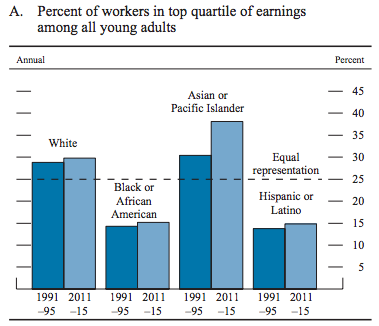
“Overall, the
representation of black and Hispanic workers in the top earnings
quartile continues to lag in the later period,” the report adds.
For the complete detailed report click here: There's a large group of Americans missing out on the American dream
\
So it was relieving to see, tucked in the US central bank’s latest semi-annual report to Congress on monetary policy, an analysis of recent inequality research that refutes the idea that education is the only factor behind income inequality. Race, unsurprisingly, also plays a major role, as do social and economic measures, including taxation, interest rates, and labor policies. The Fed states:
“The persistent gaps in economic outcomes by race and ethnicity in the United States raise important questions about how people ascend the economic ladder. Education, particularly a college degree, is often seen as a path to improved economic opportunities.
“However, while education continues to be an important determinant of whether one can climb the economic ladder, sizable differences in economic outcomes across race and ethnicity remain even after controlling for educational attainment. Data on earnings for two cohorts of young adult workers (aged 25 to 34) approximately a generation apart confirm both the gaps in economic outcomes and the lack of substantial upward progress for disadvantaged groups over the past quarter-century.”
Foto: source Federal Reserve
For the complete detailed report click here: There's a large group of Americans missing out on the American dream
7/11/17
EU Educational Sector: 80% of graduates in the field of education are women
Almost 5 million tertiary education students graduated in the European Union (EU) in 2015: 58% were women and 42% men.
Male dominated fields are 'Information and Communication Technologies' (where men account for 81% of the graduates) and 'Engineering, manufacturing and construction' (73%).
On the other hand, four out of five graduates in 'Education' are women (80%). Another field where women are largely over-represented is 'Health and welfare', with 74% female graduates.
One in four graduates studied 'Business, administration and law'
The largest share of graduates in the EU studied 'Business, administration and law' (24%). This was the most popular field in all Member States except for Belgium, Denmark, Sweden and Finland, where the largest share of graduates were in 'Health and welfare', and Portugal, where the most popular field was 'Engineering, manufacturing and construction'.
'Business, administration and law' was particularly popular in Luxembourg, with 39% of all graduates. It accounted for a large share also in Cyprus (35%), Bulgaria and France (both 34%).
One in five graduates in Germany (22%), Portugal (21%) and Austria (20%) received their diplomas in 'Engineering, manufacturing and construction'.
The share of graduates in 'Health and welfare' was the highest in Belgium (26%), where one in four graduated in this field. 22% of graduates in Sweden and Denmark studied this subject.
'Arts and humanities' were a popular field in the United Kingdom and Italy (both 16%).
16% of the graduates in Bulgaria followed the 'Social sciences, journalism and information' programme.
The largest share of 'Education' graduates was in Cyprus (18%).
With 13%, the United Kingdom had the highest share of 'Natural sciences, mathematics and statistics' graduates.
Read more: 80% of graduates in the field of education are women - Product - Eurostat
Male dominated fields are 'Information and Communication Technologies' (where men account for 81% of the graduates) and 'Engineering, manufacturing and construction' (73%).
On the other hand, four out of five graduates in 'Education' are women (80%). Another field where women are largely over-represented is 'Health and welfare', with 74% female graduates.
One in four graduates studied 'Business, administration and law'
The largest share of graduates in the EU studied 'Business, administration and law' (24%). This was the most popular field in all Member States except for Belgium, Denmark, Sweden and Finland, where the largest share of graduates were in 'Health and welfare', and Portugal, where the most popular field was 'Engineering, manufacturing and construction'.
'Business, administration and law' was particularly popular in Luxembourg, with 39% of all graduates. It accounted for a large share also in Cyprus (35%), Bulgaria and France (both 34%).
One in five graduates in Germany (22%), Portugal (21%) and Austria (20%) received their diplomas in 'Engineering, manufacturing and construction'.
The share of graduates in 'Health and welfare' was the highest in Belgium (26%), where one in four graduated in this field. 22% of graduates in Sweden and Denmark studied this subject.
'Arts and humanities' were a popular field in the United Kingdom and Italy (both 16%).
16% of the graduates in Bulgaria followed the 'Social sciences, journalism and information' programme.
The largest share of 'Education' graduates was in Cyprus (18%).
With 13%, the United Kingdom had the highest share of 'Natural sciences, mathematics and statistics' graduates.
Read more: 80% of graduates in the field of education are women - Product - Eurostat
5/3/17
Europe's Economic Power House: Why Germany Still Has So Many Middle-Class Manufacturing Jobs - by Hermann Simon
 |
| Germany: The EU's Number One Economic Powerhouse |
These firms, which I call “Hidden Champions,” are part of what makes German economic growth more inclusive: by my calculations, they have created 1.5 million new jobs; have grown by 10% per year on average; and register five times as many patents per employee as large corporations. And they are But the reasons they are a predominantly German phenomenon are many.
This includes the German history of many small independent states (until 1918 Germany consisted of 23 monarchies and three republics), which forced entrepreneurs to internationalize early on in a company’s development if they wanted to keep growing. In addition, there are traditional regional crafts, such as the clock-making industry in the Black Forest with its highly developed fine mechanical competencies, which developed into 450 medical technology companies, most of them makers of surgical instruments.: my estimate is that in the last 25 years no more than 10% of them disappeared or were taken over, a distinctly lower percentage than for large corporations. Nearly all of them survived the great recession of 2008-2009.
Moreover, Hidden Champions have also contributed to the sustainment of the German manufacturing base, and it is in large part thanks to them that nearly a quarter of the German gross domestic product continues to come from manufacturing. The percentage in most other highly industrialized countries such as the U.S., the UK, or France is only about half of this. The effect on employment is enormous. Manufacturing creates jobs at home and at the time same allows companies, through exports, to participate in the growth of emerging countries.
Given this success, it’s not surprising that many non-German policymakers and economists have looked to the Hidden Champions, or more broadly, the Mittelstand, to try and chart a path to more inclusive growth in their own countries. But how replicable is their success? While other countries could try to emulate aspects of what makes the Hidden Champions so successful, the reasons for their success are the result of a complex network of factors, many of them historical.
A Hidden Champion is defined by three criteria: 1) a company has to be among the top three in the world in its industry, and first on its continent; 2) its revenue must be below €5 billion; and 3) it should be little known to the general public. Germany seems exceptionally good at creating these companies; I have identified 2,734 Hidden Champions worldwide and no less than 1,307 of them are based in Germany. You might argue that my research is deeper in Germany than in other countries, and most likely I wouldn’t be able to prove you wrong. But researchers in other countries have also examined this phenomenon and found far fewer Hidden Champions in their countries. A colleague who looked for Hidden Champions in Japan for years identified only 220 companies, a researcher in France has come up with only 100. With the exception of Switzerland and Austria, the per capita number of Hidden Champions is nowhere near as high as it is in Germany.
Of course, success of individual Hidden Champions is based on their leadership and strategy. The most important difference is the continuity of the leadership. The leaders of the Hidden Champions stay at the helm for an average of 20 years; according to Strategy&, which collects data on the world’s largest 2,500 companies, in large firms the average CEO tenure from 2012 – 2016 was only seven years, and the median was even shorter, at five and a half years. The leaders of Hidden Champions are also more likely to come into power at a young age and are more often women than in larger companies.
But the reasons they are a predominantly German phenomenon are many. This includes the German history of many small independent states (until 1918 Germany consisted of 23 monarchies and three republics), which forced entrepreneurs to internationalize early on in a company’s development if they wanted to keep growing. In addition, there are traditional regional crafts, such as the clock-making industry in the Black Forest with its highly developed fine mechanical competencies, which developed into 450 medical technology companies, most of them makers of surgical instruments.
Scientific competencies also play an important role. The cluster of 39 measurement technology companies in the area of the old university of town of Göttingen are the result of the leading role Göttingen university’s mathematics faculty had for centuries. The Fraunhofer Institute continues to function as a transmission belt between science and practical applications. The Munich-based Hidden Champion Arri, world market leader in professional film cameras, used the expertise of Fraunhofer to navigate the transition from analog to digital technology, and was thus able to defend its leading market position.
A further pillar of the Hidden Champions’ competitive strength is the unique German dual system of apprenticeship, which combines practical and theoretical training in non-academic trades. The Hidden Champions invest 50% more in vocational training than the average German company.
Tax advantages are another reason. The high taxes on assets in France and the inheritance tax in the U.S. prevent the accumulation of capital necessary for the formation of a strong mid-sized sector.
Finally, the international openness of a society is an essential factor in the globalized world of the future.
Germany is far ahead of other large countries with regard to mental internationalization. This includes language competencies, international experience from student exchanges, and university studies. Countries such as France, Italy, Japan, and Korea lag far behind in these respects.
Why is this mental internationalization so important? Because while Hidden Champions may be small, they compete on a global scale.
They achieve world-class quality by keeping their focus narrow; focus is the most important element of a Hidden Champion’s strategy. Flexi, for example, makes only one product — retractable dog leashes — but has the claim to make them better than anyone else. This has allowed them to reach 70% of market share in this category. But focus makes a market small. How can you make it bigger? By globalizing. Today, the Hidden Champions are present in their target markets with 30 subsidiaries on average. Despite their medium or small size, they are true global players. About one quarter of German exports comes from the Hidden Champions.
Read more: Why Germany Still Has So Many Middle-Class Manufacturing Jobs
8/5/16
The Netherlands: 38% of international students remain in Holland five years after graduation
 |
| The Erasmus University in Rotterdam |
Welcome, to work’, produced in collaboration with Bureau Blaauwberg, found that the five-year stay rate of international students from the 2008/09 graduating cohort was 38%, higher than the global average of 25% recorded by the OECD.
Of that cohort, 71% are employed in the country, reflecting the efforts of national campaigns to train foreign talent to enter the labour market.
“Substantial numbers of students come here because of the quality and reputation of the education system, without even a thought of remaining in the Netherlands to work afterwards,” the report notes, but adds that the figures “suggest that a majority of graduates wish to seriously evaluate their prospects in the Dutch labour market, or for further study.”
Promoting the Dutch labour market to foreign graduates is a leading tactic in initiatives to retain students.
Of the 7,350 international students graduating in 2008, 70% were still in the country in October 2009 while two years on, 3,540 students, or 48%, remained.
Retention figures are higher among students outside of the EU and EEA, who have free access to the Dutch labour market, the report shows.
“Since [non-EEA students] have already made a big decision, it makes sense that they would put in more effort to stay on after graduation,” it says.
The number of international students has consistently risen in the Netherlands in recent years, with close to 90,000 international student enrolments in 2014/15, up from 70,389 the previous year.
The EP-Nuffic program, Make it in the Netherlands, aims to show students the career opportunities available once they graduate.
The scheme’s efforts consist of bridging the divide between Dutch and non-Dutch students, helping to connect international students’ studies to a career path and making the Dutch language more attractive to learn for international students.
“An early acquaintance with the Dutch language is essential for a successful start in the domestic labour market,” the report notes.
The program also aims to increase the scale of regional student retention campaigns, and reduce red tape for students who are looking for work.
“Where possible, we’ve decreased this red tape and made sure that more information is provided in English,” a spokesperson from EP-Nuffic told The PIE News.
“One of the main results was that the possibilities for the so-called ‘orientation year’ in which students are allowed to stay in Holland to look for work has been simplified and elaborated.”
The report also credits higher education institutions for the higher than average stay rate.
“When it comes to increasing the stay rate and retaining international students in the Dutch labour market, to date the institutions have taken the lead,” says the report.
It also makes recommendations of what more could be done to encourage international students to stay in the country post-graduation.
“Increased efforts would benefit, for example, from more regional collaboration and a comprehensive national, social and economic agenda,” the spokesperson said.
“Municipalities, businesses, not-for-profit organizations and higher education organizations should better exploit cross connections.”
EU-Digest
8/5/15
EU Migrant Crises: The economics behind Europe’s migrant crisis - by Mohamed A. El-Erian
 |
| Fleeing economic and social miseries of home countries |
The economics of the Channel migrant crisis
are quite clear, being basically about supply, demand and regulatory
failures. They also shed light on the potential solutions, though they
will take time to materialize.
The supply of migrants to Europe is fueled
by waves of people fleeing the economic and social misery of their home
countries — and, in some case, political oppression, persecution and
violence.
They do so in hopes of a better future for themselves and
their children. The temptation for some to try and make it all the way
to the U.K., often after a perilous sea crossing and a fraught trip
through western Europe, is amplified by the attractiveness of an economy
with low unemployment, comprehensive social services and a country
where many already know the language.
Although the supply of migrants has
increased, the demand for migrant labour has gone the other way. Tougher
laws have made it harder and more dangerous for employers to hire
undocumented workers. And with a European unemployment rate of more than
10 per cent, the demand is further damped.
This imbalance in supply and demand isn't
one that can be sorted out by the markets' normal equilibrating
mechanism. The market-clearing wage — that is, the price that would
lower the migration incentive while facilitating the absorption of those
still inclined to risk life and limb — is well below the minimum wage
prevailing in Europe; and any meaningful reduction in the wage would
involve significant and unacceptable social disruptions to local
populations in Europe.
Read more: The economics behind Europe’s migrant crisis: MIGRANTS
5/3/15
USA: Smart money versus dumb voters - America dumbs down: a rising tide of anti-intellectual thinking
The American
public’s bias against established science doesn’t stop where the Bible
leaves off, however.
The same poll found that just 53 per cent of respondents were “extremely” or “very confident” that childhood vaccines are safe and effective. (Worldwide, the measles killed 120,000 people in 2012. In the United States, where a vaccine has been available since 1963, the last recorded measles death was in 2003.)
When it comes to global warming, only 33 per cent expressed a high degree of confidence that it is “man made,” something the UN Intergovernmental Panel on Climate Change has declared is all but certain. (The good news, such as it was in the AP poll, was that 69 per cent actually believe in DNA, and 82 per cent now agree that smoking causes cancer.)
If the rise in uninformed opinion was limited to impenetrable subjects that would be one thing, but the scourge seems to be spreading. Everywhere you look these days, America is in a rush to embrace the stupid. Hell-bent on a path that’s not just irrational, but often self-destructive. Common-sense solutions to pressing problems are eschewed in favour of bumper-sticker simplicities and blind faith.
In a country bedeviled by mass shootings—Aurora, Colo.; Fort Hood, Texas; Virginia Tech—efforts at gun control have given way to ever-laxer standards. Georgia recently passed a law allowing people to pack weapons in state and local buildings, airports, churches and bars. Florida is debating legislation that will waive all firearm restrictions during state emergencies like riots or hurricanes. (One opponent has moved to rename it “an Act Relating to the Zombie Apocalypse.”) And since the December 2012 massacre of 20 children and six staff at Sandy Hook Elementary School, in Newtown, Conn., 12 states have passed laws allowing guns to be carried in schools, and 20 more are considering such measures.
The cost of a simple appendectomy in the United States averages $33,000 and it’s not uncommon for such bills to top six figures. More than 15 per cent of the population has no health insurance whatsoever. Yet efforts to fill that gaping hole via the Affordable Health Care Act—a.k.a. Obamacare—remain distinctly unpopular. Nonsensical myths about the government’s “real” intentions have found so much traction that 30 per cent still believe that there will be official “death panels” to make decisions on end-of-life care.
Smart money versus dumb voters is hardly a fair fight. But it does offer compelling evidence that the survival of the fittest remains an unshakable truth even in American life. A sad sort of proof of evolution.
Read more: America dumbs down: a rising tide of anti-intellectual thinking
The same poll found that just 53 per cent of respondents were “extremely” or “very confident” that childhood vaccines are safe and effective. (Worldwide, the measles killed 120,000 people in 2012. In the United States, where a vaccine has been available since 1963, the last recorded measles death was in 2003.)
When it comes to global warming, only 33 per cent expressed a high degree of confidence that it is “man made,” something the UN Intergovernmental Panel on Climate Change has declared is all but certain. (The good news, such as it was in the AP poll, was that 69 per cent actually believe in DNA, and 82 per cent now agree that smoking causes cancer.)
If the rise in uninformed opinion was limited to impenetrable subjects that would be one thing, but the scourge seems to be spreading. Everywhere you look these days, America is in a rush to embrace the stupid. Hell-bent on a path that’s not just irrational, but often self-destructive. Common-sense solutions to pressing problems are eschewed in favour of bumper-sticker simplicities and blind faith.
In a country bedeviled by mass shootings—Aurora, Colo.; Fort Hood, Texas; Virginia Tech—efforts at gun control have given way to ever-laxer standards. Georgia recently passed a law allowing people to pack weapons in state and local buildings, airports, churches and bars. Florida is debating legislation that will waive all firearm restrictions during state emergencies like riots or hurricanes. (One opponent has moved to rename it “an Act Relating to the Zombie Apocalypse.”) And since the December 2012 massacre of 20 children and six staff at Sandy Hook Elementary School, in Newtown, Conn., 12 states have passed laws allowing guns to be carried in schools, and 20 more are considering such measures.
The cost of a simple appendectomy in the United States averages $33,000 and it’s not uncommon for such bills to top six figures. More than 15 per cent of the population has no health insurance whatsoever. Yet efforts to fill that gaping hole via the Affordable Health Care Act—a.k.a. Obamacare—remain distinctly unpopular. Nonsensical myths about the government’s “real” intentions have found so much traction that 30 per cent still believe that there will be official “death panels” to make decisions on end-of-life care.
Smart money versus dumb voters is hardly a fair fight. But it does offer compelling evidence that the survival of the fittest remains an unshakable truth even in American life. A sad sort of proof of evolution.
Read more: America dumbs down: a rising tide of anti-intellectual thinking
4/24/14
US Education: University education in America leaves most graduating students heavily in debt - by Max Keiser
The Keiser Report is a no holds barred look at the shocking scandals behind
the global financial headlines.
From the collusion between Wall Street and Capitol Hill to the latest banking crime wave, from bogus government economic statistics to rigged stock markets, nothing escapes the eye of Max Keiser, a former stockbroker, inventor of the virtual specialist technology and co-founder of the Hollywood Stock Exchange.
With the help of Keiser's co-host, Stacy Herbert, and guests from around the world, Keiser Report tells you what is really going on in the global economy.
For the latest episode of the Keiser report on the cost of a US University education click here
Some European countries, like the Netherlands, are also trying to copy this US system whereby students take out loans to finance the cost of their education. As the Keiser report explains this is a recipe for disaster.
Get more more information about the Keiser Reports
From the collusion between Wall Street and Capitol Hill to the latest banking crime wave, from bogus government economic statistics to rigged stock markets, nothing escapes the eye of Max Keiser, a former stockbroker, inventor of the virtual specialist technology and co-founder of the Hollywood Stock Exchange.
With the help of Keiser's co-host, Stacy Herbert, and guests from around the world, Keiser Report tells you what is really going on in the global economy.
For the latest episode of the Keiser report on the cost of a US University education click here
Some European countries, like the Netherlands, are also trying to copy this US system whereby students take out loans to finance the cost of their education. As the Keiser report explains this is a recipe for disaster.
Get more more information about the Keiser Reports
Subscribe to:
Posts (Atom)