Advertise On EU-Digest

Annual Advertising Rates
Showing posts with label US Federal Reserve. Show all posts

2/22/18

USA: US Federal Reserve rings alarm about unsustainable America’s soaring debt - by Chris Helgren (Reuters)

The US deficit stands at $20 trillion and will rise to $30 trillion in a decade. That should be a reason for concern, according to the US Fed. 
"I believe the Federal Reserve should be gradually and patiently raising the federal funds rate during 2018," Dallas Federal Reserve Bank President Robert Kaplan said on Wednesday.
"History suggests that if the Fed waits too long to remove accommodation at this stage in the economic cycle, excesses and imbalances begin to build, and the Fed ultimately has to play catch-up.
"
Kaplan’s words come after this week’s report by Goldman Sachs indicated that US debt will turn unsustainable under the Republican leadership. Kaplan previously worked for Goldman as vice chairman.

The new US budget pushed by Donald Trump’s administration envisages serious growth in military spending, and American debt could reach $30 trillion in just 10 years, according to some estimates.

Read more: US Federal Reserve rings alarm about America’s soaring debt — RT Business News

7/19/17

USA: Have and have not's: There's a large group of Americans missing out on the American dream

There’s a growing tendency for mainstream economists, including several of those at the Federal Reserve, to dismiss all income disparities as the product of a skills- or education gap, a misleading explanation given weak wage growth that points to ongoing weakness in the job market. 
\
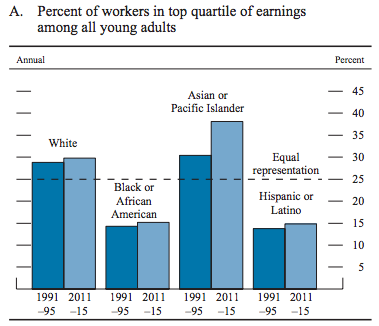
So it was relieving to see, tucked in the US central bank’s latest semi-annual report to Congress on monetary policy, an analysis of recent inequality research that refutes the idea that education is the only factor behind income inequality. Race, unsurprisingly, also plays a major role, as do social and economic measures, including taxation, interest rates, and labor policies. The Fed states:

“The persistent gaps in economic outcomes by race and ethnicity in the United States raise important questions about how people ascend the economic ladder. Education, particularly a college degree, is often seen as a path to improved economic opportunities.
“However, while education continues to be an important determinant of whether one can climb the economic ladder, sizable differences in economic outcomes across race and ethnicity remain even after controlling for educational attainment. Data on earnings for two cohorts of young adult workers (aged 25 to 34) approximately a generation apart confirm both the gaps in economic outcomes and the lack of substantial upward progress for disadvantaged groups over the past quarter-century.”

FeducationA
Foto: source Federal Reserve 
“Overall, the representation of black and Hispanic workers in the top earnings quartile continues to lag in the later period,” the report adds.

For the complete detailed report click here: There's a large group of Americans missing out on the American dream

12/21/16

Wall Street: Dow 20,000 and Donald Trump as the embodiment of animal spirits: by Don Pittis

Even as stock markets climb higher and the Dow Jones industrial average flirts with the 20,000 mark, some of our wisest critics have continued to doubt the substance of the Donald Trump rally.

Rational analysts assumed that last week's hike in interest rates from the U.S. Federal Reserve, with hints of more to come, would knock the stuffing out of the market surge.

But in a world where rationality has repeatedly failed to guide us, maybe it's time to revisit the idea that irrationality — namely president-elect Donald Trump as the embodiment of animal spirits — has a far greater effect on markets than rational analysts might have us think.

The fact is, economics contains more voodoo than many of its exponents admit.

Trump's role is as cheerleader, appointing cabinet members who seem to favour business success, promoting policy that seems to support new investment and growth.

Research conducted for the Globe and Mail's Report on Business shows that even in Canada Trump is spurring executive optimism. Studies in the U.S. also show business leaders have been energized by the election results.

For many critics, economic optimism requires a certain amount of nose-holding and ear plugging.

Trump's outrageous stance on many issues, such as yesterday's comment about "Islamists who slaughter Christians," could lead to outcomes disruptive to the economy.

And the rationalists could be right. An overpriced dollar could kill off U.S. exports. A shortage of labour could block growth. Trouble in Europe or Japan could be contagious. Growing inequality or environmental outrage could lead to a political backlash.

But if the new U.S. president can concentrate on being the economic orchestra leader, convincing Americans that now is the time to succeed and invest, urging on the sections at the back and getting everyone to play in concert, maybe the great performer will have found his best role.

Read more: Dow 20,000 and Donald Trump as the embodiment of animal spirits: Don Pittis - Business - CBC News

9/15/13

Economic Crises: Five years after Lehman bankruptcy: Will we see the next crisis coming? - by Mark Trumbull,

In the lead-up to the crisis of 2008, regulatory agencies each had their own sphere of supervision – such as banking, securities dealing, or (at the state level) insurance. A big-picture view was lacking. Some people thought about how all the pieces connected, but no one had the both the responsibility and tools to thoroughly monitor potential risks across the whole system.

"Our regulatory structure was not set up really to do that," says Richard Berner, director of the federal Office of Financial Research, and a nonvoting member of the oversight council. "Each regulator was charged with regulating different parts of the financial system, and for different purposes."

It's not that no one saw problems. The bursting of a housing bubble and the ensuing losses for investors in "subprime" mortgages made the risks of real estate investments fairly plain for all to see. And by the middle of 2008, Lehman Brothers was widely regarded as an investment bank with lots of trouble embedded in its portfolio.

But to regulators and economists, it wasn't easy to see all the interconnections among financial firms, or how the problems in US real estate would ripple outward to threaten the larger economy in America and worldwide.

Ben Bernanke, who as Federal Reserve chairman sits on the Financial Stability Oversight Council (FSOC) has put it this way: "... Prospective subprime losses were clearly not large enough on their own to account for the magnitude of the crisis.”

Read more: Five years after Lehman bankruptcy: Will we see the next crisis coming? - CSMonitor.com

5/16/12

Fed says several members could support additional efforts to boost economy if needed - by Martin Crutsinger

The US Federal Reserve policymakers are open to further efforts to stimulate the U.S. economy if growth falters or threats escalate.

Minutes of the central bank's April 24-25 meeting released Wednesday stated that "several members" thought additional Fed support could be needed if the recovery lost momentum or if the risks to the economy became great enough.

The minutes did not spell out what circumstances would trigger further Fed efforts to lower interest rates to boost the economy. But they did note some threats to the U.S. economy. One is Europe's debt crisis. Another is the risk that spending cuts and tax increases that could take effect at year's end if Congress can't reach a budget agreement could slow growth more than expected.

The comments stood in contrast to the previous minutes, which said that only "a couple" of members expressed support for further bond purchases. Since the financial crisis, the Fed has pursued two rounds of bond purchases to try to push down long-term interest rates, with a goal of encouraging borrowing and spending.

Read more: Fed says several members could support additional efforts to boost economy if needed - Winnipeg Free Press

5/14/12

US Banking System recipe for disaster: JP Morgan debacle reveals flaw in Federal Reserve thinking

Experienced Wall Street executives and traders concede, in private, that Bank of America is not well run and that Citigroup has long been a recipe for disaster.

But they always insist that attempts to re-regulate Wall Street are misguided because risk-management has become more sophisticated — everyone, in this view, has become more like Jamie Dimon, head of JP Morgan Chase, with his legendary attention to detail and concern about quantifying the downside.

In the light of JP Morgan's stunning losses on derivatives, announced yesterday but with the full scope of total potential losses still not yet clear (and not yet determined), Jamie Dimon and his company do not look like any kind of appealing role model.

But the real losers in this turn of events are the Board of Governors of the Federal Reserve System and the New York Fed, whose approach to bank capital is now demonstrated to be deeply flawed.
JP Morgan claimed to have great risk management systems — and these are widely regarded as the best on Wall Street.

But what does the "best on Wall Street" mean when bank executives and key employees have an incentive to make and misrepresent big bets — they are compensated based on return on equity, unadjusted for risk?

Bank executives get the upside and the downside falls on everyone else — this is what it means to be "too big to fail" in modern America.


Read more: JP Morgan debacle reveals flaw in Federal Reserve thinking | The Nelson Daily

5/11/12

The Banking system: Too big to fail has become a total farce


Ben Bernanke

Regardless of all the US Government rhetoric the "Wall Street Bandits" continue their dangerous manipulation of Global markets practically unopposed... with all the negative result for the world economic system.


When it comes to regulating banks, Europe is actually way ahead of the US, but unfortunately Europe still has not found a way to block speculative banks like Goldman Sachs, JPMorgan and others from operating on their shores. 

Recently Goldman Sachs Group Inc. bought euro 1.78 billion ($2.3 billion) worth of Italian sovereign debt during the first quarter, increasing its overall market exposure to troubled European countries.

Goldman Sachs's scheme and also that of some other "big banks" is to buy sovereign debt financed by the European Central Bank with European taxpayer money at close to 0 interest rates to eventually "lend" these funds with a very high interest rate to borrowers either in the open market or as often is the case, back to the original sellers. How much more crooked can this get? It basically can be described as the bank using taxpayers money to make profits for themselves.

Another dramatic example this week of this "free for all" game was that JPMorgan, the largest U.S. bank, said that it lost  euro 788 million ($2 billion) in the past six weeks in a trading portfolio designed to hedge against risks the company takes with what it calls its "own money", but which in fact is money they borrowed from the Government ( taxpayers money).

The company's stock plunged almost 7 percent in after-hours trading, and the unexpected loss at one of the world's most venerated banks undermined investor confidence. British banks were hit hard - Barclays, which has a large investment banking arm, was the biggest loser in London trading, down 2.9 percent by mid-morning.

Too big to fail has become a totally obsolete US Fed policy. In addition, if you really come down to it, most of the so called "big banks" CEO's should be prosecuted and put into jail. When is the US Government going to put an end to this nonsense and fire Bernanke?


EU-Digest