Advertise On EU-Digest

Annual Advertising Rates
Showing posts with label Nuclear Deal. Show all posts

8/17/22

EU considers Iran's response on nuclear deal talks

EU has been the go-between in the indirect talks as Iran refused to negotiate directly with America since then-President Donald Trump unilaterally withdrew the US from the accord in 2018.

Read more at: EU considers Iran's response on nuclear deal talks | Euronews

12/21/21

Iran nuclear talks: EU urges Tehran to salvage deal quickly

European negotiators on Friday called on Iran to move faster toward salvaging the 2015 nuclear deal after the seventh round of talks adjourned in Vienna.

European representatives from the UK, France and Germany, known as the E3, have called the pause "disappointing," although they say there has been some "technical progress." The diplomats say Iranian officials requested the pause in negotiations.

Read more at: Iran nuclear talks: EU urges Tehran to salvage deal quickly | News | DW | 17.12.2021

4/6/21

Middle East: Iran nuclear deal: US joins Vienna talks aimed at reviving accord

The United States has joined talks in Vienna aimed at reviving the Iran nuclear deal, which the Trump administration abandoned in 2018.

President Joe Biden has said he wants to return to the landmark accord.

But the six remaining state parties need to find a way for him to lift the sanctions imposed by his predecessor and for Iran to return to the agreed limits on its nuclear programme.

Read more at: Iran nuclear deal: US joins Vienna talks aimed at reviving accord - BBC News

7/28/19

Iran: Talks held in Vienna to try and salvage Iran nuclear deal

After meeting officials from Britain, France, Germany, Russia and China in Vienna, a senior Iranian official said the atmosphere had been "constructive".

Tensions have soared since the United States withdrew from the 2015 accord last year and reimposed sanctions
.
In recent weeks, Iran and Britain have seized a tanker each - putting further pressure on the 2015 accord.

Iran has also admitted breaching restrictions on its production of enriched uranium, used to make reactor fuel but also potentially nuclear bombs.

Read More: Talks held in Vienna to salvage Iran nuclear deal - BBC News

The Digest Group
Almere-Digest
EU-Digest
Insure-Digest 
Turkish-Digest 

For additional information, including advertising rates - e-mail:Freeplanet@protonmail.com
  

6/10/19

Iran Nuclear Deal: Germany fights to salvage Iran nuclear deal as deadline looms

Germany fights to salvage Iran nuclear deal as deadline looms

Read more at:
https://p.dw.com/p/3K3N4


The Digest Group                    
Almere-Digest
EU-Digest
Insure-Digest 
Turkish-Digest 

For additional information, including advertising rates:
e-mail: Freeplanet@protonmail.com

8/3/18

Global Politics: U.S. Risks Losing World Power to China and Russia by Splitting with Allies on Iran, Experts Say - by Tom O'Connor

The U.S. could risk forfeiting its central role on the international stage both politically and economically by splitting with its allies and other major powers that oppose upcoming sanctions against Iran, according to two former State Department officials who helped craft the 2015 nuclear deal.

In line with President Donald Trump's withdrawal from a 2015 nuclear agreement in May, the U.S. was set to impose Monday the first batch of sanctions that would affect Iran, as well as European and other international companies. The decision would be only the latest of a series of schisms between the Trump administration and the EU, which has continued to endorse the Iran deal.

When asked by Newsweek if top U.S. rivals China and Russia could stand to benefit from the split, former State Department Deputy Lead Coordinator and Coordinator for Iran Nuclear Implementation Jarrett Blanc said "yes."

"This is not strategic behavior, we're all over the map, we don't have a list of priorities, we're not relating issue A to issue B and so then of course that puts in a stronger position anyone who can set their priorities and tie these issues together,"  Blanc said Wednesday during a conference call hosted by progressive think tank Diplomacy Works, based in Washington, D.C.

Read more: U.S. Risks Losing World Power to China and Russia by Splitting with Allies on Iran, Experts Say

4/17/18

EU does not agree with Trump Administration proposal as to new sanctions against Iran

Trump Administration burning Climate and Iran agreements
The European Union has not agreed  to Trump Administration proposed new sanctions against Iran amid fears that punishing Tehran for its missile program would not stop US President Trump from abandoning a separate nuclear deal.

The EU is eager to safeguard the nuclear pact, under which Tehran agreed to curb its ambitions for at least a decade, but Trump has been a fierce critic.

Commenting on the EU foreign ministers meeting in Luxembourg, Free University of Brussels political scientist Firouyeh Nahvandian said that economic ties between some European countries and Iran are much more important than damaging reports on Iran's human rights record by the United Nations or the European Parliament.

Trump has threatened not to extend U.S. sanctions relief on Iran related to the nuclear agreement.

The deal sees the West mostly lifting extensive sanctions in exchange for Iran curbing its nuclear program

EU-Digest

1/10/18

EU-US Relations: America’s Relationship With Europe: Collateral Damage if Trump Kills the Iran Deal - by Trita Parsi

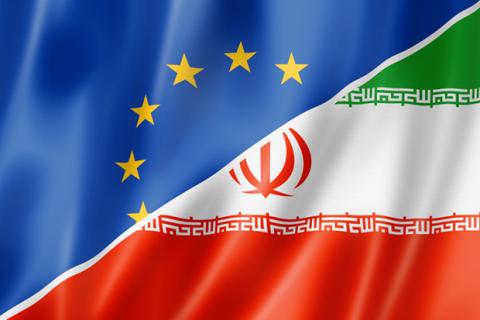
Image result for EU Iran Flag
Iran Nuclear deal as Atlantic Alliance Crumbles
“The fact that the U.S. is reducing its role in world affairs cannot be tied to the policies of a single president,” Germany’s Foreign Minister Sigmar Gabriel said last month in a stunning speech. “There will be no major changes to this trend, also after the next election.” What was once only whispered is now clearly said: Europe is readying itself for a post-American world, even after the end of the Donald Trump era. And in a surprising twist, the fate of the U.S.-European Union axis may come down to what Trump decides to do with the Iran nuclear deal later this month.

Many drew a sigh of relief back in December as the congressional deadline to impose new sanctions on Iran passed. The nuclear deal had survived another challenge, they thought. But the celebrations were premature. Trump can kill the deal this week by simply doing nothing. We’ve seen this movie before—but this time America’s relationship with Europe is at the center of the drama.

Every 120 to 180 days, the United States is obliged to renew sanctions waivers under the nuclear deal. Failing to do so would put the U.S. in violation of the agreement and likely spark retaliatory measures by Tehran that could see the entire initiative fall apart. Every time the waivers have been up for renewal, fears have risen that Trump will quit the deal  simply by doing nothing.

This time around, though, it’s particularly worrisome. Trump punted the nuclear question to Congress last October by failing to certify it. This triggered a process that gave Congress 60 days to pass new sanctions on Iran or “fix” the deal through other measures. If it failed to do so, Trump promised he would “terminate” the agreement. The protests in Iran, which Trump sees himself as a champion of, have made a confrontational position towards the Iranian regime all the more likely.

But this time around, the survival of the nuclear deal is no longer just about Iran’s centrifuges and sunset clauses. It’s about whether the EU will see the U.S. as a pillar of the liberal international order or as a fifth column seeking the it’s demise. The nuclear deal has become the latest, and perhaps most consequential, international agreement or norm that the EU seeks to uphold and Trump seeks to tear down: from the Paris agreement, to the future of NATO, to the unity of the EU, to the funding of the United Nations, to the status of Jerusalem.

To Europe, two new realities have become clear. First, if the EU acquiesces on the nuclear deal, Trump will move on to target another agreement, and then another, and then another, until the very foundation of the current international order is uprooted. This will eventually force the EU to draw a line in the sand and stand up to Trump. Logic then dictates the longer the EU waits, the more damage Trump will do before he’s stopped. Hence, the EU is better off taking its stand at the Iran deal than waiting for it to be scrapped and emboldening Trump further.

Thus, EU policy chief Federica Mogherini said in mid-December that preserving and implementing the 2015 nuclear deal with Iran is “an absolute must,” in one of her sharpest criticisms of Trump’s Iran position. “We cannot afford to undermine the credibility of a multilateral agreement, endorsed by the UN Security Council Resolution,” she added.

Europe’s second realization is more ominous: Trump is not an anomaly. He may be a political outsider, but he is not an outsider to America. His presidency is the manifestation of a deep-seated sentiment in the United States that existed long before Trump entered the political arena and which will continue to exist—if not dominate politically—long after he departs. As such, neither electoral defeat nor impeachment will be enough to restore American “normalcy” because Trump is very much a part of the new “American normal.”

Germany’s Gabriel gave the clearest hints as to Europe’s new thinking last month. While he urged the Trump administration to “help develop joint strategies that preserve both the liberal international order and a global trade system that rests on a foundation of freedom, fairness, human rights and the rule of law,” he was also clear-eyed that to the U.S., the world is no longer a “global community, but rather an arena in which nations, non-state actors and corporations fight to gain advantage.”

As such, the U.S. is “no longer responsible for underpinning the structure and dome of this arena. Rather, it is one of the combatants on its sandy floor.” This leaves the EU with no choice but to chart its own way rather than submitting to American diktats—particularly on the issue of killing the Iran deal, which Gabriel said would “jeopardize” the security of the European Union.

Trump may see an irreparable break with the EU as a bonus of jettisoning the nuclear agreement. But by putting the U.S.-EU axis at risk, even the most die-hard opponents of the deal should know that they may get more than they ever bargained for.

Read moire: America’s Relationship With Europe: Collateral Damage if Trump Kills the Iran Deal | The American Conservative

10/14/17

USA: Trump risks making US rogue actor as he condemns Iran nuclear deal - by Julian Borger

The content, tone and style of Donald Trump’s speech about Iran on Friday was a reminder of how much the current president of the United States relishes conflict.

With his domestic legislative agenda stalled at home and a federal investigation scrutinising his finances and his relations with Moscow, Trump has taken to finding enemies to rail against, including the press and black football players who kneel during the national anthem.

The tactic galvanises his core supporters and seems to rejuvenate him. He appeared similarly energised excoriating Iran on Friday. But taken into foreign policy, Trump’s visceral drive for confrontation threatens to add a second nuclear crisis to the one Trump has already escalated in the Pacific with North Korea.

Note EU-Digest: Interesting negotiation move forcing everyone back to the conference table, unfortunately it could also backfire in a big way?

Read more: Trump risks making US rogue actor as he condemns Iran nuclear deal | US news | The Guardian

7/14/15

Iran Nuclear Deal: Israel Condemns Agreement as 'Bad Mistake'- by Paul Goldman and F. Brinley Bruton

Israeli officials came out swinging against a nuclear deal with Iran even before any official announcement on Tuesday.

"Iran is going to receive a sure path to nuclear weapons," Israeli Prime Minister Benjamin Netanyahu said before a meeting in Jerusalem. "Iran will get a jackpot, a cash bonanza of hundreds of billions of dollars, which will enable it to continue to pursue its aggression and terror in the region and in the world. This is a bad mistake of historic proportions."

On Twitter, he added that Israel remained determined to stop Iran from developing a nuclear arsenal.

Read more: Iran Nuclear Deal: Israel Condemns Agreement as 'Bad Mistake' - NBC News

7/9/15

Iran Nuclear Deal: As deadline looms, Kerry says U.S. in no rush to get Iran deal - by Louis Charbonneau and Parisa Hafezi

The United States and other major powers are not in a rush to reach a nuclear deal with Iran, U.S. Secretary of State John Kerry said on Thursday, suggesting an accord was unlikely hours ahead of a deadline set by the U.S. Congress for a quick review.

"We're here because we believe we are making real progress," Kerry told reporters in the Austrian capital. "We will not rush and we will not be rushed."

However, Kerry said Washington's patience was not unlimited. "We can’t wait forever," he said. "If the tough decisions don’t get made, we are absolutely prepared to call an end to this."

He did not say how much longer the talks could continue. Shortly after Kerry spoke, the White House said the talks would not likely drag on for "many more weeks."

Over the past two weeks, Iran, the United States, Britain, France, Germany, Russia and China have twice extended deadlines for completing a long-term deal under which Tehran would curb nuclear activities for more than a decade in exchange for sanctions relief.

Kerry's announcement echoed earlier remarks by Iranian Foreign Minister Mohammad Javad Zarif, who said Iran and major powers would not be hurried.

"We're working hard, but not rushed to get the job done," he said on his Twitter account. Speaking later, Zarif said "We will stay here as long as it is necessary."

France's Foreign Minister Laurent Fabius said the parties would continue negotiating overnight to try to resolve the "difficult issues" that remained in nuclear talks. He added that "things are ... going in the right direction."


Read more: As deadline looms, Kerry says U.S. in no rush to get Iran deal | Reuters

4/2/15

Iran nuclear framework agreement: Not a bad deal - say Israeli Insiders - by Barak Ravid

Thursday night’s dramatic declaration of a framework nuclear agreement between Iran and the world powers surprised almost everyone outside of the locked negotiating rooms at the hotel in Lausanne, Switzerland, including the doubtful, cynical journalists waiting outside those rooms over the past eight days for the results.

Also surprised, though they’ll never admit it, were many officials, including Israelis, who have vehemently attacked the emerging deal in recent months.

In contrast to the messages conveyed in Prime Minister Benjamin Netanyahu’s speech at Congress, the Israeli government’s public position over the last two years and the Pavlovian response that came out of Jerusalem on Thursday night, the framework agreement is not a bad deal at all. In-depth examination of the details shows that the deal includes many positive aspects that preserve Israeli security interests and answer some of Jerusalem’s concerns.

Iran perhaps scored some victories in terms of the narrative. Its rights, as it sees them, were respected by the world powers, and Iran can declare that its nuclear facilities won’t be closed, that uranium enrichment will continue, and that the humiliating sanctions will be lifted. But the world powers made significant achievements of their own on the real practical issues.

The framework agreement levels many restrictions on the Iranian nuclear program for generations to come. The Israeli government’s claims that in a decade, Iran’s nuclear program will be normalized in the eyes of the world, and that the Islamic Republic could then do as it wishes, have turned out to be baseless.

Read more: Iran nuclear framework agreement: Not a bad deal - Diplomacy and Defense - Israel News | Haaretz

3/14/15

Iran - USA: Politics: Republicans Go Ballistic Over Plan to Take The Iran Nuke Deal to the U.N.

The latest move in the nuclear negotiations with Iran could be to take them to the United Nations. And that will trigger a Republican hatefest for the ages.

The Obama administration hinted Thursday that it may take elements of an Iranian nuclear deal to the United Nations—while bypassing Congress for now. And that possibility has turned an already ugly political fight over the negotiations even nastier.

In one scenario floated this week, the White House would not immediately put aspects of an Iran deal up for a vote in Congress. Instead, the Obama administration would take aspects of the agreement to the United Nations Security Council—making the U.N. the target of a congressional hatefest.

“The United Nations has no authority whatsoever to bind the United States of America,” Republican Sen. Ted Cruz told The Daily Beast, arguing that only treaties and congressionally-passed laws could do that. “If President Obama attempts to end-run the Constitution by enlisting the United Nations to enforce an Iran deal that sets the stage for Iran to acquire nuclear weapons, it would be both profoundly dangerous to the national security of the United States and our allies, and also patently unconstitutional.”

Read more: GOP Goes Ballistic Over Plan to Take The Iran Nuke Deal to the U.N. - The Daily Beast

3/13/15

Middle East - Iran’s Supreme Leader Needs Obama’s Deal - by Djavad Khadem

Ali Khamenei needs a nuclear deal with the U.S. to preserve the power of the Supreme Leader after he passes. 
As U.S. and Iranian representatives fiercely negotiate a grand nuclear deal, I am reminded of Churchill's famous saying: “You can always count on Americans to do the right thing, after they've tried everything else.”

Secretary of State John Kerry talks about leaving the negotiation table if Iran does not accept the 5+1 while Iran's Supreme Leader, Ali Khamenei, says through various mouthpieces that it is America that needs these talks. Kerry wants a sequential deal, first political then technical, but Khamenei asks for a simultaneous one.

While Kerry and Mohammad Javad Zarif, Iran’s foreign minister, walk the walk in Geneva, Iranian president Hassan Rouhani talks the talk, applauding progresses made abroad along with yet to be verified domestic economic achievements.  It is déjà vu as he attempts to cool down mounting popular frustrations at home.

Israelis and Saudis can tear themselves apart reminding their American ally of the long-term threats to stability should the Shia revolutionary regime obtain U.S. and international recognition for its nuclear threshold capabilities. The world can speculate on the next move to be made on the Iranian exchequer.

The House of Khamenei, that focal point of real power in Iran known to all Iranians as The Beyt, can push its pawns ever farther into every single conflict in the region. America seems to be ready to make yet another wrong decision before she eventually decides on the right one.

Read more: Iran’s Supreme Leader Needs Obama’s Deal - The Daily Beast

12/14/13

Iran: US Congress -Tea Party Republicans Considering New Iran Sanctions


Read more: US Congress Considering New Iran Sanctions

11/9/13

Iran: No agreement reached over Iran nuclear program as negotiations continue - by Jeffrey Brown and Judy Woodruff

Secretary Kerry and foreign ministers from France, Germany and Britain arrived in Geneva, saying they hope to narrow the gap with Iran.

But the secretary of state notably sought to lower expectations after a flurry of reports yesterday that a short-term deal was imminent.

The reported deal would suspend and in some cases reverse Iranian nuclear activity for perhaps six months. In return, the Islamic republic would receive moderate sanctions relief. In particular, Iran wants oil and banking penalties eased.

But Israeli Prime Minister Netanyahu bluntly dismissed the potential deal today. He and Kerry had a reportedly tense meeting in Tel Aviv before the secretary flew to Geneva. Shortly after that session, Netanyahu derisively labeled the reports from Geneva as the deal of the century for Iran.

Russia and China are also involved in the talks, and Russian Foreign Minister Sergei Lavrov arrived in Geneva late today.

And this evening, the White House said that President Obama had called Prime Minister Benjamin Netanyahu and told him the U.S. remains committed to preventing Iran from obtaining a nuclear weapon.

Note EU-Digest: It seems amazing that the US, the EU, China and Russia in reaching a deal with Iran could have this deal derailed by Benjamin Netanyahu who is acting like a spoiled kid.

Read more: No agreement reached over Iran nuclear program as negotiations continue | PBS NewsHour | Nov. 8, 2013 | PBS