

3/14/18
Science: Stephen Hawking's Legacy Spans the Universe
A functioning brain coupled with what little of his body survived — less and less over time — was enough for this formidable individual to have a life far more active than that of most able-bodied individuals and a life of the mind that exceeded others’ by many multiples.
Read more: Stephen Hawking's Legacy Spans the Universe | Time
1/19/18
Predictions over the long term: AI, climate change: Looming disasters humanity can’t ignore
Two national security and counter-terrorism experts believe governments were warned about some of the world’s most horrific events. Not only that, they say there are new predictions about the future we should not ignore.
R.P. Eddy, a former director of counter-terrorism at the White House National Security Council, and Richard Clarke, who served more than a decade in the White House as national co-ordinator for security and counter-terrorism, said for nearly every catastrophe in the world, there was an expert who said it would happen but was ignored.
In 2012, then ambassador to Syria, Robert Ford, warned the White House a group similar to Al-Qaeda would form and take over large areas of land and even major cities.
He made the prediction after seeing the conflict that began to arise on the ground in Syria.
His views were ignored and then Islamic State began to propagate, becoming more dangerous and causing global terror. Just last month Islamic State claimed responsibility for the Manchester attack at the Ariana Grande concert, which killed 22 people. Yesterday, the group claimed responsibility for a bombing in Kabul, Afghanistan, that killed 90.
The first person to ever win the Polk, Pultizer and Peabody awards, Laurie Garrett, predicted the devastating rise in HIV/AIDS. She, too, was ignored.
“She saw these men dying of a disease called ‘gay related immune deficiency’, ‘GRID’, or ‘gay cancer’,” Mr Eddy told the Huffington Post.
“They didn’t know what it was. Gay men didn’t think they had a transmissible disease. They thought they were sharing a cancer somehow, but just by looking at them and seeing the hypocrisy sarcoma on their face, Laurie Garrett knew this was a contagious illness and started getting the media to pay attention.”
Mr Eddy and Mr Clarke have released a new book, Warnings: Finding Cassandras to Stop Catastrophes, to pre-empt future disasters and warn those in power not to hide away from the inevitable.
For the complete report click here: : AI, climate change: Looming disasters humanity can’t ignore
9/27/15
USA: Ignoring science isn't a Republican problem. It's an American problem.- by Dan Rather
But what does that phrase even mean? I'm not a cardiologist.
So I go to one to have my heart checked. I'm not an electrician, so I hire one to rewire my house. I trust people who have training in those fields to give me advice on important things. You're right, Mr. or Ms. Presidential Candidate, you are not a scientist. So, why won't you listen to the men and women who are?
I grew up in an age where children were crippled and died from diseases like polio and measles, and now we have Donald Trump irresponsibly repeating long-discredited links between vaccines and autism. It's an offense to reason. Equally, so was the reaction of the two doctors on stage, Rand Paul and Ben Carson.
Sure, if you read their words, they support vaccines, yet raise questions about the timing of giving vaccines that is without scientific merit. Moreover, their tone is apologetic and equivocal. About vaccines! These are medical advances that have done more to alleviate human suffering than anything ever conjured by the ingenuity of the human mind.
The stated position of almost every Republican candidate flies in the face of overwhelming scientific evidence. The only "debate" over climate change in essentially the entire world occurs in the United States. I can hear some Democrats I know thinking this anti-science farce is a Republican problem.
But when I talk to scientists about this frightening trend, they don't just mention climate change. They bring up things like Genetically Modified Organisms (GMOs); most of the anti-GMO heat comes from the political left.
If you excoriate climate change deniers along the lines that there is overwhelming scientific evidence for manmade climate change, you can't ignore the fact that that same scientific consensus exists on the safety of GMOs. You can argue that GMOs aren't as important a problem as climate change. And that may be true. But the anti-science spirit remains the same, and that is dangerous. This isn't to say we can't have a debate about how we use GMOs or how we respond to climate change. We just can’t ignore the science.
Vaccines, climate change, GMOs. If you are a Republican reading this you are likely to criticize me for at least one of these issues; if you are a Democrat, maybe another.
Why has science become political? Many intelligent people have written about this issue and surely there are many factors — loss of faith in authority, suspicion of big corporations, a general political balkanization. I am in no position to judge the relative influence of these components. But let me add another on which I feel qualified to weigh in on: my own profession, the press.
It's not just that we don't understand the facts, or that we hype certain "advances" that are more PR than science, or that we shy away from covering important stories because they're "too complicated." It's that we don't even do a good job explaining how scientific research works. We don't understand how data should be analyzed or what a scientific consensus actually means. And with cuts to newsrooms and "specialized beats," it's only getting worse. There are some science news outlets and individual reporters at media companies big and small that do a great job. If I were to generously grade the "mainstream media" on science coverage, I would give us a C -..
Read more: Ignoring science isn't a Republican problem. It's an American problem.
2/4/15
USA: Attacks on federal research funding anger scientists — by Ben Goldfarb
The unorthodox research was designed to study how changing ocean conditions affect animals’ resistance to disease. But the study’s purpose was overshadowed by its methodology after the biologists — Lou Burnett, at the College of Charleston in South Carolina, and David Scholnick, at Pacific University in Oregon — posted a video of the jogging crustacean to YouTube. The clip went viral; today, you can watch the decapod working out to Eye of the Tiger, the Benny Hill theme song, and Justin Timberlake’s Sexyback.
But the shrimp’s saga later took a dark turn. In 2011, Senator Tom Coburn, R-Oklahoma, included the federally funded experiment in his annual “Wastebook,” a compendium of supposedly frivolous government spending. Suddenly the shrimp was everywhere — skewered on a thousand websites, fried by talking heads, roasted in an AARP commercial. “I don't want my shrimp going to the gym," groused Mike Huckabee. Overnight, shrimp-on-a-treadmill had gone from charming internet curio to deplorable embodiment of government waste.
The whole episode would be funnier if it didn’t embody a metastasizing trend: attacks on government-funded science. No longer is it just Wastebooks that impugn the value of research. In October, Science reported on investigations led by Representative Lamar Smith, R-Texas, into federal grant-making procedures. Reported Jeffrey Mervis:
Smith has insisted that he’s not waging war on science — he’s just trying to make agencies more transparent and accountable. “If we, as a country, have decided to spend taxpayers’ hard-earned dollars on funding science and research, then we need to spend wisely,” he wrote recently.
Note EU-Digest: Maybe Republicans, instead of questioning Government funding for Science should question Government funding for military projects like the F35 etc. ?
Read more: Attacks on federal research funding anger scientists — High Country News
4/21/13
Facial-recognition tech played no role in ID'ing bomb suspects
Despite several images of Tamerlan and Dzhokhar Tsarnaev from the scene of the deadly bombings and the existence of images of the brothers in official government databases, facial-recognition software was unable to put names to their faces, Boston Police Commissioner Edward Davis told the Washington Post in an interview published Saturday. Dzhokhar Tsarnaev has a Massachusetts driver's license, while Tamerlan Tsarnaev, the elder brother who died Friday after a shootout with police, had been the subject of an FBI investigation, the Post noted.
After a dozen forensic experts spent days combing through hundreds of hours video and thousands of still images to construct a timeline of events, law enforcement use of facial-recognition software "came up empty," according to the Post. Conducted in a sprawling warehouse in Boston's Seaport district, the work was "painstaking and mind-numbing," according to the Post, with one agent reviewing the same segment of video 400 times.
Read more: Facial-recognition tech played no role in ID'ing bomb suspects | Internet & Media - CNET News
3/4/13
Germany - Communications, Science and Technology: CeBIT 2013 focuses on 'shareconomy'
Frank Pörschmann, the head of CeBIT, believes the fair's form and structure is unique. "It focuses on the whole technology sector - IT, telecommunications, electronics and content and all that comes out of this system and network," he told DW.
With its large number of exhibitors and countries represented, CeBIT is still the biggest event of its kind in the world. But most all, said Pörschmann, "it is the most important one. It's where the innovations and the industry business are pushed forward."
This year, CeBIT's theme is "shareconomy" - a growing trend among users to share not only digital data on the Internet, but also organize sharing models for material products - this is especially the case among most young people who share knowledge, experience and music. Cars and bikes can be hired on an hourly basis online. And this year, CeBIT visitors can get a sense of this growing trend.
Knowledge is the only resource that multiplies when it is shared, said Porschmann, "That's the core of what we are seeing today on social networks - in the age of Twitter and Facebook." People are sharing knowledge, contacts and experiences.
"And that - what I call facebookisation - is also a growing trend in the economy. Through it, the availability of knowledge as a scarce resource is widened - that can help the economy development faster and bring about innovation."
Read more: CeBIT 2013 focuses on 'shareconomy' | Sci-Tech | DW.DE | 04.03.2013
8/1/12
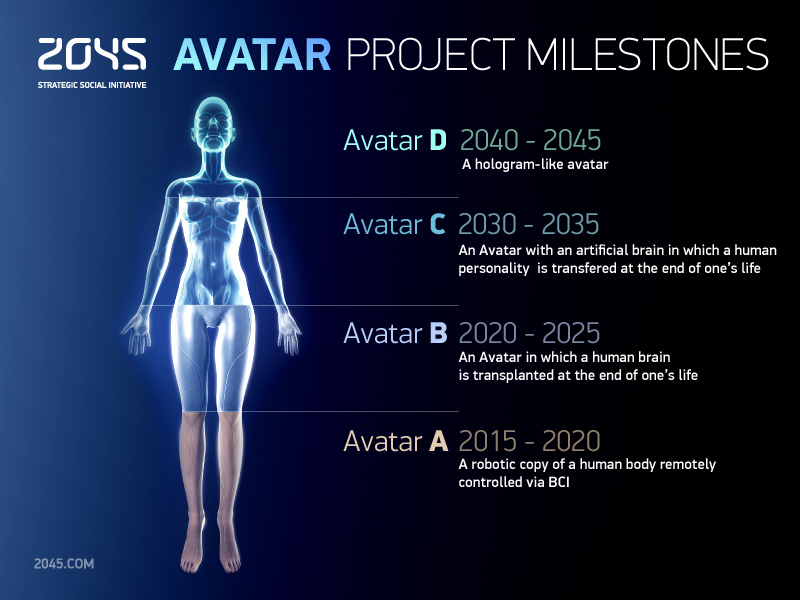
Artificial Life: Human immortality could be possible by 2045, say Russian scientists - by Lauren O'Neil
It may sound ridiculous, but the 31-year-old Russian mogul is dead serious about neuroscience, android robotics, and cybernetic immortality.
He has already pulled together a team of leading Russian scientists intent on creating fully functional holographic human avatars that house artificial brains which contain a person's complete consciousness - in other words, a humanoid robot.
Together, they've laid out an ambitious course of action that would see the team transplant a human brain into an artificial body (or 'avatar') in as little as seven years time.
Read more: Human immortality could be possible by 2045, say Russian scientists - Your Community
10/21/08
The Independent: Religion vs science: can the divide between God and rationality be reconciled? - by Paul Vallely
Religion vs science: can the divide between God and rationality be reconciled? - by Paul Vallely
''A clergyman in charge of education for the country's leading scientific organisation – it's a Monty Python sketch," pronounced Britain's top atheist, Richard Dawkins, recently. The problem was that Reiss, as well as being an evolutionary biologist and population geneticist, is a non-stipendiary priest in the Church of England. When he said recently that science teachers should answer questions about creationism if pupils asked them he was deemed to have been advocating the idea that British schools should teach the idea that the world was magicked up (complete with fossils and ancient geology) just 6,000 years ago – and then tell pupils to make their own minds up between that and the theory of evolution to which the overwhelming scientific evidence points.The idea that science and religion are incompatible is a fairly recent import into contemporary culture. It has been given huge credence by the 9/11 terrorist attacks on the United States. The pronounced motivation of Islamic fundamentalists in 2001 hammered home that some people are prepared to inflict outrageous acts of inhumanity in the name of religion.
3/24/08
Scotsman.com: Tension between Christianity and science exists only for propagandists - by Richard Lucas
Tension between Christianity and science exists only for propagandists-by Richard Lucas
The myth of "tension" between science and Christianity rests on just two episodes. The Catholic Church's rejection of Galileo's heliocentrism was a mistake by the Church leaders of the time. The dispute over the sufficiency of undirected natural processes to produce the startling complexity and diversity of life is ongoing, and is a genuine academic debate (although some evolutionists behave more like inquisitors than scientists). Huge numbers of scientists were and are Christians, experiencing no tension at all, and I have never met a Christian who does not hold science in high regard. The "myth" is propagated as common knowledge by secularists and scientists rejecting the moral guidance of the Church. If the Catholic Church has blundered in scientific matters on occasion, how many times have scientists blundered in scientific matters?
12/24/07
The Times of India: Science Could Support Spiritual Beliefs- by Mani Bhaumik
Science Could Support Spiritual Beliefs- by Mani Bhaumik
Some questions we've posed persistently through the ages have remained largely unanswered: Why are we here? Is there a purpose to our lives? Is there a Creator who brought us here? All of us have asked these questions sometime in our lives. That's when we have traditionally turned to spirituality to find the answers. However, since we live in the age of science that pervades our daily lives, it would be essential to ask: Can science support our belief in spirituality? Those who followed spirituality down the ages did so with blind faith. Why? Because their experience showed that spirituality enriched their lives. But blind faith invariably gets mixed up with some false and undesirable beliefs such as superstitions and dogmas that can lead people down a thorny path.
The question then begs itself: Could it be that our consciousness is a fundamental reality which is intertwined with the universe itself? Is physicist Freeman Dyson right when he says: "The universe in some sense must have known that we were coming?" Quantum physics and modern cosmology support the oneness of all spiritual traditions, popularly known as God. However, the God that science supports is an abstract entity akin to Brahmn, which manifests itself through us. When we realise our oneness with God, our minds acquire a laser-like focus and we instinctively know the purpose of life.
10/6/07
Press TV Iran: Iran 1st in Romania science fair
Iran 1st in Romania science fair
Iran has gained first place in Romania's 11th international science, innovation and technology fair, winning a total of 20 medals. The Iranian science team won 9 gold, 7 silver, 4 bronze medals, and the competition's special award for their innovative project on thermal concrete.
3/13/07
ZDNet India: Science skills gap is Europe-wide - by David Meyer
Science skills gap is Europe-wide - by David Meyer
The lack of young people taking up scientific careers is a pan-European rather than UK-specific problem, according to a senior Nokia executive. Speaking with ZDNet UK shortly after the announcement of a collaboration between Nokia's research team and Cambridge University ? with an initial focus on nanotechnology ? Dr Tapani Ryhanen said the same story could be told "in Germany or whatever leading EU country".
Last year Intel shut down its own Cambridge labs, which had covered fields from optical systems to wireless networking. Intel's European general manager, Gordon Graylish, subsequently complained that "there's an almost deliberate streaming by the schools out of mathematics and sciences, based on the fact that those are harder subjects" and said the issue should be a major priority for the government.
2/27/07
European research goes for gold
"European research goes for gold
By Jonathan Amos
Science reporter, BBC News, Berlin
Europe has a new flagship agency to fund the brightest ideas in science.
The European Research Council (ERC) has been given a budget of 7.5bn euros (£5bn) to 2013, and will focus solely on fundamental, or 'blue skies', study."
2/17/07
Networkworld: EU to encourage online publication of science research - by Paul Meller
EU to encourage online publication of science research - by Paul Meller
In a bid to speed up the dissemination of scientific discoveries, the European Commission said Thursday it plans to shake up the old-fashioned world of scientific publishing by throwing its weight behind a move to make scientific research results freely available on the Internet.
Until now results have been published in journals along with peer reviews of the research. Publishers of scientific, technical and medical journals argue that the peer review system wouldn't work as reliably if results were published willy-nilly online.