Advertise On EU-Digest

Annual Advertising Rates

9/7/16

REFUGEES : UNICEF Report Finds Half of All Refugees Are Now Children - by Alexander Smith

Children now make up nearly half of the world's refugee population, according to a new report from the United Nations children agency.

The report published Wednesday comes not long after the image of a bloodied 5-year-old named Omran Daqneesh refocused international attention on the conflict in Syria, which has created millions of refugees.

"We must not forget that each child, each picture, represents many millions of children in danger at home — and many millions of children who have left their homes," the UNICEF report noted.

Read more: UNICEF Report Finds Half of All Refugees Are Now Children - NBC News

Italy: Silvio Berlusconi’s last act - by Jacopo Barigazzi

Berlusconi — notorious for his irreverent humor, gaffes, “Bunga-Bunga” sex scandals and his ability to escape prosecutors who for almost two decades have tried to nail him for tax evasion, corruption, false accounting and other crimes — has not said publicly that he’s quitting politics for good. But the mere suggestion that he is retiring as party leader is shifting the landscape as Italy once again faces questions about its economic stability and about political leadership.

Forza Italia has lost ground in parliament in recent years to the populist Northern League, which has had success luring center-right politicians with its anti-immigrant, Euroskeptic stance. In an environment of transformismo, with lawmakers switching parties in growing numbers, Forza Italia has been especially hard-hit — more than 100 leaving it for other parties. It’s also been slipping in the polls. In the 2013 national elections, his party lost more than 6 million votes from its showing in the previous elections in 2008, when it came first.

Part of that is due to Forza Italia’s association with Berlusconi — and the past.

“Italians are not prepared to believe in him anymore,” said pollster Roberto D’Alimonte. “He still has 10-15 percent support but he no longer has any chance of being a leader.”

For the complete report click here: Silvio Berlusconi’s last act – POLITICO

Democracy and Islam: Muslim writer explains why Islam and democracy are incompatible - by Bob Taylor

We in the West love to philosophize and fantasize about bringing democracy to the Middle East. Like Christian missionaries who venture into remote corners of the world to bring the word of God to uncivilized cultures, Westerners believe that if we can just get Muslims to understand the democratic way of life, then all our problems will vanish.

Muslim writer Salem Ben Ammar completely refutes that idea, and his explanation is crystal clear. In fact, it is so simple that if everybody read it, especially those in authority in Washington, there would be no doubt why a true Islamic democracy is an oxymoron.

“To hell with democracy! Long live Islam!,” writes Ammar. “These two competing political systems are antithetical to each other. You can’t be democratic and be a Muslim or a Muslim and be a democrat. A Jew can’t be a Nazi and a Nazi can’t be a Judeophile.”

When you consider the last sentence of Ben Ammar’s opinion, the complex is simplified in a matter of 13 words.

Ammar continues, “Islam is the brain and the spinal fluid of all Muslims. Outside its path, there’s no salvation for them. Now, it’s rather hard to imagine Muslims abandoning Islam to embark on the democratic path. They’ll be the first to take advantage of benefits in the West, right up till the day when they become masters of the political game and with democratic legitimacy be able to impose the dictatorship of Islam and put to death individual and collective freedoms. It won’t be an Islamic republic that’ll see the light of day…that’s just an optical illusion as in the case of Iran…it’ll be a caliphate to govern the Muslim Reich, the Ummah.”

Here the key to Ammar’s statement is that Muslims do, indeed, enjoy the creature comforts of their Western foes. When they have the financial resources, Muslims thrive on all things Western; nice cars, air conditioning, fast food, high definition television. You name it, wealthy Muslims will purchase the West’s top of the line products in virtually every situation.

Once in control, however, all bets are off, because Islam takes over. It is the “controlling legal authority” for Muslims to paraphrase an old quote by former presidential candidate Al Gore.

Westerners rationalize that the Middle East will one day embrace what we know as “Jeffersonian democracy.” True, some Muslim countries may hold elections but, as Ammar clearly points out, “Democracy is not a simple matter of elections by universal suffrage. It needs to be neutral to all influence by religion, and making laws mustn’t be conducted in the name of Allah.

“In a real democracy, justice is not done in the name of Allah. Muslim countries are condemned to live under the tyranny of Islam. Such experiences of democracy are just mirages that evaporate at the first call to prayer.”

And there you have it, Salem Ben Ammar nails it in two simple paragraphs. Democracy and Islam are incompatible. So long as we believe in the West that we can somehow reorganize the Muslim world adapt to our way of life we have no chance of ever coexisting with them.

That, in a nutshell, explains the futility of the nuclear arms agreement with Iran. When a Muslim society is forced to make a choice between Islam and democracy, Islam will win every time. The only way Western ideas can prevail is for Muslims to completely renounce their beliefs.

Ammar explains further that, “In a democratic system, religion cannot codify the life of its citizens and dictate to them the conduct to be followed in the management of public affairs and their individual liberties. Using the excuse that it’s a Muslim country, the sale of alcohol is prohibited on Friday. Forbidding women to marry a non-Muslim or to force fasters to hide to eat during Ramadan is proof of the pre-eminence of religion above private human business.”

Like it or not, accept it or not, believe it or not, Salem Ben Ammar’s article summarizes the crux of the dynamics between the West and the Islamic world. Sadly, there is nothing we can do to change it until Muslims themselves are willing to alter 14 centuries of revelations by a man named Muhammad.

Read more: Muslim writer explains why Islam and democracy are incompatible | Communities Digital News

9/6/16

Terrorism: UK court sentences Islamist preacher Anjem Choudary for supporting ′Islamic State′

British judge Timothy Holroyde on Monday announced a court decision to sentence Anjem Choudary, Britain's most well-known Islamist preacher, to five years and six months in prison for inviting support for the "Islamic State" militant group on social media.

Prosceutors claimed that Choudary used online lectures and messages to bolster support for the militant group, which rose to notoriety in 2014 when it seized large swathes of land in Iraq and Syria.

The preacher's name appeared on an oath declaring legitimacy for the "proclaimed Islamic Caliphate State," calling on Muslims to obey or provide support for its leader Abu Bakr al-Baghdadi, prosecutors said.

Note EU-Diges: a very weak sentence by the British judge.


Read more: UK court sentences Islamist preacher Anjem Choudary for supporting ′Islamic State′ | News | DW.COM | 06.09.2016

Daesh weakening: France sees sharp fall in number of citizens joining Islamic State

The number of French citizens traveling to join Islamic State in 2016 has dropped drastically from last year, Interior Minister Bernard Cazeneuve said on Tuesday, putting the fall down to military reverses suffered by the militant group.

With Europe's largest Muslim population, France has been a major center for recruitment of would-be jihadis joining Islamic State, with hundreds of people traveling to the region since the group took control of large swathes of Iraq and Syria.

Speaking to security agents at the ministry, Cazeneuve said there had been a "fourfold decrease" with just 18 French people recorded traveling to the area in the first six months of the year compared with 69 in the corresponding period in 2015.

The depletion, he said, was explained by the group's recent losses on the ground but also by France's "enhanced anti-terrorism efforts."


Read moreFrance sees sharp fall in number of citizens joining Islamic State | Reuters

The Netherlands: "Turkish PM Erdogan should first look at messTurkey is in before criticising other nations",says Dutch Citizen from Turkish descent

Turkish Government critical of Netherlands
The Turkish Foreign Ministry criticized Dutch Prime Minister Mark Rutte Tuesday September 5, for his recent remarks about   what he called   "Turkish people" living in the Netherlands, saying the prime minister generalized a single incident to reach an overall conclusion.

Turkish foreign minister Tanju Bilgiç, who as a Dutch member of parliament said,"should be better informed", keeps referring in his statements to Turkish people living in the Netherlands", but  they are in fact Dutch Citizens from Turkish descent, some even second and third generation descent.

Unfortunately, if Mr Tanju Bilgiç and Mr. Erdogan like it or not, the people in question are Dutch citizens and automatically fall under Dutch law.

Obviously,  as the Dutch PM Rutte also said, if any Dutch Citizen from foreign descent feels more attracted and loyal to his former country of origin and has difficulty to integrate in his new home country, he is always free to go.

The Turkish Foreign Minister spokesperson Tanju Bilgiç, however, said that the remarks made by the Dutch prime minister on the Dutch TV channel NPO 1, about the Turkish nation and people, are not appropriate for a prime minister to make, adding that Rutte used an isolated incident and turned it into a precedent about "Turkish people" living in Netherlands.

Tanju Bilgiç also noted "in a time where xenophobic statements and attacks are on the rise, these remarks will harm our efforts to help Turkish people participate in the social life of the country they reside".

Several non-demonstrating Dutch citizens of Turkish origin, who were also interviewed afterwards on Dutch TV and Radio stations, said  they could not believe the arrogance of the Turkish government in trying to meddle in not only Dutch government affairs, but also in those of many other EU bations.

One person interviewed noted: ""why doesn't Prime Minister Erdogan look at the mess he created in Turkey before being critical of other countries ? "

In the meantime Dutch police on Monday, September 4, detained a 42-year-old Dutchman of Turkish descent for alleged death threats and hate speech after the failed Turkish coup in July, which has ratcheted up tension among Dutch citizens from Turkish descent in the Netherlands. 

EU-Digest

Freedom of the Press? As Turkey confiscates DW footage of interview with Minister Kilic

Immediately following the recording of a television interview with the Turkish Minister of Youth and Sports, Akif Kilic, for DW's talk show " Conflict Zone," Turkish authorities confiscated the video footage. The interview with DW host Michel Friedman took place in Ankara on the evening of September 5.

The interview at the ministry of youth and sports in Ankara included questions which had been divulged to the ministry in advance.

Host Michel Friedman asked about the coup attempt in July as well as the mass layoffs and arrests that took place in its aftermath. He asked about the media situation in Turkey as well as the position of women in Turkish society. The minister was asked to further explain several quotes made by President Erdogan regarding these subjects.

Immediately following the interview, the minister excused himself. As soon as he had left the room, the minister's press officer announced that DW would not be allowed to broadcast the interview. When Friedman and his editorial colleague protested, the video material was confiscated by employees of the Turkish ministry of youth and sports. It was made clear to the TV crew that they would not be able to leave the ministry in possession of the video footage.

DW Director General Peter Limbourg spoke out about the behavior of the Turkish authorities today. He said: "This incident is proof of a blatant violation of press freedom in Turkey. What we are experiencing constitutes an act of the Turkish regime's coercion. It no longer follows the rule of law and has nothing to do with democracy. It cannot be that a minister willingly responds to an interview and then tries to block the transmission in such a manner just because he did not like the questions posed. We are requesting the Turkish authorities to return the video material straightaway and we will consider our legal options."

Immediately following the incident, DW appealed to the Turkish ministry of youth and sports as well as to the Turkish directorate-general for press and information and demanded the release of the video material. A deadline set for today at noon local time expired without any response. During several phone conversations with representatives of the ministry of youth and sports this morning, Deutsche Welle repeatedly requested the video footage. The response has remained unchanged: the ministry is not in agreement with the broadcasting of the interview.

In his statement made to DW's Turkish language department Übeydullah Yener, press officer of the Sport Minister said "There was no authorisation for the interview. The questions asked were not the ones that were planned. Mr. Friedman himself knows exactly why this happened. Some statements were right out allegations. In such a situation, there was no authorization granted."

Read more: Turkey confiscates DW footage of interview with Minister Kilic | World | DW.COM | 06.09.2016

European Politics: Germany Will Keep Calm And 'Merkel' On - by Carsten Nick

Angela Merkel
Hangzhou, China, is some 9,000km away from Angela Merkel's home town Templin, north of Berlin. But Merkel must have felt the crushing defeat in her Northeast German home state of Mecklenburg-Vorpommern on Sunday attending the G20 summit.

But even after the local branch of her Christian Democratic Union party was overtaken by far-right newcomers Alternative for Germany (AfD) in a regional election, the Chancellor still remains on course for a fourth term in office. Going into a crucial election year, Germany’s political observers are best advised to keep calm — and ‘Merkel’ on.

On Monday morning, Merkel broke with the unwritten rule of not commenting on domestic politics on visits abroad. In a statement read out from the sidelines of the G20 summit, the Chancellor assumed responsibility for the disastrous election result.

Sunday’s vote was a regional state election, but it was not about local issues. Instead, popular opposition to Merkel’s open-door policy for migrants last summer was the key factor benefitting the AfD. Understandably, the immediate focus has therefore been on the drubbing that the CDU took. Commentators, investors, and Germany’s international partners are worried; Is Germany becoming Euroskeptic? Is Europe’s most powerful leader on her way out?

What is certain however is that German politics is becoming interesting again. After ten years of almost unchallenged authority, Merkel will finally have to put in a fight to secure a fourth term in office in the September 2017 Bundestag elections to overtake her mentor-turned-foe, Germany’s Uber-Chancellor Helmut Kohl, who governed for an unrivalled 16 years. But even after Sunday’s poll verdict, Merkel will likely succeed.

The strong AfD result was no flash in the pan, both given the recent polls and the traditional strength of the populists in East Germany. Voters’ party allegiances are still weak in the country’s former communist regions, and the economy is less robust. The ten percentage point rise in local turnout on Sunday has benefitted the AfD more than any transfer of votes from other parties, including the CDU.

But Merkel’s real competition is not so much based on the rightist fringes anyway. Instead, it is all about the political center, where Merkel’s true challengers in the 2017 Bundestag elections are located, and they have hardly fared much better than her CDU.

The Social Democrats (SPD) retain the regional premiership in Schwerin — but they have incurred losses even bigger than Merkel’s party. In the national polls, they remain hopelessly behind the CDU. Trapped in a grand coalition with Merkel (as a party of the center-left), they struggle to criticize the chancellor over immigration. The SPD is not benefitting from the emerging split on the political right.

Read moreL Germany Will Keep Calm And 'Merkel' On

9/5/16

American Exceptionalism: Hillary Clinton Makes A Case for American Exceptionalism -

 Hillary Clinton is making a case for American exceptionalism. “The United States is an exceptional nation,” she said on Wednesday at the American Legion’s national convention in Cincinnati. “It’s not just that we have the greatest military, or that our economy is larger than any on Earth, it’s also the strength of our values.” Clinton added: “Our power comes with a responsibility to lead.”

The Democratic presidential nominee believes talking up her commitment to American engagement abroad will help her secure the White House. Focusing on foreign policy allows Clinton to showcase her experience as a former secretary of state and emphasize how high the stakes are in the election. Elect Trump, her campaign argues, and America hands over its nuclear codes to a man with poor judgement and a history of erratic behavior. Yet what is most remarkable about Clinton’s embrace of American exceptionalism is how it highlights the inverted politics of foreign policy in the 2016 presidential race.

Hillary Clinton is making a case for American exceptionalism. “The United States is an exceptional nation,” she said on Wednesday at the American Legion’s national convention in Cincinnati. “It’s not just that we have the greatest military, or that our economy is larger than any on Earth, it’s also the strength of our values.” Clinton added: “Our power comes with a responsibility to lead.”

The Democratic presidential nominee believes talking up her commitment to American engagement abroad will help her secure the White House. Focusing on foreign policy allows Clinton to showcase her experience as a former secretary of state and emphasize how high the stakes are in the election. Elect Trump, her campaign argues, and America hands over its nuclear codes to a man with poor judgement and a history of erratic behavior. Yet what is most remarkable about Clinton’s embrace of American exceptionalism is how it highlights the inverted politics of foreign policy in the 2016 presidential race.

Note EU-Digest: American Exceptionalism also has a very dark side when it comes to their failed foreign policy since the Vietnam war .

Hillary Clinton Makes A Case for American Exceptionalism - The Atlantic

Corporate Tax Evasion: "No, Apple, there is no Irish tax fairy"

Image result for Apple Logo
Hi -Tec Tax Evaders
You wouldn’t think we’d be taking sides against a cool, innovative, imaginative tech corporation, Apple Inc., and standing with one of the world’s most opaque bureaucracies, the European Commission. But we are. And you should too.


Apple’s deserved success doesn’t depend – and never depended – on complex income-shifting and income-tax-fleeing arrangements, including income-tax enticements in Dublin that seemed mutually convenient, back in 1991. But its bottom line was helped by them.

On general principles, a company’s profit is taxed according to where its value is generated. However, Apple created a number of internal arrangements that moved profits around within the company, and across geographies. For example, it stated that much of its intellectual property rights resided in Ireland, and that subsidiaries around the world were required to pay some share of their profits to the Irish subsidiary, as compensation for using Apple’s intellectual property.

But Apple also had an arrangement with the Irish government under which nearly all of those profits notionally sent to Ireland ended up untaxed in Eire, or anywhere else.

The Irish government was quite happy with all this. It levied very little tax on Apple but, without this deal, it might not have collected any tax at all from Apple. The EU, however, says this accounting sleight of hand, and the special tax break thereby given to Apple, weren’t acceptable under European law. It says the deal cost the Irish government 13 billion euros in unpaid taxes. And it has ordered Apple to pay up.

The Irish government seems at least as angry at the European Commission as Tim Cook, the CEO of Apple Inc. But Margrethe Vestager, the competition commissioner of the EU, is surely correct. Her job is to prevent EU countries from giving special advantages to particular companies. Aside from being anti-competitive, such special deals are pointless. Rather than creating economic activity and jobs, they merely shift them from one place to another, with taxpayers in the receiving place picking up the tab.

When it comes to innovation and marketing, Apple has a history marked by genius. But Apple is also one of many multinationals that has devoted considerable effort to, and shown a comparable genius for, tax-code alchemy. The EU was right to call it out.

Read more: No, Apple, there is no Irish tax fairy - The Globe and Mail

G20 Summit: Barack Obama warns US-UK trade relations could unravel after Brexit

Barack Obama has said the US and UK will have to do everything they can to make sure strong trade links do not start "unravelling" as a result of Brexit.

In a blow to Brexiteers' hopes of a quick trade deal with the US, he stood by his comment that the UK was now at the "back of the queue"  for trade talks.

Speaking at the G20 Summit alongside Theresa May, he said the US trade negotiations with the EU was his priority.

Read more: G20 Summit: Barack Obama warns US-UK trade relations could unravel after Brexit | The Independent

9/4/16

Corruption in the European Union: Scandals in Banking, Fraud and Secretive TTIP Negotiations - by Graham Vanbergen

In Brussels alone there are now over 30,000 corporate lobbyists, shadowy agitators as The Guardian puts it, which are responsible for influencing three quarters of legislation in the EU. But even they are left in the shade when it comes to the power being afforded to corporations in the TTIP negotiations.

The US Chamber of Commerce the wealthiest of all US corporate lobbies and DigitalEurope, whose members include all the big IT names like Apple, Blackberry, IBM, and Microsoft are there. So are the Transatlantic Business Council, a corporate lobby group representing over 70 EU and US-based multinationals. ACEA, the car lobby working for BMW, Ford, Renault and others, the Chemical Industry Council lobbying for BASF, Bayer, Dow, and the like, are all there.

The European Services Forum, a lobby outfit banding together large services companies are present as are powerful big Pharma companies and FoodDrinkEurope, the biggest food industry lobby group representing multinationals like Nestlé, Coca Cola, and Unilever are sitting at the negotiating table.

One in every 5 corporate lobby groups, which have lobbied for trade on TTIP (80 out of 372 corporate actors), is not registered in the EU’s Transparency Register. Of 597 closed meetings the EU Commissioners conducted over TTIP, 88% were with big corporations. Just 9% were with public interest groups.

Many, if not most of these corporations are not strangers to scandals of corruption in one sort or another. TTIP if successful, would perhaps be the apex of their achievement.

Transparency International explains the connection between lobbying and corruption thus:

    Any activity carried out to influence a government or institution’s policies and decisions in favour of a specific cause or outcome. Even when allowed by law, these acts can become distortive if disproportionate levels of influence exist — by companies, associations, organisations and individuals.

 It should be clear to anyone that when transparency of policy making, basic safeguards and accountability are limited, this can lead to illegal, undue and unfair influence in a country’s policies and politics. TTIP is the embodiment of a corrupt system where corporations decide what are best, not democratic principles.

In the meantime, Cecelia Malmstrom has faced huge public opposition over TTIP. Millions have signed petitions. Mass protests groups have rallied in many cities across Europe and America, some have turned ugly with protestors facing riot police in Brussels and elsewhere. In response the EU Commission conducted the largest ever survey since its 1951 birth and reluctantly published the results in January 2015 where 97% of 150,000 respondents from 28 nations voiced their unequivocal opposition to the deal. At the same time, the Commission also received individual replies from more than 450 organisations who represented a wider spectrum of EU civil society, including trade unions, NGOs, business organisations, consumer groups, charities, legal firms and academics, all of whom expressed either deep concern or outright opposition – to no avail. (5)

Questioned by a reporter from The Independent on why she continued her persistent promotion of the deal against such massive public opposition, Malmström’s chilling response was: “I do not take my mandate from the European people.” EU commissioners are supposed to follow the elected governments of Europe and so this deal proves it is nothing more than a corporate coups d’état that clearly breaches any definition, no matter how low the bar, of corruption. (6)

This stark reality is highlighted by a report from War on Want who revealed that The European Commissioner for Trade receives orders directly from the corporate lobbyists that swarm around Brussels.

    Given that the European Commission takes its steer from industry lobbies it’s hardly surprising that 70 per cent of Europe’s population think corruption is now centered on politics and corporations.

Read moreCorruption in the European Union: Scandals in Banking, Fraud and Secretive TTIP Negotiations | Global Research - Centre for Research on Globalization

US Presidential Elections:Clinton needs to reboot with clean slate - by Russ Wiles

Although a confirmed, albeit rather passive Democrat, I am appalled at the frightening perils and forces the current presidential campaign has unleashed and the electoral choice Americans face.

Donald Trump’s dodgy history as a businessman and TV impresario, along with his smarmy personal life, would seem to most thinking people to disqualify him from being a serious candidate for any public office, let alone president. But for a country that has seen the likes of actors and sports stars turn politicians, Trump may not seem so bizarre. Given his offensive and erratic behavior and temperament, now coupled with his unambiguous tilt to the Dark Side by teaming up with Steve Bannon, chief of Breitbart News, the voters’ choice on Nov. 8 should be an easy one.

But in my view, Hillary Clinton is in many ways an imperfect choice despite her fabulous career of public service. Her shortcomings, taken together with many people’s justifiable disillusionment and frustration with the entrenched ways of Washington, should keep us from being complacent despite Clinton’s current poll numbers. The risk of a Trump victory is just too real given Clinton’s propensity for avarice, scandalous ethical lapses and predilection to blame others for her own foibles and poor judgment.

Read more: Clinton needs to reboot with clean slate: Column

ISIS on the run in Syria as fighters flee from last territory on Turkish border - by Anthony Bond

Islamic State fighters in Syria have fled the battlefield having lost their last territory on the Turkish border.

Turkish-backed rebels on Sunday secured the area in northern Syria stretching from Azaz to Jarablus, pushing out Islamic State militants, state-run Anadolu Agency reported.

The move marks a substantial advance for an operation called Euphrates Shield, which started on August 24.

Turkish-backed rebels fighting under the loose banner of the Free Syrian Army have now taken the border town of Jarablus.

Read more: ISIS on the run in Syria as fighters flee from last territory on Turkish border - Mirror Online

9/3/16

Far East: Is the US Ready for War With China?

China’s improved military capabilities, particularly for anti-access and area denial (A2AD), mean that the United States cannot count on gaining operational control, destroying China’s defenses and achieving decisive victory if a war occurred.

With that in mind, this report examines alternative paths that a war between the United States and China might take, losses and other effects on both sides, preparations that the United States should make and ways to balance U.S. war aims against costs should war occur.

We postulate that a war would be regional and conventional. It would be waged mainly by ships on and beneath the sea, by aircraft and missiles of many sorts, and in space (against satellites) and cyberspace (against computer systems).

We assume that fighting would start and remain in East Asia, where potential Sino-U.S. flash points and nearly all Chinese forces are located. Each side’s increasingly far-flung disposition of forces and growing ability to track and attack opposing forces could turn much of the Western Pacific into a “war zone,” with grave economic consequences.

It is unlikely that nuclear weapons would be used: Even in an intensely violent conventional conflict, neither side would regard its losses as so serious, its prospects so dire, or the stakes so vital that it would run the risk of devastating nuclear retaliation by using nuclear weapons first.

We also assume that China would not attack the U.S. homeland, except via cyberspace, given its minimal capability to do so with conventional weapons. In contrast, U.S. non-nuclear attacks against military targets in China could be extensive. The time frame studied is 2015 to 2025.

The need to think through war with China is made all the more important by developments in military capabilities. Sensors, weapon guidance, digital networking and other information technologies used to target opposing forces have advanced to the point where both U.S. and Chinese military forces seriously threaten each other.

This creates the means as well as the incentive to strike enemy forces before they strike one’s own. In turn, this creates a bias toward sharp, reciprocal strikes from the outset of a war, yet with neither side able to gain control and both having ample capacity to keep fighting, even as military losses and economic costs mount.

This article is an edited version of a report by the Rand Corp. The full report may be found in PDF format or online here.


Read more: Are We Ready for War With China?

Middle East: The U.S.-Syria Scandal: Supporting Sectarian War - by Gareth Porter

The main criticism of U.S. policy in Syria has long been that President Barack Obama should have used U.S. military force or more aggressive arms aid to strengthen the armed opposition to Assad.

The easy answer is that the whole idea that there was a viable non-extremist force to be strengthened is a myth – albeit one that certain political figures in London and Washington refuse to give up.

But the question that should have been debated is why the Obama administration acquiesced to its allies funding and supplying a group of unsavory sectarian armed groups to overthrow the Assad regime.

That U.S. acquiescence is largely responsible for a horrible bloodletting that has now killed as many as 400,000 Syrians.

Worse yet, there is still no way to end the war without the serious threat of sectarian retribution against the losers.

Read more: The U.S.-Syria Scandal: Supporting Sectarian War - The Globalist

9/2/16

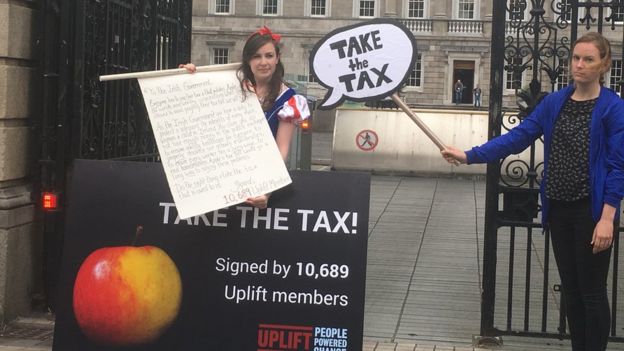
EU Apple tax: Irish cabinet to appeal against EU ruling - "have they gone crazy?"

Protesters outside the Irish Parliament on FridayThe Republic of Ireland's cabinet has agreed to appeal against the European Commission's ruling that Ireland granted undue tax benefits of up to €13bn (£11bn) to Apple.

Taoiseach Enda Kenny said he made no apology for defending the Irish government's right to appeal.

The decision to appeal was agreed by the Irish cabinet on Friday morning.

Apple chief executive Tim Cook said he was "very confident" the ruling would be overturned on appeal.

He called the European Commission's decision "maddening" and "political".

Speaking after the cabinet meeting, Mr Kenny said: "This is about Ireland, it is about our people, it's about us as a sovereign nation, actually setting out what we consider our appropriate policies".

Note EU-Digest: either the Irish Government went crazy or they made a secret deal with Apple. 

This is Apple and Ireland in terms of the back taxes Apple owns.


€13bn
demanded in back taxes. Equal to:

  • ALL of Ireland's healthcare budget
  • 66% of its social welfare bill
  • 15 million iPhones
  • 27% of Apple's 2015 profit
Read more: Apple tax: Irish cabinet to appeal against EU ruling - BBC News

8/31/16

Turkey: rumblings in cabinet

Turkish Unterior minister resigns in surprise move http://f24.my/2bVZWhB