hina maintains an anchored presence in the contested waters of the South China Sea through fishing fleets, hundreds of vessels in scale, an undertaking imperative to the advancement of its Belt and Road Initiative (BRI), a reimagining of the ancient Silk Road with which it plans to encircle the globe by 2049.
In March 2021, the Philippines called attention to a fleet of Chinese vessels occupying the Whitsun Reef, to which both China and the Philippines lay claim. The National Taskforce for the West Philippine Sea revealed more than 200 Chinese maritime militia vessels anchored in the reef.
Filipino fishermen, as they have done for generations, rely heavily on the rich waters around the Whitsun Reef for their livelihoods. They are now on the frontlines of what could become a critical moment for international conflict.
Read more at:
China Seeks Maritime Dominance with Gunboat-filled 'Fishing Fleets'
Showing posts with label Far East. Show all posts
Showing posts with label Far East. Show all posts


10/20/20
China's economy accelerates as virus recovery gains strength
A woman wearing a face mask walks out of the Auchan supermarket in Beijing on Monday. China's economic growth accelerated to 4.9 per cent over a year earlier in the three months ending in September, up from the previous quarter's 3.2 per cent. (Wang Zhao/AFP via Getty Images)
China's shaky economic recovery from the coronavirus pandemic is gaining strength as consumers return to shopping malls and auto dealerships while the United States and Europe endure painful contractions.
Growth in the world's second-largest economy accelerated to 4.9 per cent over a year earlier in the three months ending in September, up from the previous quarter's 3.2 per cent, official data showed Monday. Retail spending rebounded to above pre-virus levels for the first time and factory output rose, boosted by demand for exports of masks and other medical supplies.
Read more at: China's economy accelerates as virus recovery gains strength | CBC News
China's shaky economic recovery from the coronavirus pandemic is gaining strength as consumers return to shopping malls and auto dealerships while the United States and Europe endure painful contractions.
Growth in the world's second-largest economy accelerated to 4.9 per cent over a year earlier in the three months ending in September, up from the previous quarter's 3.2 per cent, official data showed Monday. Retail spending rebounded to above pre-virus levels for the first time and factory output rose, boosted by demand for exports of masks and other medical supplies.
Read more at: China's economy accelerates as virus recovery gains strength | CBC News
8/2/20
China: Xi stresses modernization of national defense, armed forces
Xi Jinping, general secretary of the Communist Party
of China (CPC) Central Committee, has stressed advancing the
modernization of the national defense and armed forces.
Xi made the remarks while presiding over a group study session of the Political Bureau of the CPC Central Committee on strengthening the modernization of the national defense and armed forces, which was held on Thursday.
To uphold and develop socialism with Chinese characteristics and achieve national rejuvenation, Xi underscored ensuring both development and security, and ensuring that efforts to make the country prosperous and efforts to make the military strong go hand in hand.
The modernization of the national defense and armed forces must be in step with the country's modernization process, and the military capabilities must fit national strategic needs, Xi said.
Xi underscored implementing the military strategic guideline for the new era, formulating the 14th five-year (2021-2025) plan for building the military, drawing a scientific road map, and cultivating a new type of high-caliber and professional military talent.
Read more at:
Xi stresses modernization of national defense, armed forces - Global Times
Xi made the remarks while presiding over a group study session of the Political Bureau of the CPC Central Committee on strengthening the modernization of the national defense and armed forces, which was held on Thursday.
To uphold and develop socialism with Chinese characteristics and achieve national rejuvenation, Xi underscored ensuring both development and security, and ensuring that efforts to make the country prosperous and efforts to make the military strong go hand in hand.
The modernization of the national defense and armed forces must be in step with the country's modernization process, and the military capabilities must fit national strategic needs, Xi said.
Xi underscored implementing the military strategic guideline for the new era, formulating the 14th five-year (2021-2025) plan for building the military, drawing a scientific road map, and cultivating a new type of high-caliber and professional military talent.
Read more at:
Xi stresses modernization of national defense, armed forces - Global Times
3/30/20
Stock market : Data: Rings a Warning – The Stock Market Crash Isn't Over
Google Trends data shows huge interest from retail investors looking to
learn how to buy stocks, and that's bad news for the Dow Jones
Read more at:
https://www.ccn.com/google-trends-data-rings-a-warning-the-stock-market-crash-isnt-over/
Read more at:
https://www.ccn.com/google-trends-data-rings-a-warning-the-stock-market-crash-isnt-over/
10/22/17
Go by Rail to Asia: New rail routes between China and Europe will change trade & tourism patterns
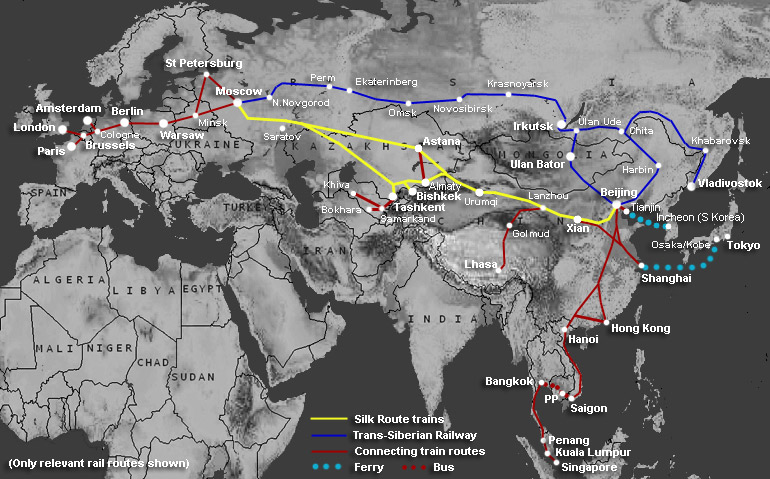 ASTANA in Kazakhstan is one of the world’s most remote
capitals, surrounded by thousands of kilometres of empty steppe. This
summer Astana attempted to launch itself onto the global stage by
hosting the World Expo, which closed on September 10th and underwhelmed
many attendees. But there are other ways to have an impact. On the
city’s north side, away from the Expo’s exhibits, a series of diesel
trains, each pulling dozens of containers, roll through the old railway
station. Most are heading from China to Europe. Last year over 500,000
tonnes of freight went by train between the two, up from next to nothing
before 2013. Airlines and shipping firms are watching things closely.
ASTANA in Kazakhstan is one of the world’s most remote
capitals, surrounded by thousands of kilometres of empty steppe. This
summer Astana attempted to launch itself onto the global stage by
hosting the World Expo, which closed on September 10th and underwhelmed
many attendees. But there are other ways to have an impact. On the
city’s north side, away from the Expo’s exhibits, a series of diesel
trains, each pulling dozens of containers, roll through the old railway
station. Most are heading from China to Europe. Last year over 500,000
tonnes of freight went by train between the two, up from next to nothing
before 2013. Airlines and shipping firms are watching things closely.The trains rumbling through Astana result from a Chinese initiative, in tandem with countries like Kazakhstan, to build a “New Silk Road” through Central Asia. The earlier overland routes were once the conduits for most trade between Europe and China and India; they faded into irrelevance when European ships started circumnavigating the Cape of Good Hope.
China has long wanted to develop its inland regions and push industry to “go west”, in order to spread economic growth more evenly. Manufacturers have been loth to shift, in part because of the higher cost of moving goods to ports for export. Developing a rail-freight network to Europe—an important part of China’s “One Belt One Road” policy—opens up a new route to market for its poorest areas. The land route through Central Asia is relatively short. A container ship too large for the Suez canal must make a 24,000km journey to reach Europe. Trains travel no more than 11,000km to reach the same destination.
Kazakhstan has spent over 1.1trn tenge ($3.2bn) on upgrading its railway lines and rolling stock since 2011. That includes $250m on the Khorgos Gateway, a dry port at the border with China that lifts containers from Chinese trains onto Kazakh ones to overcome a change in track width (a problem that has stymied previous efforts to build railway routes between Europe and China).
Volumes of freight travelling between China and Europe by rail are rising quickly. Between 2013 and 2016 cargo traffic quintupled in weight. In the first half of this year the value of goods travelling by train rose by 144% compared with the same period in 2016. Western firms have been keen to embrace rail freight because it helps them to lower costs, says Ronald Kleijwegt, an expert on the industry. In the case of high-tech electronics, for example, which consumers like to receive quickly, making them on China’s coast and air-freighting them to Europe is extremely pricey.
How worried should shipping firms and airlines be? Kazakhstan’s national rail company, KTZ, says it will have capacity for 1.7m containers to pass through the country between Europe and China each year by 2020; that is a tenth of the volume currently carried by sea and air between the two. In the longer term, a full modernisation of the existing main three rail routes from China to Europe could produce 3m containers a year in capacity.
But there are also reasons to doubt that will happen. For one thing, China plans to stop handing out government subsidies for additional rail-freight capacity from 2020, which will slow the network’s expansion. Sea freight has little to fear in the near term, says Soren Skou, chief executive of Maersk, the world’s biggest container-shipping line. Trains may take away some future growth from ships, he concedes, but not their existing business.
Air cargo is more vulnerable. Last year, 180,000 tonnes of cargo travelled on trains to western Europe from China (the remainder was destined for Russia and eastern Europe). That is a small fraction of the 52m tonnes that came by sea, but a big chunk of the 700,000 tonnes that came by air. Much of that air cargo could switch to rail in future, says Mr Kleijwegt, with one important proviso—that Russia would need to lift the retaliatory sanctions it placed in 2014 on imports of Western food, which stop most foodstuffs from traveling by land between Europe and China. That is unlikely for the time being. But it was only a decade ago that people thought the idea of freight trains between Europe and China was a joke, says Mr Kleijwegt—and no one laughs at that any more.
Read more: New rail routes between China and Europe will change trade patterns
9/21/16
9/3/16
Far East: Is the US Ready for War With China?
China’s improved military capabilities, particularly for anti-access and area denial (A2AD), mean that the United States cannot count on gaining operational control, destroying China’s defenses and achieving decisive victory if a war occurred.
With that in mind, this report examines alternative paths that a war between the United States and China might take, losses and other effects on both sides, preparations that the United States should make and ways to balance U.S. war aims against costs should war occur.
We postulate that a war would be regional and conventional. It would be waged mainly by ships on and beneath the sea, by aircraft and missiles of many sorts, and in space (against satellites) and cyberspace (against computer systems).
We assume that fighting would start and remain in East Asia, where potential Sino-U.S. flash points and nearly all Chinese forces are located. Each side’s increasingly far-flung disposition of forces and growing ability to track and attack opposing forces could turn much of the Western Pacific into a “war zone,” with grave economic consequences.
It is unlikely that nuclear weapons would be used: Even in an intensely violent conventional conflict, neither side would regard its losses as so serious, its prospects so dire, or the stakes so vital that it would run the risk of devastating nuclear retaliation by using nuclear weapons first.
We also assume that China would not attack the U.S. homeland, except via cyberspace, given its minimal capability to do so with conventional weapons. In contrast, U.S. non-nuclear attacks against military targets in China could be extensive. The time frame studied is 2015 to 2025.
The need to think through war with China is made all the more important by developments in military capabilities. Sensors, weapon guidance, digital networking and other information technologies used to target opposing forces have advanced to the point where both U.S. and Chinese military forces seriously threaten each other.
This creates the means as well as the incentive to strike enemy forces before they strike one’s own. In turn, this creates a bias toward sharp, reciprocal strikes from the outset of a war, yet with neither side able to gain control and both having ample capacity to keep fighting, even as military losses and economic costs mount.
This article is an edited version of a report by the Rand Corp. The full report may be found in PDF format or online here.
Read more: Are We Ready for War With China?
With that in mind, this report examines alternative paths that a war between the United States and China might take, losses and other effects on both sides, preparations that the United States should make and ways to balance U.S. war aims against costs should war occur.
We postulate that a war would be regional and conventional. It would be waged mainly by ships on and beneath the sea, by aircraft and missiles of many sorts, and in space (against satellites) and cyberspace (against computer systems).
We assume that fighting would start and remain in East Asia, where potential Sino-U.S. flash points and nearly all Chinese forces are located. Each side’s increasingly far-flung disposition of forces and growing ability to track and attack opposing forces could turn much of the Western Pacific into a “war zone,” with grave economic consequences.
It is unlikely that nuclear weapons would be used: Even in an intensely violent conventional conflict, neither side would regard its losses as so serious, its prospects so dire, or the stakes so vital that it would run the risk of devastating nuclear retaliation by using nuclear weapons first.
We also assume that China would not attack the U.S. homeland, except via cyberspace, given its minimal capability to do so with conventional weapons. In contrast, U.S. non-nuclear attacks against military targets in China could be extensive. The time frame studied is 2015 to 2025.
The need to think through war with China is made all the more important by developments in military capabilities. Sensors, weapon guidance, digital networking and other information technologies used to target opposing forces have advanced to the point where both U.S. and Chinese military forces seriously threaten each other.
This creates the means as well as the incentive to strike enemy forces before they strike one’s own. In turn, this creates a bias toward sharp, reciprocal strikes from the outset of a war, yet with neither side able to gain control and both having ample capacity to keep fighting, even as military losses and economic costs mount.
This article is an edited version of a report by the Rand Corp. The full report may be found in PDF format or online here.
Read more: Are We Ready for War With China?
11/6/15
Far East: How China and India May Come to Blows - by Peter Navarro
Quick question to test your global know-how: Which source of friction
between China and India is the most likely trigger or tripwire for war
between these two most populous countries in the world?
Read more: How China and India May Come to Blows - The Globalist
-
1. A territorial dispute involving Aksai Chin or Arunachal Pradesh
2. China’s supply of nuclear and conventional weapons to India’s archenemy Pakistan
3. India’s harboring of the Dalai Lama and other issues related to China’s authoritarian grip on Tibet
4. China’s diversion of key sources of India’s water supply
5. Any or all of the above
Read more: How China and India May Come to Blows - The Globalist
5/15/15
Far East: Tension rising in South China Sea - by Paul Koring
US President Barack Obama’s much-hyped “pivot” to the Pacific, supposedly
shifting U.S. foreign policy and military focus away from the Middle
East to face the emerging strategic challenges posed by China, has, so
far, not amounted to much: a few hundred Marines stationed in Australia,
ramped-up military exercises with the Philippines, more bombers
deployed to Guam.
U.S. warships and aircraft may soon be crisscrossing the South China
Sea, deliberately ignoring the 12-nautical-mile lines that could be
claimed as territorial waters should Beijing attempt to assert full
sovereignty over the islands it is creating from reefs and rocks,
according to senior defence officials.
Predictably, Beijing has responded with its own tough talk.
“Freedom of navigation certainly does not mean that foreign military ships and aircraft can enter another country’s territorial waters or airspace at will,” Hua Chunying, China’s foreign ministry spokesperson, said in response to reports that Defence Secretary Ash Carter had ordered up options for sending U.S. warships and aircraft into the area.
Read more: Tension rising in South China Sea - The Globe and Mail
But in recent months, Mr. Obama has seemed willing to go
beyond rhetoric and symbolism. He has rallied China’s regional rivals,
reaffirmed the United States’ hard pledges to defend Pacific allies and
started to paint some red lines in the seas Beijing regards as its own.
Predictably, Beijing has responded with its own tough talk.
“Freedom of navigation certainly does not mean that foreign military ships and aircraft can enter another country’s territorial waters or airspace at will,” Hua Chunying, China’s foreign ministry spokesperson, said in response to reports that Defence Secretary Ash Carter had ordered up options for sending U.S. warships and aircraft into the area.
Read more: Tension rising in South China Sea - The Globe and Mail
Far East: Japan's Cabinet Approves Bills Allowing Greater Military Powers - by Aditya Tejas
Japan’s cabinet approved a set of major military reforms on
Thursday, which would significantly bolster the country’s defense
capabilities. The new set of bills is designed to allow Japanese armed
forces to operate with fewer restrictions.
Under its current constitution,
which includes terms imposed by the U.S. at the end of World War II,
Japan is prohibited from maintaining a standing military and can only
keep a self-defense force to use in the event of a direct attack. The
latest move would allow Japan to act in its "collective defense" if it
were put in an "apparent danger" by an attack on its closest ally, the
United States. Japanese Prime Minister Shinzo Abe, however, said that
Japan would "never become entangled in a war being fought by the United
States," the Washington Post reported.
The decision was taken by the cabinet last year, but Thursday’s legislation formally introduced it.
The new laws would also enable Japanese troops to be
deployed overseas in a supporting role alongside other nations, although
the government would require the approval of Japan’s parliament, the
Diet, every time it wished to send troops abroad.
Read more: Japan's Cabinet Approves Bills Allowing Greater Military Powers
8/19/14
Canada: Nova Scotia exports up 50 per cent in first half of 2014: APEC report - by Kelly Shiers
Nova Scotia’s economy has been buoyed by gains in export sectors,
despite factors such as weakening employment and retail spending and a
slowdown in home construction being felt across the entire region, says a
report released Wednesday.
“In general, it’s a pretty soft economy across the region, including in Nova Scotia,” said Fred Bergman, senior analyst with the Atlantic Provinces Economic Council.
“Nova Scotia benefited from strong growth in natural gas exports. … Part of it was from Deep Panuke being on stream this year and also the Sable Project producing at a higher level.”
In its economic update for the region, the think-tank said total exports in Nova Scotia increased 50 per cent from January to May.
There has also been an increase in lobster and wood pulp exports.
Lobster fishery exports increased by 43 per cent to May of this year, compared to the same period in 2013. While the United States is the largest importer by far, there are growing sales to Asia over the past five years.
Sales will benefit from weekly shipments of live lobster from Halifax Stanfield International Airport via Korean Air that began May 25 and are expected to continue to the end of August, the report says.
Read more: Nova Scotia exports up 50 per cent in first half of 2014: APEC report | The Chronicle Herald
“In general, it’s a pretty soft economy across the region, including in Nova Scotia,” said Fred Bergman, senior analyst with the Atlantic Provinces Economic Council.
“Nova Scotia benefited from strong growth in natural gas exports. … Part of it was from Deep Panuke being on stream this year and also the Sable Project producing at a higher level.”
In its economic update for the region, the think-tank said total exports in Nova Scotia increased 50 per cent from January to May.
There has also been an increase in lobster and wood pulp exports.
Lobster fishery exports increased by 43 per cent to May of this year, compared to the same period in 2013. While the United States is the largest importer by far, there are growing sales to Asia over the past five years.
Sales will benefit from weekly shipments of live lobster from Halifax Stanfield International Airport via Korean Air that began May 25 and are expected to continue to the end of August, the report says.
Read more: Nova Scotia exports up 50 per cent in first half of 2014: APEC report | The Chronicle Herald
5/28/14
US Foreign Policy-A New Intelligent Approach ? : Obama: "Being The Best Hammer Doesn't Mean Every Problem Is A Nail" - by Mark Lander
 |
| 'Not every problem is a nail' |
Speaking under leaden, chilly skies, Mr. Obama delivered the commencement address at the United States Military Academy.
“America
must always lead on the world stage,” he said. “But U.S. military
action cannot be the only – or even primary – component of our
leadership in every instance. Just because we have the best hammer does
not mean that every problem is a nail.”
Under
pressure from critics who say the United States has been rudderless
amid a cascade of crises, the president said that those who “suggest
that America is in decline, or has seen its global leadership slip away –
are either misreading history or engaged in partisan politics.”
A day after announcing that the last American soldier would leave
Afghanistan at the end of 2016, the president told this latest class of
Army officers that the United States faced a new, more diffuse threat in
an arc of militancy stretching from the Middle East to the African
Sahel.
Mr. Obama has been deeply frustrated by the criticism of his foreign
policy, which during his first term was generally perceived as his
strong suit. He has lashed out at critics, whom he accuses of
reflexively calling for military action as the remedy for every crisis.
The overriding objective he said is to avoid an error on the order of the Iraq war.
He brushed aside as reckless those who say the United States should consider
enforcing a no-fly zone in Syria or supplying arms to Ukrainian troops.
In
the speech, Mr. Obama described an array of priorities, ranging from
the Iran nuclear negotiations to a new global climate change accord,
which he said would occupy his final two-and-a-half years in office.
He
also spoke of the need for the United States to look eastward to Asia,
promoting his long efforts to negotiate a trans-Pacific trade agreement
and pledging to defend American allies in the region in their
territorial disputes with China in the South and East China Seas.
Note EU-Digest: Kudos to President Obama for at least showing the intention of his Administration to the world, in this major foreign policy speech at West Point, that the "gun-boat diplomacy" of the US is not acceptable anymore and has come to an end.
2/1/14
Russia: Arctic city hopes to cash in as melting ice opens new sea route to China - by John Vidal
The city of Nadym, in the extreme north of Siberia, is one of the
Earth's least hospitable places, shrouded in darkness for half of the
year, with temperatures plunging below -30C and the nearby Kara Sea
semi-permanently frozen.
But things are looking up for this Arctic conurbation halfway between Europe and China. Over the next 30 years climate change is likely to open up a polar shipping route between the Pacific and Atlantic oceans, cutting travel time to Asia by 40% and allowing Russia's vast oil and gas resources to be exported to China, Japan and south Asia much faster.
Nadym stands to benefit from a warmer climate more than any other Arctic city – the Russian government plans to connect it by road and rail to other oil and gas centres; Gazprom, the world's largest gas company, is building a port nearby with French oil major Total; and if the new northern sea route is open for even six months of the year, Nadym will find itself on the 21st-century equivalent of the ancient silk route.
"The entire centre of gravity of the world economy is shifting to Nadym," said the mayor, Stanislav Shegurov, a former gas worker, at a recent meeting of Arctic leaders in Norway.
Expectations are high that the route will complement the Suez canal as a key waterway for trade to and from Asia. "The Arctic is our home and our future. We will make full use of the northern sea route. We are building infrastructure, we are making history. We have ambitious plans," said Anton Vasiliev, Russian ambassador for the Arctic.
Only 71 large ships, working mostly with Russian icebreakers, navigated the route in 2013, but Russia expects a 30-fold increase in shipping by 2020 and ice-free water over most of its length by 2050.
Read more: Arctic city hopes to cash in as melting ice opens new sea route to China | World news | The Observer
But things are looking up for this Arctic conurbation halfway between Europe and China. Over the next 30 years climate change is likely to open up a polar shipping route between the Pacific and Atlantic oceans, cutting travel time to Asia by 40% and allowing Russia's vast oil and gas resources to be exported to China, Japan and south Asia much faster.
Nadym stands to benefit from a warmer climate more than any other Arctic city – the Russian government plans to connect it by road and rail to other oil and gas centres; Gazprom, the world's largest gas company, is building a port nearby with French oil major Total; and if the new northern sea route is open for even six months of the year, Nadym will find itself on the 21st-century equivalent of the ancient silk route.
"The entire centre of gravity of the world economy is shifting to Nadym," said the mayor, Stanislav Shegurov, a former gas worker, at a recent meeting of Arctic leaders in Norway.
Expectations are high that the route will complement the Suez canal as a key waterway for trade to and from Asia. "The Arctic is our home and our future. We will make full use of the northern sea route. We are building infrastructure, we are making history. We have ambitious plans," said Anton Vasiliev, Russian ambassador for the Arctic.
Only 71 large ships, working mostly with Russian icebreakers, navigated the route in 2013, but Russia expects a 30-fold increase in shipping by 2020 and ice-free water over most of its length by 2050.
Read more: Arctic city hopes to cash in as melting ice opens new sea route to China | World news | The Observer
10/12/13
Sweat Shops:You should care where your T-Shirt was made: The true cost of a T-shirt - by M. MacKinnon and M. Strauss
 |
| A Sweatshop making your T-Shirt |
Work had just begun at the welter of garment factories when the power went out. So a manager on the seventh floor, home to the New Wave Style factory, was quick to stand up as the lights went back on and announce that the building was safe. Everyone should continue doing their jobs.
But this time, Rana Plaza didn’t stop shaking.
“He died on the spot as he was announcing that we should keep working,” Raehana Akhter recalls. Then she fell, too. “It was like stepping into an elevator [shaft]. I felt this feeling in my stomach, and then everything fell.”
When she landed, Ms. Akhter, a 22-year-old mother who worked as a quality control officer for about $2 a day, was in complete darkness, with her left leg trapped under shattered cement.
“The ceiling was just here,” she says, putting her hand about 30 centimetres above her face. “I felt like this would be my little grave.”
The building did become a grave – for 1,129 people. Its collapse was the world’s worst industrial accident in almost three decades. Fatal accidents in the garment-trade belt around Dhaka have become all too regular.
 |
| Sweatshop |
The collapse of Rana Plaza spotlighted the potentially tragic costs of the cheap T-shirt – now a staple of fast fashion – and sparked debate about just how much responsibility retailers should have for the supply chain that moves product onto their shelves.
Yet as the ties between countries have become stronger, accountability has become a loose thread. The Globe’s investigation shows how companies such as Loblaw place their orders through middlemen, who in turn source work to a network of far-flung factories. The retailer whose shelves are stocked with cheap T-shirts in many cases does not know where in the world it or its materials is going to be produced when an order is placed. Inspecting buildings and working conditions has been beyond the retailer’s scope.
Note EU-Digest: Maybe it is high time that the EU Parliament approves legislation which only allows in products made overseas into the EU that have a 'Trade Mark' which says: "This product has been produced in a workplace which meets EU approved standards for safety". Just talking about the issue with the Governments in question that allow these sweatshops or corporate entities which import these products has had very little effect.
In the meantime consumers should check the label of the products they are buying and think twice about buying the product if it is not clearly specified that it was produced in a safe workplace.
Read more: Spinning tragedy: The true cost of a T-shirt - The Globe and Mail
Subscribe to:
Posts (Atom)