Advertise On EU-Digest

Annual Advertising Rates
Showing posts with label Debt. Show all posts

6/7/22

Russia Debt: US Treasury says all buying of Russian debt and equity banned under sanctions

The US Treasury Department has advised US money managers that Washington’s sanctions on Moscow bar any secondary market purchases of debt or stocks...

The Treasury’s guidance published yesterday said executive orders imposing sanctions on Russia “prohibit US persons from purchasing both new and existing debt and equity securities issued by an entity in the Russian Federation.”“Consistent with our goal to deny Russia the financial resources it needs to continue its brutal war against Ukraine, Treasury has made clear that US persons are prohibited from making new investments in the success of Russia, including through purchases on the secondary market,” a Treasury spokesperson said.

Read more at: US Treasury says all buying of Russian debt and equity banned under sanctions - Russia Debt

4/10/20

EU - Coronavirus Debt: Netherlands refuses to 'Go Dutch' on EU coronavirus debt

As the European Union spars over an emergency economic package for countries reeling from the COVID-19 pandemic, the Dutch have revived their image of thriftiness by refusing to support a plea by southern members to take on collective debt.

Read more at:
https://www.reuters.com/article/us-health-coronavirus-eu-netherlands/netherlands-refuses-to-go-dutch-on-eu-coronavirus-debt-idUSKCN21R31J

9/2/18

US Economy: might look good based on Wall Street figures, but certainly not good for "Joe Bloke" and the "Have Not"s

US economy might look good, but reports show collectively, Americans have more than $1 trillion in credit-card debt, according to the Federal Reserve.

They have another $1.5 trillion in student loans, up from $1.1 trillion in 2013. Motor vehicle loans are now topping $1.1 trillion, up from $878.5 billion in 2013. And they have another nearly $15 trillion in mortgage debt outstanding.

EU-Digest

2/19/18

US Economy: Trump's America will be saddled with debt – like his bankrupted hotels were - by Richard Wolffe

Once upon a time, conservatives said they hated Barack Obama because of his budget deficits. They said he was destroying America and its future, which made them very angry indeed. They were so mad about all those Obama debts that they invented a new party, and named it after the revolutionaries who opposed a nasty British king.

The Tea Party was a collection of strange people, including one candidate who promised she wasn’t a witch. But the strangest thing happened after Obama moved out of the White House, and an orange man moved in. That was when conservatives all across America decided they didn’t actually hate debt and deficits after all.

That was just one of the many ways Donald Trump made everyone happy in America all over again. Another one was the stock market, which sometimes goes up and sometimes goes down. Everyone was happy when it went up, and nobody talked about it when it went down.

Donald Trump knows a lot about debt because he has created so much of it himself. He’s like a grand wizard of debt because he has magically escaped from several dark boxes of it. He also knows a few grand wizard types and thinks they are some very fine people
.
Grand Wizard Trump first learned his magic debt spells when he built a palace called the Taj Mahal in Atlantic City. He called it the eighth wonder of the world, and it certainly was wonderful how the business went bankrupt a year after it opened. Five other Trump palaces went bankrupt the next year, but he waved his wand and everything turned out fine. For him.

Read more: Trump's America will be saddled with debt – like his bankrupted hotels were | Richard Wolffe | Opinion | The Guardian

1/11/18

China - US Relations: Treasurys: Bond markets move because US depends on China as buyer - by Huileng Tan

Markets took a hit following a Bloomberg News report that cited unnamed sources as saying that officials in Beijing have recommended China, the largest holder of U.S. Treasurys, to slow or even halt its purchases of that debt.

U.S. stocks on Wednesday snapped a six-day winning streak, and Treasury yields, already in an upswing, moved higher with the 10-year reaching 2.597 percent, their highest level since March 15. Bond yields rise when bond prices fall.

China's foreign exchange regulator publicly refuted the Bloomberg report on Thursday, saying it cited "false information." But the jolt to markets may have been designed as a warning to Washington, which is clashing with China over trade and other issues.

China holds $1.2 trillion of U.S. debt — more than any country. When it buys U.S. bonds, it is effectively lending money to the United States. Washington uses bond sales to China and others to help finance itself.

Read more: Treasurys: Bond markets move because US depends on China as buyer

4/23/16

USA: The United States of Insolvency - by James Grant

This much I have learned about debt after 40 years of writing and study: It is better not to incur it. Once it is incurred, it is better to pay it off. America, we have a problem.

We owe more than we can easily repay. We spend too much and borrow too much. Worse, we promise too much. We conjure dollar bills by the trillions–pull them right out of thin air. I won’t insist that this can’t go on, because it has. I only say that it will eventually stop.

I don’t know the date, but I believe that I know the reason. It will stop when the world loses confidence in the dollars we owe. Come that moment of truth, the nation will resemble Chicago, a once prosperous polity now trying to persuade its once trusting creditors that it is actually solvent.

To understand our financial fix, put yourself in the position of the government. Say you earn the typical American family income, and you spend and borrow as the government does. So assuming, you would earn $54,000 a year, spend $64,000 a year and charge $10,000 to your already slightly overburdened credit card. I say slightly overburdened–your outstanding balance is about $223,000.

Of course, MasterCard wouldn’t allow you to run up that kind of tab. At an annual percentage rate of 15%, the cost to service a $223,000 balance would absorb 62% of your pretax income. But the government is different from you and me (and Chicago). It has a central bank.

The Federal Reserve is the government’s Monopoly-money machine. It sets some interest rates and influences many others. It materializes dollars. It regulates–now regiments–the nation’s banks. It pulls levers to make the stock market go up.

Congress is the source of the Fed’s power. The Constitution is the source of Congress’s power. The parchment enjoins Congress to coin money and regulate the value thereof. The founders viewed money as a scale or yardstick, something that measures value. The Fed views money as a magic wand, something that creates value.

Dollars aren’t so much minted these days. Rather, they issue from the Fed’s computers in billowing digital clouds. The cost of producing them is only the energy expended on tapping the keys. The Fed emits these electronic greenbacks to attempt to control the course of economic events. It’s a heaven-sent monetary system for a big-spending government.

You may struggle to pay that midteens rate on your outstanding credit-card balance. The Treasury gets by paying an average of just 1.8% on that portion of the debt, held by savers and investors both here and abroad. Defined in this way, we owe $13.9 trillion. The $19 trillion figure ticking upward on the famous National Debt Clock adds the debts the government owes itself. (How does this pseudo bookkeeping work?

The Social Security Administration takes in–temporarily–more than it pays out. With the surplus it buys Treasury bonds. The bonds enlarge the debt clock’s debt.) It’s not so important that the government pays itself on time. What is important is that the government pay its public creditors on time. So cast your eyes on the exact numerical rendering of that slightly smaller sum: $13,903,107,629,266. It is unmanageable.

One can assume that the creditors trust the currency in which they expect to be repaid. I wonder why, and for how much longer. The Fed once fought inflation. Now it actually sets out to cause it–about 2% a year is the target. Striving to inflate, it presses down interest rates and rustles up new dollars.

From the nation’s 18th century founding until 1971, the dollar was defined as a weight of gold or silver. Americans did business with paper, of course. But these commercial bills and banknotes were convertible into monetary bedrock, the precious metals. The expression sound as a dollar derives from the ring of a gold piece when you plunked it on a counter.

Sound money coincided with balanced budgets. Government borrowings climbed in wartime and subsided in peacetime. The pattern was disarranged by depression in the 1930s and war in the 1940s. It was broken by the Johnson Administration’s guns and butter and entitlements programs in the 1960s. Richard Nixon administered the coup de grĂ¢ce on Aug. 15, 1971, when he announced that the dollar would derive its value from the say-so of the government. The Fed could print as many green bills as the traffic would bear.

Many applauded that sea change, then and later. Easy money rarely fails to please–at first. It buoys stocks, bonds and commercial real estate. House prices jump, and car sales zoom. (Average auto-lending rates, now 4%, have been nearly sawed in half since 2007.) Politicians, noticing how a bull market fattens public pension funds, ratchet up the benefits they promise to retirees (a fact that state and federal pensioners are encouraged to remember on Election Day).

Periodically, the buzz wears off. What remains is a hangover of debts and promises. The proliferating dollars facilitate heavy borrowing. Ultra-low interest rates mask the cost.

I don’t ask that we return to some long-lost fiscal and monetary Eden. None has ever existed, even in America. Crises and business cycles are always with us. I merely observe that sound money and a balanced budget were two sides of the coin of American prosperity.

Then came magical thinking. Maybe you had a taste of modern economics in school. If so, you probably learned that the federal budget needn’t be balanced–it’s nothing like a family budget, the teacher would say–and that gold is a barbarous relic. To manage the business cycle, the argument went, a government must have the flexibility to print money, to muscle around interest rates and to spend more than it takes in–in short, to “stimulate.”

Oh, we have stimulated. Between the fiscal years 2008 and 2012 alone, federal deficits totaled $5.6 trillion. The public debt nearly doubled in the same span of years, to $11.2 trillion. The Federal Reserve tickled $1.6 trillion in new digital dollars into existence. True, our Great Recession proved no Great Depression, but the post-2008 recovery is the limpest on record.

It’s tomorrow’s trillions–the ones we’ve grandly promised to pay ourselves–that lie at the heart of the problem. The granddaddy of far-off commitments was Social Security, which dates from the 1930s. Medicare and Medicaid in the 1960s and the Affordable Care Act in 2010 duly followed. The debt, as big as it is, is the measure of past spending in excess of tax receipts, a pattern of bad fiscal habits that traces its intellectual roots to John Maynard Keynes and has its dollars-and-cents origins with Lyndon Johnson and his Great Society. What awaits us and our children and their children is the unpaid tab of the future.

“Nobody knows anything,” screenwriter William Goldman wisely observed about the accuracy of Hollywood box-office forecasts. The economists, in general, are no better than the studio executives.

You can’t blame people for not paying attention. America has forever defied the doomsdayers. The very language of government debt is calculated to tranquilize the critical mind. We speak of the Department of the Treasury rather than the Department of the Debt. (There’s no net treasure in the Treasury.) We say entitlement instead of taxing Peter to pay Paul and Social Security trust fund when we mean just another ordinary government account at the Department of Debt. (There is no trust fund because there is no division of assets, no accounts containing funds earmarked for you, the citizen, who so faithfully “contributed” your payroll taxes.)

Today’s miniature interest rates constitute another form of public sedation. You’d suppose the doubling of the debt would jack up the cost of servicing the debt. Nothing of the kind. As the debt has doubled, the rate of interest has halved.

In 2007, we owed $5 trillion and paid an average interest rate of 4.8%. Net interest expense: $237 billion. In 2016 we’ll owe $14.1 trillion and pay the average interest rate I already mentioned: 1.8%. Net interest expense: $240 billion. It’s a wonder we didn’t think of this financial perpetual-motion machine about a thousand years ago.

Debt per se is neither good nor bad, though less is usually better than more. How it’s priced and how it’s used are what tips the scales. If chocolate cake cost a penny a slice, the best of us would be tempted to break our diets. Well, government debt is priced at less than 2%, and Washington fell off the wagon years ago.

How do we escape from our self-constructed fiscal jail? According to the Government Accountability Office, unpaid taxes add up to more than $450 billion a year. Even so, according to the Tax Foundation, Americans spend 6.1 billion hours and $233.8 billion each tax season complying with a federal tax code that runs to 10 million words. Are we quite sure we want no part of the flat-tax idea? An identical low rate on most incomes. No deductions, no H&R Block. Impractical? So is the debt.

So is the spending (and the promises to spend more down the road). We need to stop the squandermania. How? By resuming the principled fight that Vivien Kellems waged against the IRS during the Truman Administration. It enraged Kellems, a doughty Connecticut entrepreneur, that she was forced to withhold federal taxes from her employees’ wages. She called it involuntary servitude, and she itched to make her constitutional argument in court. She never got that chance, but she published her plan for a peaceful revolution.

She asked her readers–I ask mine–to really examine the stub of their paycheck. Observe how much your employer pays you and how much less you take home. Notice the dollars withheld for Medicare, Social Security and so forth. If you are like most of us, you stopped looking long ago. You don’t miss the income that you never get to touch.

Picking up where Kellems left off, I propose a slight alteration in payday policy. Let each wage-earning citizen hold the whole of his or her untaxed earnings–actually touch them. Then let the government pluck its taxes.

“Such a payroll policy,” wrote Kellems in her memoir, Taxes, Toil and Trouble, “is entirely legal and if it were universally adopted, in six months we would have either a tax revolution or a startling contraction of the budget!”

Black ink, sound money and the spirit of Vivien Kellems are the way forward. “Make America solvent again” is my credo and battle cry. You can fit it on a cap.

Read more: The United States of Insolvency | TIME: Insolvenc

9/14/15

China is dumping U.S. debt

So should Americans be concerned that China has started dumping some of its Treasury holdings because it is no secret China is the largest holder of US debt ?

After all, it raises serious questions about whether China will keep lending Washington money to help finance the federal deficit in the future.

But right now, China is selling because it's in dire need of cash. Recently, it unleashed multiple moves to support its markets and prevent its currency from a freefall, while at the same time trying to stimulate the economy.

China owned $1.3 trillion of U.S. Treasuries as of June, making it the biggest holder of U.S. debt.

But China's foreign-exchange reserves plunged by a record $94 billion in August, according to the country's central bank, leaving it with a war chest of $3.6 trillion. Analysts say it's very safe to believe a big chunk of that decline occurred due to a reduction in U.S. Treasury holdings.

The selling and the potential that China will not be buying U.S. debt in the near future raises questions on its potential to increase America's borrowing costs.

Read more: China is dumping U.S. debt - Sep. 10, 2015

8/31/15

Global Economy: US and Chinese Economies are in "lockstep" and this could spell major trouble for US

Let no one fool you - specially not the Wall Street "news makers.

Both the US and Chinese Economies are in lockstep and the US economy could get  in big trouble because of that.

The investment relationship that has blossomed between China and the U.S., even though it has benefited both countries, has also made both of their economies very dependent on each other, but the US more so than China.

Chinese companies have started  more companies or joint ventures in the U.S., thereby increasing the number of Americans working for Chinese firms.In a sense China has now also become a supplier of secondary capital to the USA, in addition to the regular  US debt they have been buying up..

Another alarming fact is that based on the present (June 2015 figures) US debt to China stands at $1.272 trillion,.

That's roughly one-fifth of the $6.175 trillion held by foreign countries. The rest of the $18 trillion debt is owned by either the American people, or by the U.S. government itself.

The United States has thus allowed China to become one of its biggest bankers, to provide the American people low consumer prices.

This selling of debt to China is mainly used by the US to help the US economy to grow by funding federal government programs. It has also kept  U.S. interests rates artificially low. However, what very people want to talk about, specially the financial world, is that China's increasing ownership of U.S. debt is shifting the economic balance of power in China's favor.

China's position as America's largest banker also gives it considerable political leverage. Consequently every now and then China threatens to sell part of its US debt holdings. It knows that, if it did so, U.S. interest rates would rise, which would slow U.S economic growth to a trickle.

As China grew economically stronger it has also been calling for a new global currency to replace the dollar, which is presently used in most international transactions. China usually makes this call whenever the U.S. lets the value of the US dollar drop, which makes the debt China holds less valuable.

China certainly is not so stupid to call in its US debt all at once. If it did so, the demand for the dollar would plummet like a rock. A dollar collapse would disrupt international markets worse than the 2008 financial crises and China's economy would suffer along with everyone else's.

It's more likely that China will slowly begin selling off its US Treasury holdings.

Bottom line the financial poker game between the two most powerful economic players in the world is certainly not over yet, but China is holding some very powerful cards in its hand.

The financial world better sit up and start smelling the roses.

EU-Digest


8/27/15

USA Wall Street: "Casino Capitalism": Economist Michael Hudson on What’s Behind the Stock Market’s Rollercoaster Ride

The real problem is that we’re still in the aftermath of when the bubble burst in 2008, that all of the growth in the economy has only been in the financial sector, in the monopolies—only for the 1 percent. 

And it’s as if there are two economies, and the 99 percent has not grown. And so, the American economy is still in a debt deflation. So the real problem is, stocks have doubled in price since 2008, and the economy, for most people, certainly who listen to your show, hasn’t grown at all.

So, finally, the stocks were inflated really by the central bank, by the Fed, creating an enormous amount of money, $4.5 trillion, essentially, to drop over Wall Street to buy bonds that have pushed the yields down so high—so low, to about 0.1 percent for government bonds, that pension funds and investors say, "How can we make money?" 

So they buy stocks. And they borrowed at 1 percent to buy up stocks that yield maybe 4 percent. But who are the largest people who buy the stocks? They’re the companies themselves that have done stock buybacks. They’re the managers of the companies that have used their earnings, essentially, to push up stock prices so they get more bonuses. 

Ninety precent of all the earnings of the biggest companies in America in the last five years have gone for stock buybacks and dividends. It’s not being invested. It’s not building new factories. It’s not employing more people.

So, the real problem is that we’re in a nonrecovery in America, and Europe is in an absolute class war of austerity. 

hat’s what the eurozone is, an austerity zone. So that’s not growing. And that’s really what’s happening. And all that you saw on Monday was just sort of like a shift, tectonic shift, is people realizing, "Well, the game is up, it’s time to get out." And once a few people want to get out, everybody sees the game’s up.

Read more: "Casino Capitalism": Economist Michael Hudson on What’s Behind the Stock Market’s Rollercoaster Ride | Democracy Now!

7/9/15

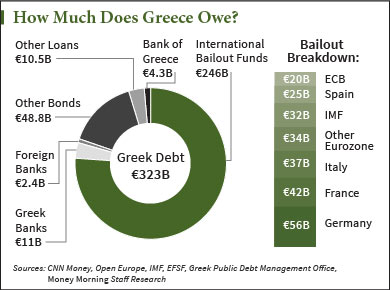
Greece crisis: Tsipras under pressure to submit reform blueprint to creditors - total foreign debt: € 246 billion

http://cdn.moneymorning.com/wp-content/blogs.dir/1/files/2015/03/How-much-does-Greece-owe-graph.jpg
Fforeign debt of €246b Greece and local debt € 32b 
Greece is under intense pressure to table a last-chance blueprint for radical economic reform, tax increases and spending cuts on Thursday in order to secure a future in the euro and stave off financial collapse.

The reform proposals are to be sent to Greece’s creditors with negotiations at the critical stage. The embattled Greek prime minister, Alexis Tsipras, accused his eurozone creditors on Wednesday of exploiting his country as an “austerity laboratory” for the past five years while formally asking Europe for three more years of rescue funds.

Note EU-Digest: Athens has accumulated a debt mountain of 175% of GDP amounting to € 246 billion. If you spread that over the population of 11.3 million Greeks, every Greek Citizens presently would owe approximately € 21 million to cover the debt. Very difficult to figure out how Greece would ever be able to pay this off unless a lot of the debt would be "forgiven".

EU-Digest


6/27/15

Greece debt crisis: Tsipras announces bailout referendum

Is the party over for Greece?
Greece will hold a referendum on 5 July on a controversial bailout deal with foreign creditors, Prime Minister Alexis Tsipras has announced. 

In a televised address, he described the plan as "humiliation" and condemned "unbearable" austerity measures demanded by creditors.

The Greek government earlier rejected the proposals, aimed at avoiding the country defaulting on its debt.

Greece has to make a €1.5bn ($1.7bn; £1.06bn) IMF debt repayment on 30 June.

In the speech, Mr Tsipras said: "These proposals, which clearly violate the European rules and the basic rights to work, equality and dignity show that the purpose of some of the partners and institutions was not a viable agreement for all parties, but possibly the humiliation of an entire people."

"The people must decide free of any blackmail," he added.

Read more: Greece debt crisis: Tsipras announces bailout referendum - BBC News

6/25/15

Greece: Weekend deadline for Greece after negotiations draw blank - by Ian Traynor, Jennifer Rankin, Helena Smith

Greece’s creditors have set the country a weekend deadline to avoid default and stay in the eurozone, after more than 24 hours of non-stop Brussels negotiations at the highest level resulted in stalemate.

After talks between Athens and its creditors failed to reach an agreement on Thursday, a further meeting of eurozone finance ministers will be held on Saturday in a bid to achieve a breakthrough. With the German chancellor Angela Merkel insisting that a deal must be reached before markets open on Monday morning, Greece is now running out of time to secure an accord and make a €1.6bn payment to the International Monetary Fund (IMF) on Tuesday.

Following a 24-hour period that involved three rounds of talks between Greek prime minister Alexis Tsipras and Greece’s creditors, as well as two sessions of eurozone finance ministers, officials described the situation as entrenched and immobilised.

“They can talk and talk, but the gap does not narrow,” said an EU official. “Both sides are in their trenches.” Arriving at an EU leaders’ summit on Thursday evening that threatened to be overshadowed by the Greek crisis, Merkel said Greece had “gone backwards” on some issues.

Read more: Weekend deadline for Greece after negotiations draw blank | Business | The Guardian

6/18/15

Curtain Time for Greece? Hope in short supply as Greece, EU seek bailout deal

Optimism was in short supply Thursday over the prospects of a deal that might prevent Greece’s bankruptcy as eurozone finance ministers gathered for a keenly awaited meeting in Luxembourg, with both sides refusing to budge on their demands.

With Greece fast approaching a potential default on June 30 and amid signs that Greeks are withdrawing money from their banks, officials acknowledged that a Greek exit from the euro was now being discussed.

Pierre Moscovici, the European Union’s top economy official, said the eurozone meeting will be “very difficult” but that he hoped everyone turns up “with cool heads and the political will to succeed”.

Read more: france 24 - Hope in short supply as Greece, EU seek bailout deal - France 24

3/2/15

Euro Zone: Despite Greece, euro zone is turning the corner - by Paul Taylor

The latest episode of Greece's debt crisis has revived doubts about the long-term survival of the euro, nowhere more so than in London, Europe's main financial center and a hotbed of Euroskepticism.

The heightened risk of a Greek default and/or exit comes just as there are signs that the euro zone is turning the corner after seven years of financial and economic crisis and that its perilous internal imbalances may be starting to diminish.

To skeptics, the election of a radical leftist-led government in Athens committed to tearing up Greece's bailout looks like the start of an unraveling of the 19-nation currency area, with southern countries rebelling against austerity while EU paymaster Germany rebels against further aid
.
A last-ditch deal to extend Greece's bailout for four months after much kicking and screaming between Athens and Berlin did little to ease fears that the euro zone's weakest link may end up defaulting on its official European creditors.

U.S. economist Milton Friedman's aphorism - "What is unsustainable will not be sustained" - is cited frequently by those who believe market forces will eventually overwhelm the political will that holds the euro together.


Despite Greece, euro zone is turning the corner | Reuters

2/9/15

US Economy: Donald Trump Tells Americans to Prepare for "Financial Ruins"

The United States could soon become a large-scale Spain or Greece, teetering on the edge of financial ruin.

That’s according to Donald Trump, who painted a very ugly picture of where this country is headed. Trump made the comments during a recent appearance on Fox News’ “On the Record with Greta Van Susteren.”

According to Trump, the United States is no longer a rich country. “When you’re not rich, you have to go out and borrow money. We’re borrowing from the Chinese and others. We’re up to $16 trillion in debt.”

He goes on to point out that the downgrade of U.S. debt is inevitable.

“We are going up to $16 trillion [in debt] very soon, and it’s going to be a lot higher than that before he gets finished. When you have [debt] in the $21-$22 trillion, you are talking about a downgrade no matter how you cut it.”

Ballooning debt and a credit downgrade aren’t Trump’s only worries for this country. He says that the official unemployment rate “isn’t a real number” and that the real figure is closer to 15 percent to 16 percent. He even mentioned that some believe the unemployment rate to be as high as 21 percent.

“Right now, frankly, the country isn’t doing well,” Trump added, “Recession may be a nice word.”

Read more:: Donald Trump Tells Americans to Prepare for "Financial Ruins"

2/1/15

Greece economy: Merkel rules out more debt relief

German Chancellor Angela Merkel has ruled out cancelling any of Greece's debt, saying banks and creditors have already made substantial cuts.

But Mrs Merkel told the Die Welt newspaper she still wanted Greece to stay in the eurozone.

Greece's left-wing Syriza party won last weekend's election with a pledge to have half the debt written off.

Its new finance minister has refused to work with the "troika" of global institutions overseeing Greek debt.

The troika - the European Commission, European Central Bank and International Monetary Fund - had agreed a €240bn (£179bn; $270bn) bailout with the previous Greek government.

Read more BBC News - Greece economy: Merkel rules out more debt relief

2/28/14

Turkey’s troubles contagious due to bad policies in West - by Paul Krugman

Okay, who ordered that? With everything else going on, the last thing we needed was a new economic crisis in a country already racked by political turmoil. True, the direct global spillovers from Turkey, with its Los Angeles-sized economy, won’t be large. But we’re hearing that dreaded word “contagion” – the kind of contagion that once caused a crisis in Thailand to spread across Asia, more recently caused a crisis in Greece to spread across Europe, and now, everyone worries, might cause Turkey’s troubles to spread across the world’s emerging markets.

It is, in many ways, a familiar story. But that’s part of what makes it so disturbing: why do we keep having these crises? And here’s the thing: the intervals between crises seem to be getting shorter, and the fallout from each crisis seems to be worse than the last. What’s going on?

Before I get to Turkey, a brief history of global financial crises.

For a generation after the second World War, the world financial system was, by modern standards, remarkably crisis-free – probably because most countries placed restrictions on cross-border capital flows, so that international borrowing and lending were limited. 

In the late 1970s, however, deregulation and rising banker aggressiveness led to a surge of funds into Latin America, followed by what’s known in the trade as a “sudden stop” in 1982 – and a crisis that led to a decade of economic stagnation.

Latin America eventually returned to growth (although Mexico had a nasty relapse in 1994), but, in the 1990s, a bigger version of the same story unfolded in Asia: huge money inflows followed by a sudden stop and economic implosion. Some of the Asian economies bounced back quickly, but investment never fully recovered, and neither did growth.

Most recently, yet another version of the story has played out within Europe, with a rush of money into Greece, Spain and Portugal, followed by a sudden stop and immense economic pain.

As I said, although the outline of the story remains the same, the effects keep getting worse. Real output fell 4 per cent during Mexico’s crisis of 1981-83; it fell 14 per cent in Indonesia from 1997 to 1998; it has fallen more than 23 per cent in Greece.

Read more: Turkey’s troubles contagious due to bad policies in West - Economic News | Ireland & World Economy Headlines |The Irish Times - Tue, Feb 04, 2014

1/15/14

US Economy: The US Dollar Printing Presses Are Running Out of Ink - by RM

"stop the dollar printing press"
For someone to get a n immediate birdseye view as to the status of the US economy, the usdebtclock.org shows that the official US deficit of US 17 trillion dollar now breaks  down to a $753,000 debt share for each American citizen.

But is that the whole deficit picture?

When US politicians speak about the US debt they usually only refer to this 17 plus trillion US deficit.  They hardly ever mention that this is only the tip of the iceberg. For on top of that 17 trillion dollar deficit, the US also has a 17 trillion liability for social security, 22 trillion in prescription drug liability, 88 trillion in medicare liability, and 127 trillion in unfunded liabilities, including, but not limited to such items as the quantitative easing program.

The US debt is in fact now more than the debt of all the 27 EU nations combined.

This means that if you add to the US deficit all the other liabilities and financial obligations it would equates to every US citizen carrying a  $ 1,107.000 of that debt burden.

As to the US's ability to pay off this mounting debt and interest on the debt, which is mainly money borrowed from abroad,  the US Fed’s answer so far has been to print more dollars to pay the bills.

So far this scheme has worked relatively smooth, mainly because the dollar became the world’s reserve currency after the second world war and as a result most international trade is now conducted in dollars. This has also provided the US with the ability to call the shots ( manipulate) the figures when it concerns the actual value of the dollar in comparison to other currencies.
 
But printing dollars can not go on forever and will not only devalue it's value, but eventually also dilute the total money supply of the US. In essence

"Pay back time", where the US has to cough up the money it borrowed from its overseas creditors is coming closer every day. For the foreign creditors are also getting very wary about the US financial status. 

Unfortunately for the US,  just as small businesses object to getting paid with a deflated currency for goods they purchased abroad at a hard currency rate, so do the international trading partners of the US .

Sooner, rather than later, US trading partners will  require payment for all the money the US owes them or for new purchases and loans, in hard currencies, like the European Euro'  or Chinese Renminbe.

When that happens, the US will have to go onto the International Financial Marketplace to buy hard currencies with their inflated “weaker” dollars to pay of those debts abroad.  Obvious the result will  be that this creates an even bigger deficit for the US tax payer and the US Treasury.

The present hype about an improving US economy, booming stock market and other positive financial reports are all basically frantic attempt by political and economic forces to  delay the inevitable pay-back time and present a rosy picture of what in reality is a very dire situation.

EU-Digest


10/24/13

EU - Focus on growth on eve of EU summit in Bruxelles and US NSA spying on Europeans

The summer is past and European summits return. Europe's leaders gather in Brussels on Thursday with the markets becalmed and some economic statistics to celebrate. 

Even the threat - a few weeks back - of the Italian government falling scarcely ruffled the markets. The promise by the president of the European Central Bank, Mario Draghi, a year ago, to do whatever it takes to defend the euro continues to act as a shield against the bond market vigilantes. No one, it seems, is prepared to bet against the ECB.

It is true that almost on a daily basis there are reassuring signs of progress.

The Spanish economy has just edged out of recession after two years. Since 2008 its exports have grown by an impressive 14.6%. Unemployment at above 26% may have peaked. Italy is running a trade surplus and Greece this year will register a primary budget surplus excluding debt repayments. Ireland is set to exit its bailout programme in mid-December.

And yet despite all the austerity and spending cuts the level of debt, amongst the countries that use the eurozone, is still rising.

French unemployment, which was down in August, is set to rise again. Italy is struggling to bring down its labour costs without which it cannot be competitive. The Greeks are locked in argument with their lenders over a budget gap. It may need further funding. It was revealed this week that Greeks are, on average, 40% poorer than in 2008.

Even the most Panglossian of Europe's leaders recognises that the recovery is fragile and solid growth is needed so in Brussels the leaders will concentrate on supporting and expanding the digital economy and building a single digital market.

But new allegations of US eavesdropping on Germany's Chancellor Angela Merkel may also be discussed.

France's President Francois Hollande is pressing for the issue to be put on the summit agenda, following reports that millions of French calls have been monitored.

The veteran French EU Commissioner Michel Barnier told the BBC that "enough is enough", and confidence in the US had been shaken.

Mr Barnier, the commissioner for internal market and services, said Europe must not be naive but develop its own strategic digital tools, such as a "European data cloud" independent of American oversight.

The digital economy is on the official summit agenda for Thursday evening ( tonight) . 

Read more: BBC News - Focus on growth on eve of EU summit