Advertise On EU-Digest

Annual Advertising Rates
Showing posts with label Shipping. Show all posts

10/22/17

Go by Rail to Asia: New rail routes between China and Europe will change trade & tourism patterns


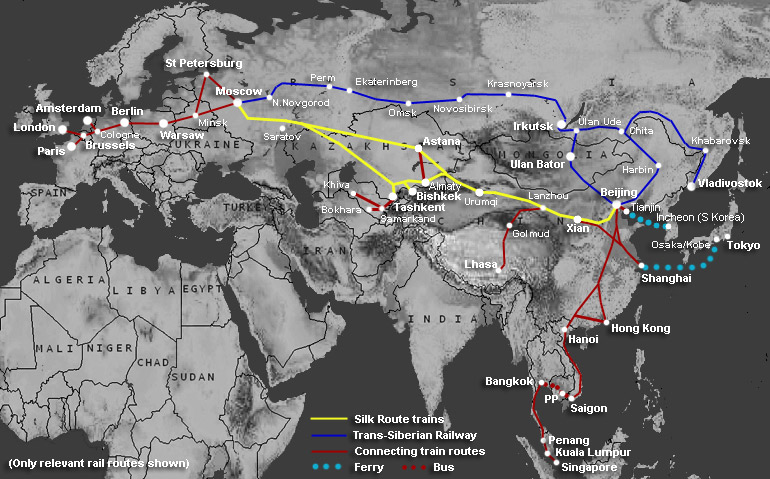
Route map - The Silk Route & Central Asia by trainASTANA in Kazakhstan is one of the world’s most remote capitals, surrounded by thousands of kilometres of empty steppe. This summer Astana attempted to launch itself onto the global stage by hosting the World Expo, which closed on September 10th and underwhelmed many attendees. But there are other ways to have an impact. On the city’s north side, away from the Expo’s exhibits, a series of diesel trains, each pulling dozens of containers, roll through the old railway station. Most are heading from China to Europe. Last year over 500,000 tonnes of freight went by train between the two, up from next to nothing before 2013. Airlines and shipping firms are watching things closely.

The trains rumbling through Astana result from a Chinese initiative, in tandem with countries like Kazakhstan, to build a “New Silk Road” through Central Asia. The earlier overland routes were once the conduits for most trade between Europe and China and India; they faded into irrelevance when European ships started circumnavigating the Cape of Good Hope.

China has long wanted to develop its inland regions and push industry to “go west”, in order to spread economic growth more evenly. Manufacturers have been loth to shift, in part because of the higher cost of moving goods to ports for export. Developing a rail-freight network to Europe—an important part of China’s “One Belt One Road” policy—opens up a new route to market for its poorest areas. The land route through Central Asia is relatively short. A container ship too large for the Suez canal must make a 24,000km journey to reach Europe. Trains travel no more than 11,000km to reach the same destination.

Kazakhstan has spent over 1.1trn tenge ($3.2bn) on upgrading its railway lines and rolling stock since 2011. That includes $250m on the Khorgos Gateway, a dry port at the border with China that lifts containers from Chinese trains onto Kazakh ones to overcome a change in track width (a problem that has stymied previous efforts to build railway routes between Europe and China).

Volumes of freight travelling between China and Europe by rail are rising quickly. Between 2013 and 2016 cargo traffic quintupled in weight. In the first half of this year the value of goods travelling by train rose by 144% compared with the same period in 2016. Western firms have been keen to embrace rail freight because it helps them to lower costs, says Ronald Kleijwegt, an expert on the industry. In the case of high-tech electronics, for example, which consumers like to receive quickly, making them on China’s coast and air-freighting them to Europe is extremely pricey.

How worried should shipping firms and airlines be? Kazakhstan’s national rail company, KTZ, says it will have capacity for 1.7m containers to pass through the country between Europe and China each year by 2020; that is a tenth of the volume currently carried by sea and air between the two. In the longer term, a full modernisation of the existing main three rail routes from China to Europe could produce 3m containers a year in capacity.

But there are also reasons to doubt that will happen. For one thing, China plans to stop handing out government subsidies for additional rail-freight capacity from 2020, which will slow the network’s expansion. Sea freight has little to fear in the near term, says Soren Skou, chief executive of Maersk, the world’s biggest container-shipping line. Trains may take away some future growth from ships, he concedes, but not their existing business.

Air cargo is more vulnerable. Last year, 180,000 tonnes of cargo travelled on trains to western Europe from China (the remainder was destined for Russia and eastern Europe). That is a small fraction of the 52m tonnes that came by sea, but a big chunk of the 700,000 tonnes that came by air. Much of that air cargo could switch to rail in future, says Mr Kleijwegt, with one important proviso—that Russia would need to lift the retaliatory sanctions it placed in 2014 on imports of Western food, which stop most foodstuffs from traveling by land between Europe and China. That is unlikely for the time being. But it was only a decade ago that people thought the idea of freight trains between Europe and China was a joke, says Mr Kleijwegt—and no one laughs at that any more.

Read more: New rail routes between China and Europe will change trade patterns

9/22/14

Shipping and the Global Economy: An economic indicator that floats - by Anne VanderMey

Containership
The economy is recovering, Right? Look at the latest government data, and it’s not entirely clear.

The Labor Department in September reported disappointing growth in employment, but other surveys for the same period said the labor market was strong. Similarly, GDP declined an alarming 2% in the first quarter, but the report was so full of statistical noise that the market mostly ignored it. In the following quarter it beat estimates, but no one’s exactly sure whether that’s because of genuine economic gains or something else—for example, the weather improved.

Economic forecasting is a fraught process. Numbers lie, signals are mixed, and even the most widely accepted measures of economic health can often be misleading. So are there any metrics out there that can float above the fray? Try shipping.

For years economists have been tracking global maritime trade for information not just on the health of the global economy but on how it’s evolving and where it’s headed. Shipping makes up the lifeblood of global markets. Nearly 90% of goods traded across borders were transported by sea during at least some part of their journey to your shopping cart.

“I see GDP growth as the surface,” says Peter Sand, chief shipping analyst at BIMCO, the world’s largest international shipping association. “Global trade in goods is a vital indicator for gaining insight beyond the surface.”

And what does shipping tell us about the state of the economy today? While there’s not yet overwhelming data, some nascent signals indicate that things could be looking up.

In April the World Trade Organization revised upward its earlier estimates for growth in global trade, pegging it at a 4.7% increase this year. That’s more than double the rate of last year. And in August shipping giant A.P. Moller-Maersk’s stock soared after releasing a standout earnings report. Because Maersk moves such a large portion of global goods, some 15% of all containerized trade, the $58 billion company is seen as a market bellwether. In the second quarter it reported an unexpectedly strong 6.6% increase in container volume.

Despite the encouraging initial signs shipping offers, Doug Mavrinac, a managing director at Jefferies, says he’s still waiting on the industry to offer concrete evidence of a comeback. In particular, he’s watching throughputs at ports for longer-lasting gains than have occurred so far. Once imports really start to pick up, he says, that will be a leading indicator, but it hasn’t happened yet. Eventually, maybe as soon as 2016, supply will come back under control too, leading to an increase in prices. And then, just maybe, the Baltic Dry Index will be worth looking at again.

Read more: An economic indicator that floats

9/1/14

Global Shipping: Kaliningrad Branch of Baltic Sea Ports Authority commences operation

Kaliningrad Branch of FSBI Baltic Sea Ports Authority commences operation on September 1, 2014, IAA PortNews has been informed by Peotr Parinov, head of FSBI Baltic Sea Ports Authority . Former federal state institution Kaliningrad Sea Port Authority had been reorganized. Port dues are now collected by Kaliningrad Branch of FSBI Baltic Sea Ports Authority.

According to Parinov, personnel of FSI Kaliningrad Sea Port Authority had been employed by FSBI Baltic Sea Ports Authority (90 employees). Valery Bodryakov is appointed as the Acting Harbour Master of port Kaliningrad. Earlier he held the position of the first deputy to the head of Kaliningrad Sea Port Authority.

Before the reorganization procedure is completed, Aleksandr Shevtsov will act as the head of Kaliningrad Sea Port Authority. According to Parinov, Aleksandr Shevtsov will later be appointed as the Harbour Master of port Kaliningrad. The reorganization is to be completed by October 1, 2014. 

Read more: Kaliningrad Branch of Baltic Sea Ports Authority commences operation

7/16/14

The Netherlands: World's Largest Vessel to be Assembled in Rotterdam

Pieter Schelte’, the biggest vessel in the world, is to be completed in the port of Rotterdam. Owner and designer Allseas and the Port of Rotterdam Authority have signed an agreement to this effect. The plan is for ‘Pieter Schelte’ to arrive in Rotterdam at the end of 2014, informs the Port of Rotterdam.

‘Pieter Schelte’ is 382 metres long and 124 metres wide. The length, in combination with the massive width, makes this vessel unique with the ability to lift topsides off offshore platforms weighing up to 48,000 tonnes and jackets up to 25,000 tonne

The vessel is intended for installing and removing topsides and jackets of large offshore oil and gas platforms in a single lift. At the bow of the vessel is a slot, where topsides are lifted. It is also equipped for laying large pipelines and, with her capacity, will be the largest pipelay vessel as well.

Read more: World's Largest Vessel to be Assembled in

9/20/13

Belgium: PSA Antwerp expanding its hinterland terminal port network

Recently PSAA Europa Terminal (quay 869) and PSAA Deurganck Terminal (quay 1742) became the ‘terminals of call’ for the rail connection to/from Athus (Belgium). These PSAA terminals will now be able to offer to shipping lines, forwarders and shippers a direct rail connection to Athus, respectively 2 and 3 times a week.

Furthermore, depending on the volume demand the possibility exists to organize two additional calls a week on the river terminals of PSAA (quay 869, quay 1742 and/or PSAA Noordzee Terminal – quay 913).
Athus was the most important rail link in the NARCON network and this inland location services a wide hinterland area, ranging from Belgian Lorraine, to the Grand Duchy of Luxembourg and French Lorraine/Alsace to the German Saarland and Rhineland-Pfalz.

As an alternative to the termination of the rail bundling concept in the port of Antwerp PSAA is providing the synchromodal consolidation of the Athus rail cargo (both by barge and truck).

In addition, the partnership with Delta Marine Terminal (DMT) in Moerdijk (Netherlands) was also formalized yesterday. The existing barge connection with three barge shuttles a week between the PSAA terminals and DMT will be optimized. It is the aim to shortly establish a similar paperless customs concept, by analogy with the CT Vrede set-up (to their inland terminal locations in Amsterdam & Zaandam), launched late August 2013.

Also, with the inland terminal operators in Ghent, La Louvière, Brussels (Belgium) and Gorinchem (The Netherlands) formal agreements have been made to realize barge connections to/from all PSAA terminals. 

Read more: PSA Antwerp expanding its hinterland network

12/28/12

Netherlands - Ports - Shipment of goods via Rotterdam port up by 1.7 pct

The amount of goods shipped through Rotterdam port in the Netherlands in 2012 grew by 1.7% to reach 442 million tonnes, the Rotterdam port authority announced on Friday.

The growth was mainly due to an increase in shipment of crude oil and oil products, President of the port of Rotterdam, Hans Smits, said in a statement.The amount of goods shipped through Rotterdam port in the Netherlands in 2012 grew by 1.7% to reach 442 million tonnes, the Rotterdam port authority announced on Friday.

The growth was mainly due to an increase in shipment of crude oil and oil products, President of the port of Rotterdam, Hans Smits, said in a statement.

Shipment of of crude oil increased by 6%, and mineral oil product by 12% this year. Shipment of naphtha, gas oil, diesel, kerosene and petrol also increased. A total of 214 million tonnes of liquid bulk was handled. This cargo segment thus represents half of the cargo throughput in the port of Rotterdam, said the statement.
LNG imports remained at a low level, because the prices in Asia are much higher, resulting in the product being transported to the Far East rather than to Europe.

Read more: KUNA : Shipment of goods via Rotterdam port up by 1.7 pct - Economics - 28/12/2012

11/24/12

Russian WTO membership strengthens Hamburg’s position as Russia’s major European trade partner

The start of Russia’s WTO membership on 22 August 2012 will give trade relations with Europe a significant boost. “The dismantling of trade barriers will strengthen Hamburg’s role as the leading hub of Russia’s trade with the European Union and the world“, says Jutta Ludwig, CEO of HWF Hamburg Business Development Corporation. She continues: “Hamburg’s trade relations with Russia date back to the first days of the Hanseatic League and have been renewed ever since. Already, some 120 companies with Russian roots have chosen Hamburg for their expansion into the EU. By future simplifications of the commercial law, Hamburg’s position in Russian trade and as bridgehead of the Russian economy will be further strengthened.

This evaluation is confirmed by Dr. Sergey P. Ganzha, Consul General of the Russian Federation: “With the Russian Federation joining the WTO, the good trade relations with Hamburg will be strengthened by establishing common international standards. The interest of Russian companies in Hamburg has been growing for a long time. This development will be furthered and positively stimulated by Russia’s WTO membership.“

The Port of Hamburg is of particular importance to Russia. It is the central hub for Russia’s trade with the European Union. Claudia Roller, CEO of Hafen Hamburg Marketing e.V., explains: “With Russia joining the WTO in the middle of this year, trade barriers will gradually be further abolished. This also contributes to the benefit of the Port of Hamburg, as it is closely tied to the Russian market. For the port of the Elbe metropolis, Russia has become the second-most important trade partner in container traffic. Undeterred by the fluctuations in the global economy, the container handling increased by more than 35 per cent to 595.000 TEU in 2011.

Read more: News | Port of Hamburg

Shipping: As Panama Canal expands, Latin America rushes to be ready - by Jim Wyss, Jacqualine Charles, and Mimmi Whitefield

Standing atop a hulking crane at this country’s largest Pacific port, Alejandro Echeverri pointed out scurrying workers below reinforcing pylons, preparing the ground for an extended pier and tending to a dredging boat that has been deepening the harbor.

As the planning director for the Buenaventura Regional Port Authority, Echeverri says his job is to be a “futurologist” and try to stay ahead of the industry. Right now, the industry’s future is high stakes and under the sway of a singular event: the expansion of the Panama Canal, which will make the ships that straddle the seas larger and heavier than these ports have ever seen.

The industry “doesn’t care what ports need to do to be ready or what it costs,” Echeverri said. “If you’re not ready, they’ll simply take you off their route.”

Ports throughout the Americas and the Caribbean are rushing to be ready for the post-Panamax future. Currently, the Panama Canal can handle ships 965 feet long that need a depth of 39.5, a size known as Panamax. Once the expansion is complete in 2015, the canal will be able to accommodate ships 1,200 feet long with a 50-foot draft — and shippers are already building to those dimensions.

Read more: BUENAVENTURA, Colombia: As Panama Canal expands, Latin America rushes to be ready - Americas - MiamiHerald.com

9/21/12

International Shipping: Port of Halifax signs MOU with Panama Canal Authority

The Port of Halifax and Panama Canal Authority have jointly announced the signing of the first Canadian port MOU with the Panama Canal Authority.

With the Panama expansion well underway, ports are raising awareness of their ability to handle the “big ships” after the Canal expands.

The Port of Halifax said the MOU “serves to raise awareness in the industry that Halifax is ready when the widening project is complete in 2015.”

The Halifax Port Authority began working with the Panama Canal Authority in 2010 when officials visited the Canal to view the expansion progress.

“Work together can now continue in a more formalized way ensuring global awareness of Halifax’s connections via the Panama Canal,” said a Port release.

The purpose of the Memorandum of Understanding is to identify business opportunities, increase awareness of the ports, exchange information, and undertake joint marketing initiatives.

The Port of Halifax also has several MU's with Ports in Europe. It is the closest major North American port to Europe, in close proximity to the Great Circle Route – one full day faster to Europe than other North American east coast container port 


Read more: Port of Halifax signs MOU with Panama Canal Authority | Canadian Transportation and Logistics

8/6/12

Belgium: Port of Antwerp steady on course

Seaports PR reports that Port of Port of Antwerp in Belgium handled 93,822,976 tonnes of freight during the first six months of this year. This represents a drop of 2.1 per cent compared with the same period last year, due mainly to the Belgian Refining Corporation (BRC) suspending its activities.

The container volume expanded slightly during the past half year, demonstrating that the port of Antwerp is able to maintain its position in the difficult economic situation over the past few months.
Ro/ro and dry bulk for their part managed to return good growth figures, of 16.2 per cent and 5.0 per cent respectively. Liquid bulk too has begun to recover in the past month, thanks to BRC restarting.

Read more: Port of Antwerp steady on course - Dredging News Online

7/31/12

Eastport Maine A Profitable US East Coast Sea Link To Europe - by RM

Eastport a pittoresque Maine coastal town
What first started as a small experimental shipment of 500 pregnant cows from Maine to Turkey has now grown into an important source of income for Eastport, a pittoresque New England coastal town just across from the Canadian Province of New Brunswick.

On of the reason's for this success is that Eastport's location makes it the closest port on the US East Coast to Europe.

Initial facility expansions in 1998 allowed the Eastport Port Authority to enter into a series of record breaking years for its cargo operations. Recently the Port completed a further $8 million modernization and expansion program. Today the Port of Eastport is seen as one of the fastest growing cargo ports in all of New England.

Eastport's modern automated Port facilities
Following years of handling largely pulp and pulp-related products from local mills, livestock exports have emerged as a major growth market not only as a result of its proximity to Europe, but  importantly, Maine’s clean bill of health with regard to certain livestock diseases.

The Cattle for export via Eastport comes from Maine and other New England and US states,

Animal friendly, ventilated, climate-controlled livestock containers
The port’s dominant livestock customer has been a Texas company called Sexing Technologies that uses technology to sort bull semen for farmers that specifically want either male or female calves.

Following their arrival in Eastport Heifers (young cows) impregnated with semen from Sexing Technologies’ system are then loaded onto the ship in animal friendly, ventilated, climate-controlled livestock containers for their trip overseas. Usually to the port of Izmir in Turkey.

Izmir Port, Turkey
The positive results of this niche market are quite evident.

Since the beginning of the year some 17,000 cattle have passed through this Washington County community (also known for its commercial fisheries) on their way to Europe.

Chris Gardner, executive director of the Eastport Port Authority, who is also a Maine Washington County commissioner, says the livestock exports have opened a huge new international market for local and US farmers and has had a significant economic impact on the Port and the town of Eastport in the form of new businesses and jobs.

EU-Digest

11/25/08

Xinhua: Greece - Hu Jintao's visit highlights friendly ties between China, Greece and Greece and sign euro831.2 million Port deal - by Liang Yeqian

For the complete report from Xinhua click on this link

Greece -FM: Hu Jintao's visit highlights friendly ties between China, Greece and Greece - by Liang Yeqian

Chinese President Hu Jintao's ongoing official visit to Greece reflects the excellent bilateral relations between the two countries, Greek Foreign Minister Dora Bakoyannis said Monday in an interview with Xinhua. She said current Greek-Chinese relations, strong as they are, could be further strengthened through enhanced cooperation in the fields of commercial shipping, tourism, culture and education, and people-to-people exchanges. Bakoyannis said Greece has particular strength in the merchant shipping sector as it has the busiest ports in southeast Europe and the eastern Mediterranean Sea. Greek ship-owners are currently the biggest and most important customers of Chinese shipyards, and nearly 50 percent of merchandise traveling to and from China are transported by Greek merchant fleets, she went on to say. She said the strategic partnership between Greece and China also includes their cooperation in international affairs, adding that her country supports increased dialogue between China and the European Union.

Note EU-Digest: Chinese President Hu Jintao has promised to expand maritime trade with Greece after finalizing a euro831.2 million (US$1b) container-port concession deal Tuesday. Under the agreement, China's Cosco Pacific Ltd. will receive a 35-year concession to manage two container terminals at Greece's main port of Piraeus.The agreement was signed after Hu met Greek Prime Minister Costas Karamanlis for talks. Karamanlis said Greece will become a key transit point for Chinese goods bound for southeast Europe and the eastern Mediterranean.

12/30/07

IceNews: A.P. Møller-Mærsk is no longer the largest company in Denmark

For the complete report from the IceNews click on this link

A.P. Møller-Mærsk is no longer the largest company in Denmark

Nova Nordisk has become bigger than Mærsk, while the Novo Nordisk group experienced huge growth Mærsk had problems in the shipping company’s container business and is barly maintaining levels from the year before. The Copenhagen Post reports that “Throughout this year, Novo grew to a whopping DKK 248 billion enterprise and increased its market value by 40 per cent. A whole five billion more than A.P. Møller-Mærsk’s DKK 243 billion.”

5/30/07

Flanders Investment and Trade: Japanese Shipping giant NYK moves HQ from London to Antwerp

For the complete report from the Flanders Investment and Trade Organization click on this link

Japanese Shipping giant NYK moves HQ from London to Antwerp

Japanese shipping line NYK is moving its Bulk Transport Headquarters from London to Antwerp. NYK’s European feasibility study showed the best location for this was, for a number of reasons, the Port of Antwerp. For one thing, NYK can enjoy Flanders’ beneficial tonnage tax. In addition, the shipping firm was attracted by a unique treaty between Belgium and Hong Kong which avoids double taxation and the notional interest deduction scheme which allows companies to reduce their taxable base when making investments from their own resources.