Advertise On EU-Digest

Annual Advertising Rates
Showing posts with label Transportation. Show all posts

3/11/20

Tourist Industry: Coronavirus concerns, anxiety send travel industry into a spiral - by Curtis Tate, Dawn Gilbertson and Morgan Hines

A government warning not to board a cruise ship or long flight if you're frail. Convention and event cancellations from coast to coast. Global travel warnings.

The travel and tourism industry has taken hit after hit since the coronavirus outbreak began in January. It's still early for concrete data, but economists and industry executives fear 9/11- or recession-like repercussions. Travel demand plummeted, then and was slow to recover.

"Unfortunately, they're on the front lines on the effect of this virus. They're getting pummeled,'' said Mark Zandi, chief economist for Moody's Analytics.

He said the travel and tourism impact from coronavirus could be greater than the fallout from 9/11, or the 2003 SARS outbreak, because of the global nature of the crisis.

"Global travel is effectively shutting down,'' he said. "It's going to take a while to get it back up and running again. This is going to be a very tough year for the travel and tourism industry.''

The International Air Transport Association, which represents global airlines, last week boosted its estimates of the global financial hit from COVID-19 from $29.3 billion to between $63 billion and $113 billion as the bookings falloff has spread beyond Asia.

That would put airlines in their most precarious position since after the Sept. 11, 2001, terrorist attacks. In the U.S. alone, the travel industry lost $40 billion from 2001 to 2005.

 Read more at: Coronavirus concerns, anxiety send travel industry into a spiral

11/26/19

EU Security Concerns EU Executve Travel: "Spy-air? EU warned on VIP jet leasing

Flying EU and Nato VIPs on jets from a part-Chinese firm could be a security risk, a Belgian aviation company has said.

Its warning was lambasted as a "James Bond" fantasy, by reference to the fictional British spy.

But if there is a risk, then top EU officials have already been exposed on other "air-taxis".

And the Belgian aviation company which raised the China alarm has its own security questions to answer on Russia.
 
Read more at: Spy-air? EU warned on VIP jet leasing

8/15/19

Combatting Terrorism: EU may extend 'passenger name records' to rail and sea - by Peter Teffer

The national governments of the EU member states are considering extending mandatory record-keeping of air passenger data to high-speed rail travel and sea traffic.

A majority of states have said in diplomatic discussions that they were in favour of applying the rules from the EU's passenger name record (PNR) directive, currently only applicable to air travel, to other modes of transportation.

The PNR directive, adopted in 2016 to fight terrorism, requires air carriers to transfer personal data about their customers to the authorities.

In February, Romania (then holding the rotating six-month presidency of the Council of the EU) sent member states a confidential document with the results of a questionnaire about the future of the PNR directive.

The paper, published on the Statewatch website, said that "the majority of the member states agreed on broadening the scope of the PNR directive".

Read more: EU may extend 'passenger name records' to rail and sea

For additional information, including advertising rates - e-mail:Freeplanet@protonmail.com

10/22/17

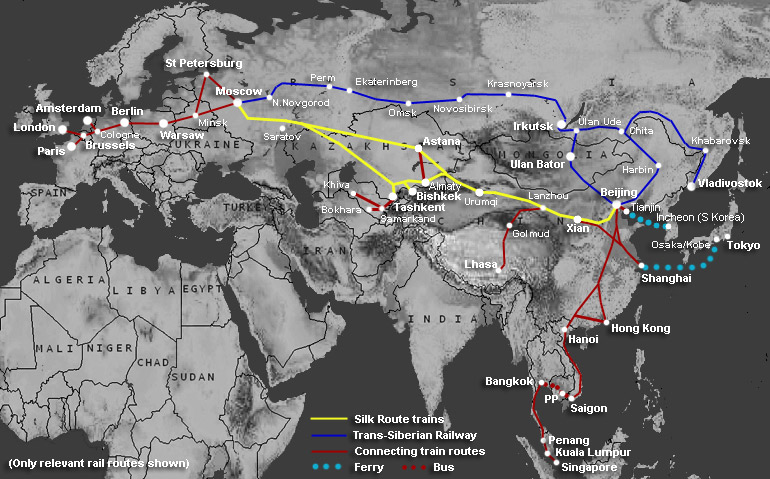
Go by Rail to Asia: New rail routes between China and Europe will change trade & tourism patterns


Route map - The Silk Route & Central Asia by trainASTANA in Kazakhstan is one of the world’s most remote capitals, surrounded by thousands of kilometres of empty steppe. This summer Astana attempted to launch itself onto the global stage by hosting the World Expo, which closed on September 10th and underwhelmed many attendees. But there are other ways to have an impact. On the city’s north side, away from the Expo’s exhibits, a series of diesel trains, each pulling dozens of containers, roll through the old railway station. Most are heading from China to Europe. Last year over 500,000 tonnes of freight went by train between the two, up from next to nothing before 2013. Airlines and shipping firms are watching things closely.

The trains rumbling through Astana result from a Chinese initiative, in tandem with countries like Kazakhstan, to build a “New Silk Road” through Central Asia. The earlier overland routes were once the conduits for most trade between Europe and China and India; they faded into irrelevance when European ships started circumnavigating the Cape of Good Hope.

China has long wanted to develop its inland regions and push industry to “go west”, in order to spread economic growth more evenly. Manufacturers have been loth to shift, in part because of the higher cost of moving goods to ports for export. Developing a rail-freight network to Europe—an important part of China’s “One Belt One Road” policy—opens up a new route to market for its poorest areas. The land route through Central Asia is relatively short. A container ship too large for the Suez canal must make a 24,000km journey to reach Europe. Trains travel no more than 11,000km to reach the same destination.

Kazakhstan has spent over 1.1trn tenge ($3.2bn) on upgrading its railway lines and rolling stock since 2011. That includes $250m on the Khorgos Gateway, a dry port at the border with China that lifts containers from Chinese trains onto Kazakh ones to overcome a change in track width (a problem that has stymied previous efforts to build railway routes between Europe and China).

Volumes of freight travelling between China and Europe by rail are rising quickly. Between 2013 and 2016 cargo traffic quintupled in weight. In the first half of this year the value of goods travelling by train rose by 144% compared with the same period in 2016. Western firms have been keen to embrace rail freight because it helps them to lower costs, says Ronald Kleijwegt, an expert on the industry. In the case of high-tech electronics, for example, which consumers like to receive quickly, making them on China’s coast and air-freighting them to Europe is extremely pricey.

How worried should shipping firms and airlines be? Kazakhstan’s national rail company, KTZ, says it will have capacity for 1.7m containers to pass through the country between Europe and China each year by 2020; that is a tenth of the volume currently carried by sea and air between the two. In the longer term, a full modernisation of the existing main three rail routes from China to Europe could produce 3m containers a year in capacity.

But there are also reasons to doubt that will happen. For one thing, China plans to stop handing out government subsidies for additional rail-freight capacity from 2020, which will slow the network’s expansion. Sea freight has little to fear in the near term, says Soren Skou, chief executive of Maersk, the world’s biggest container-shipping line. Trains may take away some future growth from ships, he concedes, but not their existing business.

Air cargo is more vulnerable. Last year, 180,000 tonnes of cargo travelled on trains to western Europe from China (the remainder was destined for Russia and eastern Europe). That is a small fraction of the 52m tonnes that came by sea, but a big chunk of the 700,000 tonnes that came by air. Much of that air cargo could switch to rail in future, says Mr Kleijwegt, with one important proviso—that Russia would need to lift the retaliatory sanctions it placed in 2014 on imports of Western food, which stop most foodstuffs from traveling by land between Europe and China. That is unlikely for the time being. But it was only a decade ago that people thought the idea of freight trains between Europe and China was a joke, says Mr Kleijwegt—and no one laughs at that any more.

Read more: New rail routes between China and Europe will change trade patterns

8/25/17

European Railways: Why interrailing as an adult is the best way to explore Europe - by Chris Beanland

Interrailing should be a compulsory teenage rite of passage – no wonder the EU recently floated the idea of giving out free passes to all 18-year-olds. What better way to protect this beautiful, but fragile union than by showing the next generation what they have in common with each other and how many hi-jinks they can get up to in neighbouring European countries?

It was my first taste of independent travel too – 17 summers ago, though it seems like yesterday. Back then it was a Karrimor loaded with band T shirts, Lonely Planet Europe On A Shoestring and bank robber sacks of change for telephone boxes. This time, instead of sleeping cars, hostels and that tangy scent of socks, there were nice hotels and the scent of understated luxury. Three’s Feel At Home free roaming contract and my iPhone brought the whole experience into the 21st century, and meant home was only the touch of a button away.

It was a cultural whip round the first time, but it was also a piss up – getting out of your tree being the sine qua non of teenage travelling – that resulted in lost cash cards, nearly getting into fights on night trains and passing out on deck chairs on Positano Beach. And I met so many people – this was social networking avant la lettre, coming across fellow flaneurs from Australia, Canada, Finland, and making firm friends, if not for life then at least for a night.

Interrailing as an adult was much more relaxed and even more cultured, with less boozing and earlier mornings. I sped through Rotterdam’s Docklands on a watertaxi, climbed all over Tomas Saraceno’s incredible spiderweb netting art installation five floors above the ground of Dusseldorf’s Modern Art Gallery, had a sneak preview of some of the exhibits at Kassel’s famous art festival, Documenta (documenta.com), saw Eileen Gray furniture at Munich’s Design Museum, drank at Wes Anderson’s Bar Luce in Milan’s Fondazione Prada, and explored Novi Belgrade’s mind-blowing brutalist architecture.

The food was better this time around too. Back in 2000 I had inadvertently explored the premise “how can a human function on pizza alone for three weeks?” shortly after enduring the very worst meal of my entire life (do not ever accidentally order the minced heart and lung soup at Worgl station buffet).

This time I ate mushroom arancini with a vegetable mayonnaise in an old swimming pool in Rotterdam (alohabar.nl) and fresh white asparagus at the BMW Welt’s restaurant. Even the train food was good – on Deutsche Bahn’s ICE I chowed down on lamb kofte with yoghurt and mashed carrots in the Bordrestaurant.

Read more: Why interrailing as an adult is the best way to explore Europe | The Independent

12/23/14

Transportation: the Hyperloop system will transport you at 1287.5 km per hour

Hyperloop, the ultra-fast tube transport dreamed up by SpaceX founder and Tesla Motors CEO Elon Musk, could be ready for passengers in as few as 10 years.

In a 76-page report released on Dropbox on Thursday, a new startup called Hyperloop Transportation Technologies laid out plans for building Musk's futuristic transportation system, which could cut travel time between Los Angeles and San Francisco down to 35 minutes. The trip takes up to 12 hours by Amtrak train, and more than six hours by car.

The system would carry passengers in pods moving as fast as 1287.5 km (800 miles) per hour, according to the white paper. The plan laid out by Musk -- who has no involvement in the project, and did not help with the paper -- has broadened beyond the two California metropoles. Hyperloop Transportation has drawn up maps with lines connecting every major U.S. city.

Read more: Image for The Real Reason Tesla Is Tanking

10/3/14

The Netherlands: Dutch Railways NS new ticketing system considered complicated and unfriendly by NS customers

A random poll by EU-Digest throughout the Netherlands shows that 68% of NS customers are unhappy with the new obligatory electronic OV Chipcard ticketing system. The new system went into effect two months ago throughout the Netherlands.

The new system did away with a paper ticketing system and replaced it with an electronic "refill" Chipcard called OV Chipcard tied into the customers bank account or credit card. The OV Chipcard can also be used on all other Public Transport in the Netherlands

Travelers find the new system complicated, riddled with technical problems and especially unfriendly to many older customers who are not tech savvy

Tourists visiting the Netherlands also complained that the ticketing system does not accept many International credit cards.

Almere-Digest

5/19/13

EU-Digest poll shows only 40% of people polled say royalty is still relevant in Europe

Dutch King Willem Alexander and Queen Maxima
The results of our latest EU-Digest Poll " Is Royalty still relevant in Europe" shows that only 40% of the people polled found it still is relevant

Ten percent said outright it was not. Twenty percent found it was too costly and should be abolished, while 30% said Royalty and Palaces should be transformed  into a "Disney-like theme park concept" and become self-sufficient.

This month's poll covers obesity and cost as it requests your input on the question:  "Should obese people be charged for an additional seat on Airplanes, Buses and Trains?

EU-Digest

2/5/13

Transportation Costs: Traffic costs U.S. economy $121B a year - it pays to invest in Public Transport

America's commuters are adapting to increasing traffic congestion by building delays into their schedules at a cost of $121 billion in wasted time and fuel, according to an annual study of national driving patterns released Tuesday.

The new report from the Texas A&M Transportation Institute found that Americans wasted an average of $818 each sitting in traffic in 2011. That also meant more carbon dioxide entering the atmosphere.

The worst commute in the country? Washington, D.C. Commuters in the nation's capital needed almost three hours for a trip that should take 30 minutes without traffic, according to the report. That compares to the least congested city — Pensacola, Fla. — where commuters needed only nine extra minutes.

On average, Americans allowed for an hour of driving time for a trip that would take 20 minutes without traffic. The total nationwide added up to 5.5 billion additional hours that Americans spent in their cars during 2011.

Read more: Traffic costs U.S. economy $121B a year - Business - CBC News

9/3/12

Turkey: Efforts for Istanbul’s third airport heat up

The Transport Ministry will announce the tender date for a third airport in Istanbul next month, Transport Minister Binali Yıldırım has said.

The government aims to receive bids in December for the facility, which is estimated to cost 10 billion Turkish Liras, he told Anatolia news agency.

“We cannot tell exactly what will be in the bids, but this is our estimate,” he said

Some foreign investors, including those from Japan, France, China and Germany, have already shown interest in the airport, which will be constructed in three phases.

Read more - BUSINESS - Efforts for Istanbul’s third airport heat up

5/9/12

The Netherlands: Commuting to work? For most Dutch, it takes less than 20 minutes

Just 5% of Dutch workers use the train to get to work, while almost six in 10 travel by car, according to new research from the national statistics office CBS.

One in four people use a bike to get to work, with public sector and hospitality industry staff most likely to cycle.

More than half the working population take less than 20 minutes to get to work, which would explain why the train is not popular, the CBS said. Train users take an average 67 minutes to reach their jobs.

However, 14% of civil servants use the train to get to work, the survey shows.

DutchNews.nl - Commuting to work? For most Dutch, it takes less than 20 minutes