The war in Ukraine represents the greatest geopolitical challenge facing the European Union. Moscow attacked Kiev with explicitly imperialist aims, with a view to restoring what it considers its rightful ‘sphere of influence’ in the European neighbourhood, thus implicitly threatening other European countries (including EU members).
The aggression also entails a systemic element. Vladimir Putin’s Russia is promoting an autocratic-state model in the European neighbourhood, in contrast to the democratic polity towards which countries such as Ukraine and Georgia have been striving—the value system on which the EU is founded and which it seeks to project.
This has led the union to rethink radically its relations with Russia. The traditionally co-operative approach is giving way to a sort of containment strategy, which will last for the foreseeable future. Hence the reflection on how to end the energy and technological dependencies that bind Europe to Russia, the offer of substantial support to democracy in countries threatened by its expansionism and the defence of the resilience of our societies from Russian interference through disinformation and cyber assaults.
Most fundamentally, the Russian invasion of Ukraine has pushed the EU to exercise a proactive role at regional and global levels, thus testing its ability to implement the ‘strategic autonomy’ it has been advocating for a long time. And in its immediate reaction to the menace coming from east, the EU has shown a unity and resolve many—perhaps including Putin—did not expect.
Read more at:
Has the war in Ukraine made the EU a geopolitical actor? – Nicoletta Pirozzi
Showing posts with label Unity. Show all posts
Showing posts with label Unity. Show all posts
5/2/22


3/12/22
EU Unity: EU leaders announce intention to collectively rearm in face of Putin threat
EU leaders have announced their intention to collectively rearm and become autonomous in food, energy and military hardware in a Versailles declaration that described Russia’s war as “a tectonic shift in European history”.
At a summit in the former royal palace, the 27 heads of state and government said on Friday that the invasion of Ukraine had shown the urgent need for the EU to take responsibility for its own security and to rid itself of dependencies on others.
Speaking at a press conference in the palace’s Galerie des Batailles, in which France’s military achievements are celebrated in painting and sculpture, France’s Emmanuel Macron said the Versailles treaty of 1919 had divided Europe but that today leaders were uniting. He described Russia’s aggression as a “tragic turning point”.
“We can see how our food, our energy, our defence are all issues of sovereignty,” he said. “We want to be open to the world but we want to choose our partners and not depend on anybody.”
He added: “The Versailles declaration is linked to the fact that sovereignty in Europe, which might have been thought of by some as a slogan or a French fantasy, is seen by all today as crucial.”
Read more at: EU leaders announce intention to collectively rearm in face of Putin threat | European Union | The Guardian
At a summit in the former royal palace, the 27 heads of state and government said on Friday that the invasion of Ukraine had shown the urgent need for the EU to take responsibility for its own security and to rid itself of dependencies on others.
Speaking at a press conference in the palace’s Galerie des Batailles, in which France’s military achievements are celebrated in painting and sculpture, France’s Emmanuel Macron said the Versailles treaty of 1919 had divided Europe but that today leaders were uniting. He described Russia’s aggression as a “tragic turning point”.
“We can see how our food, our energy, our defence are all issues of sovereignty,” he said. “We want to be open to the world but we want to choose our partners and not depend on anybody.”
He added: “The Versailles declaration is linked to the fact that sovereignty in Europe, which might have been thought of by some as a slogan or a French fantasy, is seen by all today as crucial.”
Read more at: EU leaders announce intention to collectively rearm in face of Putin threat | European Union | The Guardian
8/6/21
USA - Poll: : 60% of Voters Say America Is More Divided
A new Rasmussen Reports national telephone and online survey finds that 60% of Likely U.S. Voters say the country has become more divided since last year’s election. Only 13% think the country is more united than it was before the election, while 24% believe the level of division is about the same. Those numbers haven’t changed much since January.
Read more at: 60% of Voters Say America Is More Divided - Rasmussen Reports®
Read more at: 60% of Voters Say America Is More Divided - Rasmussen Reports®
3/17/21
EU: Fissures that tear us apart and pressures that weigh us all down – by Kate Pickett
A friend recently gave a seminar on the destructive impact of income inequality, laying out how deeply it damages a vast array of health and wellbeing outcomes, and how it affects the affluent as well as the poor, only to be asked during the question period—with some acerbity—why he was ignoring the deep and damaging inequalities between men and women.
I’ve frequently been asked the same question, with varying flavours. Why am I not writing about racial and ethnic inequalities instead of inequalities of income? Why am I not talking about the elderly or those with disabilities? What about migrants? And what about inequalities between the global north and south or between neighbourhoods? What is so significant about income anyway—surely wealth matters more, or social class or power?
Read more at: Fissures that tear us apart and pressures that weigh us all down – Kate Pickett
I’ve frequently been asked the same question, with varying flavours. Why am I not writing about racial and ethnic inequalities instead of inequalities of income? Why am I not talking about the elderly or those with disabilities? What about migrants? And what about inequalities between the global north and south or between neighbourhoods? What is so significant about income anyway—surely wealth matters more, or social class or power?
Read more at: Fissures that tear us apart and pressures that weigh us all down – Kate Pickett
2/15/21
EU: Future of Europe: Nearly half of citizens want reforms - by Elena Sánchez Nicolás
Almost half of EU citizens (44 percent) would like to see reforms to the bloc, a survey published on Friday (12 February) revealed.
"Reform of the EU is clearly something citizens want to see, and that is why we need to launch the Conference on the Future of Europe as soon as possible," the president of the European Parliament, David Sassoli, said.
The much-delayed Conference on the Future of Europe (CoFoE) is seen as a chance to have an inclusive dialogue with citizens about the way ahead for the EU - particularly after the pandemic revealed major weaknesses of the Union.
Read more at: Future of Europe: Nearly half of citizens want reforms
"Reform of the EU is clearly something citizens want to see, and that is why we need to launch the Conference on the Future of Europe as soon as possible," the president of the European Parliament, David Sassoli, said.
The much-delayed Conference on the Future of Europe (CoFoE) is seen as a chance to have an inclusive dialogue with citizens about the way ahead for the EU - particularly after the pandemic revealed major weaknesses of the Union.
Read more at: Future of Europe: Nearly half of citizens want reforms
12/17/20
Eurozone reform—it’s not just the fiscal rules –by Willi Koll
The Covid-19 pandemic has eclipsed the general overhaul of the economic-policy framework of the European Union and the eurozone initiated in February by the European Commission. Comprehensive reform of economic governance remains nevertheless urgent and indispensable.
Reform of the Stability and Growth Pact (SGP) and the Regulation on the Prevention and Correction of Macroeconomic Imbalances (MIP), within the framework of the ‘six-pack’ and ‘two-pack’ of the European Semester and other regulations, should again be at the centre of discussions, as soon as—at the latest—the consequences of the pandemic have been dealt with.
Read more at: Eurozone reform—it’s not just the fiscal rules – Willi Koll
Reform of the Stability and Growth Pact (SGP) and the Regulation on the Prevention and Correction of Macroeconomic Imbalances (MIP), within the framework of the ‘six-pack’ and ‘two-pack’ of the European Semester and other regulations, should again be at the centre of discussions, as soon as—at the latest—the consequences of the pandemic have been dealt with.
Read more at: Eurozone reform—it’s not just the fiscal rules – Willi Koll
11/4/20
EU-US Relations: EU plots course as US awaits election winner
With key states still up for grabs, the US presidential election is anything but decided. Foreign policy experts point out that, no matter the outcome, the European Union must be willing go its own way.
Read more at: EU plots course as US awaits election winner | Europe| News and current affairs from around the continent | DW | 04.11.2020
Read more at: EU plots course as US awaits election winner | Europe| News and current affairs from around the continent | DW | 04.11.2020
8/1/20
EU: The supermarket of citizenship and European democracy, by Guido Montani
Europe’s response to the pandemic comes in the form of a major undertaking, the Next Generation EU recovery plan, based on European public debt and new own resources and haggled out
at the European Council meeting this month.
The commitment to offering young people a future shows that European solidarity exists. But various rarely-discussed phenomena are gradually eroding it—including that European citizenship is for sale.
Read more at:
The supermarket of citizenship and European democracy – Guido Montani
The commitment to offering young people a future shows that European solidarity exists. But various rarely-discussed phenomena are gradually eroding it—including that European citizenship is for sale.
Read more at:
The supermarket of citizenship and European democracy – Guido Montani
7/21/20
EU rescue deal: ‘The most important moment in the life of our Europe,’ says Macron
An historic rescue plan for economies left shattered by the coronavirus
epidemic was hailed by French President Emmanuel Macron on Tuesday as
“the most important moment in the life of our Europe since the creation
of the euro”.
Read more:
EU rescue deal: ‘The most important moment in the life of our Europe,’ says Macron
Read more:
EU rescue deal: ‘The most important moment in the life of our Europe,’ says Macron
EU summit: Leaders reach landmark €1.82 trillion COVID-19 recovery deal and budget
Speaking to reporters, European Council president Charles Michel called it a "good deal", stating that "Europe is solid".
European Commission President Ursula von der Leyen, meanwhile, underlined important concessions made in the search for a compromise, saying she regretted the cuts to "modern policies" in research and innovation.
French president Emmanuel Macron called it an "historic day for Europe".
The recovery plan includes €390 billion worth of grants and €360 billion worth of loans due to a compromise with the so-called frugal four, now five, countries — Netherlands, Austria, Finland, Sweden and Denmark.
Read more at :
EU summit: Leaders reach landmark €1.82 trillion COVID-19 recovery deal and budget | Euronews
European Commission President Ursula von der Leyen, meanwhile, underlined important concessions made in the search for a compromise, saying she regretted the cuts to "modern policies" in research and innovation.
French president Emmanuel Macron called it an "historic day for Europe".
The recovery plan includes €390 billion worth of grants and €360 billion worth of loans due to a compromise with the so-called frugal four, now five, countries — Netherlands, Austria, Finland, Sweden and Denmark.
Read more at :
EU summit: Leaders reach landmark €1.82 trillion COVID-19 recovery deal and budget | Euronews
6/24/20
Europeans 'radically' reassessing view on world order due to COVID-19, research finds
Drawing on data from nine EU member states — which together comprise two-thirds of the bloc's population — research from the European Council on Foreign Relations (ECFR)
found that 63 per cent of Europeans are in favour of more EU
cooperation to tackle the pandemic and other issues of global
significance.
The authors found that although some commentators predicted that the pandemic would lead to a surge in Euroscepticism and nationalism as borders were shut, the opposite is true. Large majorities of people in all surveyed countries said that they are now more firmly convinced of the need for further EU cooperation than they were before the crisis.
Read more at:
Europeans 'radically' reassessing view on world order due to COVID-19, research finds | Euronews
The authors found that although some commentators predicted that the pandemic would lead to a surge in Euroscepticism and nationalism as borders were shut, the opposite is true. Large majorities of people in all surveyed countries said that they are now more firmly convinced of the need for further EU cooperation than they were before the crisis.
Read more at:
Europeans 'radically' reassessing view on world order due to COVID-19, research finds | Euronews
4/16/20
EU - Coronavirus: EU apologizes to Italy for initial response
The European Parliament is meeting to discuss a joint response from member states to the novel coronavirus pandemic. A draft resolution seeks a uniform strategy for phasing out emergency measures.
Note EU-Digst: What a difference - EU "apologies policy", versus US Trump Administration , "always blame some one else policy".
Read more at:
https://www.dw.com/en/coronavirus-eu-apologizes-to-italy-for-initial-response/a-53142603
Note EU-Digst: What a difference - EU "apologies policy", versus US Trump Administration , "always blame some one else policy".
Read more at:
https://www.dw.com/en/coronavirus-eu-apologizes-to-italy-for-initial-response/a-53142603
3/29/20
EU: The coronavirus crisis has brought the EU's failings into sharp relief - by Larry Elliot
Europe is being ravaged by the coronavirus pandemic. There have been more than 10,000 deaths in Italy.
In the grimmest of league tables, Spain comes second. Normal life has
been suspended across the continent and the hit to the economy is
immense. France’s output is running at two-thirds of what it was last
year. Germany has abandoned fiscal rectitude and – along with the rest –
adopted a “whatever it takes” approach.
Border controls have been erected to stop the flow of people even though this contravenes one of the founding principles of the single market. Rules on state aid to struggling companies have been relaxed. The European Central Bank has embarked on a gigantic asset purchase scheme in an attempt to flood the eurozone economy with cheap money.
If ever there was a time for the EU to act as one, for the richer countries to show solidarity with those less fortunate, then this is it. Yet when Italy pleaded for fellow countries to send it medical equipment such as masks, France and Germany not only failed to respond, they placed export bans (since lifted) on the export of the kit Italian hospitals were crying out for. In the end it was left to China to show EU how to respond to a country in dire need.
Another problem for Italy is that because of its slow growth and high levels of public debt it has to pay a higher rate of interest on the money the government borrows than is the case for Germany and, when the hospitals in the cities of Lombardy started to fill up with Covid-19 cases, this gap – or spread – started to widen. It was therefore deeply unhelpful for Christine Lagarde, the president of the ECB, to say that it was not the job of her institution to “close bond spreads”.
Lagarde, to her credit, quickly recanted and the ECB is now doing its utmost to help Italy and the wider eurozone economy. But the crisis has highlighted the weaknesses of the eurozone: the lack of coordination between monetary policy run by the ECB from Frankfurt and fiscal policy under the control of member states; the lack of a sizeable, single budget; the absence of financial tools that would make a collective approach easier.
Last week’s virtual meeting of EU leaders was supposed to come up with a joint approach to the crisis but was instead a complete car crash. One group of countries – including Italy, Spain and France – wanted the creation of corona bonds, which would be issued collectively by all eurozone countries.
The thinking behind a corona bond is simple. By pooling risk, hard-pressed countries such as Italy and Spain would benefit from the reputation for financial probity of countries like Germany and the Netherlands. Of the money raised, the lion’s share would go to the countries at greatest need and at lower rates of interest than they would have to pay if they were issuing their own national bonds.
Read more at: The coronavirus crisis has brought the EU's failings into sharp relief | Larry Elliott | Business | The Guardian
Border controls have been erected to stop the flow of people even though this contravenes one of the founding principles of the single market. Rules on state aid to struggling companies have been relaxed. The European Central Bank has embarked on a gigantic asset purchase scheme in an attempt to flood the eurozone economy with cheap money.
If ever there was a time for the EU to act as one, for the richer countries to show solidarity with those less fortunate, then this is it. Yet when Italy pleaded for fellow countries to send it medical equipment such as masks, France and Germany not only failed to respond, they placed export bans (since lifted) on the export of the kit Italian hospitals were crying out for. In the end it was left to China to show EU how to respond to a country in dire need.
Another problem for Italy is that because of its slow growth and high levels of public debt it has to pay a higher rate of interest on the money the government borrows than is the case for Germany and, when the hospitals in the cities of Lombardy started to fill up with Covid-19 cases, this gap – or spread – started to widen. It was therefore deeply unhelpful for Christine Lagarde, the president of the ECB, to say that it was not the job of her institution to “close bond spreads”.
Lagarde, to her credit, quickly recanted and the ECB is now doing its utmost to help Italy and the wider eurozone economy. But the crisis has highlighted the weaknesses of the eurozone: the lack of coordination between monetary policy run by the ECB from Frankfurt and fiscal policy under the control of member states; the lack of a sizeable, single budget; the absence of financial tools that would make a collective approach easier.
Last week’s virtual meeting of EU leaders was supposed to come up with a joint approach to the crisis but was instead a complete car crash. One group of countries – including Italy, Spain and France – wanted the creation of corona bonds, which would be issued collectively by all eurozone countries.
The thinking behind a corona bond is simple. By pooling risk, hard-pressed countries such as Italy and Spain would benefit from the reputation for financial probity of countries like Germany and the Netherlands. Of the money raised, the lion’s share would go to the countries at greatest need and at lower rates of interest than they would have to pay if they were issuing their own national bonds.
Read more at: The coronavirus crisis has brought the EU's failings into sharp relief | Larry Elliott | Business | The Guardian
3/22/20
EU Unity Needed More than Ever: EU leaders need to be communicating a shared vision to get us through the coronavirus crisis
The role of the European institutions has been seriously questioned
during the past two weeks. As a passionate European, this hurts to see.
Despite the efforts of the European Commission to help and to intervene
in the crisis, member states have decided rather to take a national
approach and to focus less on coordination and solidarity. The fact that
the European institutions are not being seen as problem solvers tells a
relevant and consequential story. Moreover, recent developments speak
volumes about how much trust national leaders actually place -
undeservingly - in the President of the European Commission, the
commissioners and their teams.
The Commision has the opportunity to step up its communications game, since nobody else is really standing up for Europe (locally as well as globally) in these critical times. Before we achieve “Global Europe,” let us secure “Community Europe.” The Commission should act without expecting any further mandate since Europe is, as Emmanuel Macron put it on Monday in regard to France, "at war." The continent is now, after all, the new global "epicentre" of COVID-19, so communication will be paramount and the way the EU does so on key issues will matter.
First, they should concentrate on EU values and delivery amid health concerns. More important than the political relations between member states and the European institutions is the sentiment that European solidarity is as scarce as medical masks and scrubs. The initial response to the Italian call for help is not something Europe should be proud of. The option overwhelmingly embraced by national governments to close borders also highlights the difficulty of coordination at the EU level: when panic comes, we go national. Maybe expectations are too high and the crisis too deep, but, at the end of the day, what remains is the perception that every country is on its own. Perhaps this impression is wrong or will be changed as events unfold. But this should be part of a serious conversation about what European solidarity means in good and, more importantly, bad times. Here again, the European Commission - and empathically, its leader - should lead in the months to come. In times of crisis, people follow examples: think Churchill (alas, Brexit!) not chilling out.
Second, the economy. More broadly, the entire debacle over medical products and equipment brings a key question about economic globalisation and global value chains. The COVID-19 pandemic brings to the fore the idea that Europe cannot externalise everything - a reframing of strategic autonomy to include this is in order. Maintaining production capacity and facilities for essential products is fundamental, and here the strategic interest is more important than the generous principles of open trade and free markets. It is hard to say what will be the dominant view at the end of the crisis, but, at this moment, everyone is asking for expansion of the State and for more state interventions, putting the EU and more widely, the liberal democratic economic model, under stress.
Read more at: EU leaders need to be communicating a shared vision to get us through the coronavirus crisis ǀ View | Euronews
The Commision has the opportunity to step up its communications game, since nobody else is really standing up for Europe (locally as well as globally) in these critical times. Before we achieve “Global Europe,” let us secure “Community Europe.” The Commission should act without expecting any further mandate since Europe is, as Emmanuel Macron put it on Monday in regard to France, "at war." The continent is now, after all, the new global "epicentre" of COVID-19, so communication will be paramount and the way the EU does so on key issues will matter.
First, they should concentrate on EU values and delivery amid health concerns. More important than the political relations between member states and the European institutions is the sentiment that European solidarity is as scarce as medical masks and scrubs. The initial response to the Italian call for help is not something Europe should be proud of. The option overwhelmingly embraced by national governments to close borders also highlights the difficulty of coordination at the EU level: when panic comes, we go national. Maybe expectations are too high and the crisis too deep, but, at the end of the day, what remains is the perception that every country is on its own. Perhaps this impression is wrong or will be changed as events unfold. But this should be part of a serious conversation about what European solidarity means in good and, more importantly, bad times. Here again, the European Commission - and empathically, its leader - should lead in the months to come. In times of crisis, people follow examples: think Churchill (alas, Brexit!) not chilling out.
Second, the economy. More broadly, the entire debacle over medical products and equipment brings a key question about economic globalisation and global value chains. The COVID-19 pandemic brings to the fore the idea that Europe cannot externalise everything - a reframing of strategic autonomy to include this is in order. Maintaining production capacity and facilities for essential products is fundamental, and here the strategic interest is more important than the generous principles of open trade and free markets. It is hard to say what will be the dominant view at the end of the crisis, but, at this moment, everyone is asking for expansion of the State and for more state interventions, putting the EU and more widely, the liberal democratic economic model, under stress.
Read more at: EU leaders need to be communicating a shared vision to get us through the coronavirus crisis ǀ View | Euronews
2/20/20
EU Commission: Unhappy EU leaders begin budget haggle
EU leaders on Thursday evening (20 February) attempted to overcome major differences in the way they see the bloc's next seven-year budget, at their summit in Brussels.
The departure of the UK leaves a €60-75bn gap in the over one trillion euro spending plan over 2021-2027, and wealthier countries that pay more into the EU budget are being asked to pay the bulk of it.
While all member states will have to pay more, a group of rich
countries, the Netherlands, Sweden, Austrian and Denmark and also
Germany are arguing to limit spending at 1.0 percent of EU gross
national income (GNI) and want to retain the rebate, a form of backdated
compensation.
Poorer member states want to reverse cuts to EU subsidies. Meanwhile all member states are also feeling the pressure to do more on climate, migration, digitalisation and foreign affairs.
National leaders have all criticised the EU Council president Charles Michel's attempt at a compromise, of 1.074 percent of GNI plus deep cuts in traditional policies.
"The proposal on the table is that we are going to do more with less: less persons, less money. And I don' know if Michel is now the twin brother of David Copperfield, but I don't know how this should work," Luxembourgish prime minister Xavier Bettel quipped on arrival at the summit, referring to the magician.
"This MFF negotiation will be very hard and difficult," Estonia's prime minister Juri Ratas warned as he made his arrival.
Poland's premier Mateusz Morawiecki went furthery, saying the discussions will be the "hardest-ever negotiations in history" for the EU.
"We cannot accept a dramatic increase of our piece [contribution]," Swedish PM Stefan Lofven said as he entered talks, adding: "Countries with stronger economies need to pay more, but we cannot accept such a dramatic increase."
"[After Brexit] it is a clear signal for our citizens to say Europe is alive and we can still function really well." Latvian prime minister Arturs Karins argued before the meeting, urging an agreement.
"It's a complicated task and we will have to overcome big differences," Germany's chancellor Angela Merkel conceded.
"Germany is not satisfied with the current status of negotiations," she added
EU leaders will first discuss among themselves, then will break into smaller groups, or hold bilateral meetings. Talks could go into Friday, or even perhaps Saturday morning.
One of the key issues is whether member states can agree to retain the rebate to Germany, Denmark, Sweden, Austria and the Netherlands, while other countries argue the concept should disappear because the original UK rebate is gone.
"I have infinite patience," Portugal's Antonio Costa said on arriving.
Read more: Unhappy EU leaders begin budget haggle
The departure of the UK leaves a €60-75bn gap in the over one trillion euro spending plan over 2021-2027, and wealthier countries that pay more into the EU budget are being asked to pay the bulk of it.
-
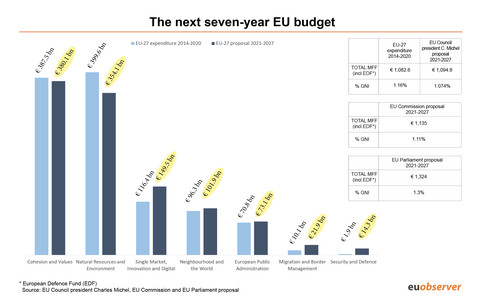
The 2021-2027 budget numbers in detail

Poorer member states want to reverse cuts to EU subsidies. Meanwhile all member states are also feeling the pressure to do more on climate, migration, digitalisation and foreign affairs.
National leaders have all criticised the EU Council president Charles Michel's attempt at a compromise, of 1.074 percent of GNI plus deep cuts in traditional policies.
"The proposal on the table is that we are going to do more with less: less persons, less money. And I don' know if Michel is now the twin brother of David Copperfield, but I don't know how this should work," Luxembourgish prime minister Xavier Bettel quipped on arrival at the summit, referring to the magician.
"This MFF negotiation will be very hard and difficult," Estonia's prime minister Juri Ratas warned as he made his arrival.
Poland's premier Mateusz Morawiecki went furthery, saying the discussions will be the "hardest-ever negotiations in history" for the EU.
"We cannot accept a dramatic increase of our piece [contribution]," Swedish PM Stefan Lofven said as he entered talks, adding: "Countries with stronger economies need to pay more, but we cannot accept such a dramatic increase."
"[After Brexit] it is a clear signal for our citizens to say Europe is alive and we can still function really well." Latvian prime minister Arturs Karins argued before the meeting, urging an agreement.
"It's a complicated task and we will have to overcome big differences," Germany's chancellor Angela Merkel conceded.
"Germany is not satisfied with the current status of negotiations," she added
EU leaders will first discuss among themselves, then will break into smaller groups, or hold bilateral meetings. Talks could go into Friday, or even perhaps Saturday morning.
One of the key issues is whether member states can agree to retain the rebate to Germany, Denmark, Sweden, Austria and the Netherlands, while other countries argue the concept should disappear because the original UK rebate is gone.
"I have infinite patience," Portugal's Antonio Costa said on arriving.
Read more: Unhappy EU leaders begin budget haggle
2/19/20
EU in turmoil: Is Europe Falling Apart?
Populism, nationalism, and internal griping are deeply, perhaps irreparably, damaging EU and NATO alliances.
Read more at:
https://www.commonwealmagazine.org/europe-falling-apart
Read more at:
https://www.commonwealmagazine.org/europe-falling-apart
2/15/20
'Europe can only be stronger with Russia,' claims Moldova's president
"I believe in a big Europe, from Lisbon to Vladivostok," Igor Dodon told Euronews.
Read more at:
https://www.euronews.com/2020/02/14/europe-can-only-be-stronger-with-russia-claims-moldova-s-president
Read more at:
https://www.euronews.com/2020/02/14/europe-can-only-be-stronger-with-russia-claims-moldova-s-president
2/9/20
France: Macron unveils nuclear doctrine, warns EU ‘cannot remain spectators’ in arms race
French President Emmanuel Macron on Friday unveiled his nuclear doctrine advocating a more coordinated European Union defence strategy in which France, the bloc's only post-Brexit nuclear power, and…
Read more at :
https://www.france24.com/en/20200207-macron-unveils-nuclear-doctrine-warns-eu-cannot-remain-spectators-in-arms-race
Read more at :
https://www.france24.com/en/20200207-macron-unveils-nuclear-doctrine-warns-eu-cannot-remain-spectators-in-arms-race
11/25/19
EU INTL.TRADE: EU needs to 'toughen up' on trade - by Urmas Paet
The European Union needs to step up its game to support the interests of
EU businesses, to counteract the increasingly agressive China and the
at times more self-centred United States.
Despite its size and wealth in the global context, the EU has not managed to play itself out as a strong global power. In order for the EU businesses to compete on a greater equal footing with companies from other countries the EU has to toughen up, reach a coherent foreign policy, harmonise its various foreign policy instruments and have stronger rules.
Currently, the EU is not ready to effectively face the significant changes in the world.
May it be a more forceful and aggressive China, Russia that raises security concerns or the increasingly isolationist United States. For instance, negotiations with China to open the Chinese market for European investments have been very slow.
And this example is only one of many where the EU has failed to use political power to achieve its economic goals and strengthen the position of its businesses.
To achieve its objectives, the EU must take use of all its foreign policy instruments.
Read more at: EU needs to 'toughen up' on trade
Despite its size and wealth in the global context, the EU has not managed to play itself out as a strong global power. In order for the EU businesses to compete on a greater equal footing with companies from other countries the EU has to toughen up, reach a coherent foreign policy, harmonise its various foreign policy instruments and have stronger rules.
Currently, the EU is not ready to effectively face the significant changes in the world.
May it be a more forceful and aggressive China, Russia that raises security concerns or the increasingly isolationist United States. For instance, negotiations with China to open the Chinese market for European investments have been very slow.
And this example is only one of many where the EU has failed to use political power to achieve its economic goals and strengthen the position of its businesses.
To achieve its objectives, the EU must take use of all its foreign policy instruments.
Read more at: EU needs to 'toughen up' on trade
11/8/19
EU needs to learn the 'language of power', incoming chief says
The European Union can no longer rely on soft power to promote its interests and must develop more security "muscle" and policy focus on trade, incoming European Commission President Ursula von der Leyen said on Friday.
In a speech on the state of Europe, von der Leyen stressed the EU’s strengths as a bastion of openness and democracy in a troubled world and said Brexit had forged a tighter group out of the remaining members of the bloc.
“We must go our own European way with confidence,” she said in Berlin. But she added: “Soft power alone won’t suffice today if we Europeans want to assert ourselves in the world. Europe must also learn the language of power.”
Read more at:
https://uk.reuters.com/article/uk-eu-commission-von-der-leyen/eu-needs-to-learn-the-language-of-power-incoming-chief-says-idUKKBN1XI2BM
In a speech on the state of Europe, von der Leyen stressed the EU’s strengths as a bastion of openness and democracy in a troubled world and said Brexit had forged a tighter group out of the remaining members of the bloc.
“We must go our own European way with confidence,” she said in Berlin. But she added: “Soft power alone won’t suffice today if we Europeans want to assert ourselves in the world. Europe must also learn the language of power.”
Read more at:
https://uk.reuters.com/article/uk-eu-commission-von-der-leyen/eu-needs-to-learn-the-language-of-power-incoming-chief-says-idUKKBN1XI2BM
Subscribe to:
Posts (Atom)