Advertise On EU-Digest

Annual Advertising Rates

7/28/17

Russia Sanctions: US Senate backs Russia sanctions, setting scene for EU clash - by Andrew Rettman

US senators have backed extra Russia sanctions, setting the scene for a clash with the EU and putting at risk a new gas pipeline.

The sanctions bill sailed through the Senate by 98 votes to two on Thursday (27 July) after having passed by 419 votes to three in the House of Representatives on Tuesday.

It will become law when signed by US president Donald Trump.

A Trump spokesman told the CNN broadcaster this week that “he may veto the sanctions”, which come despite his overtures for better relations with Russian leader Vladimir Putin.

But senators said he would be unwise to do that because the whopping majority in Congress would see his veto overturned.

"It’s typically not good for presidents to veto something that can be overwhelmingly overridden,” Bob Corker, a Republican senator, told press.

Chuck Schumer, a Democratic senator, said a veto would also harm Trump’s image amid ongoing investigations into his alleged collusion with Russia to sway last year’s US election.

"If the president vetoes this bill, the American people will know that he is being soft on Putin, that he’s giving a free pass to a foreign adversary who violated the sanctity of our democracy," Schumer said.

Note EU-Digest: Once again Russia has become the whipping boy for the US political establishment. 

When all else fails for US politicians who usually can't even agree among themselves what day of the week it is. 

Read more: Senate backs Russia sanctions, setting scene for EU clash

The Brexit Disaster: 'Billions' in regional aid needed to replace EU funding, councils warn - by Shaun Connolly

Councils will need billions of pounds in regional aid to replace EU regeneration funding after Brexit, local authority leaders have warned.

A report by the Local Government Association (LGA) stated that proposals to create a UK Shared Prosperity Fund to take over the financial assistance from Brussels so far lacked detail.

The LGA insisted such funding is vital to create jobs, support small firms and boost infrastructure.

Local authorities said the successor scheme to the European Structural and Investment Funds (ESIF) needed to be of at least equivalent size to the £8.4 billion the LGA said regeneration projects had been set to receive between 2014 and 2020 from Brussels.

“Current EU funding is allocated over a seven-year period. This long-term distribution must be maintained to allow for long-term planning. Funding must be easier to access and local areas need full control over how it is spent and what projects it is spent on.

"With national funding for regeneration increasingly being depleted, all local areas have become increasingly reliant on EU money and local areas are desperate to get on with creating jobs, building infrastructure and boosting growth
 
Read more: Brexit: 'Billions' in regional aid needed to replace EU funding, councils warn | The Independent

Middle East: US-trained Iraqi army unit 'linked to Mosul war crimes'

A US-trained Iraqi army division allegedly executed dozens of men in the final phase of the battle against ISIL fighters in Mosul's Old City, Human Rights Watch has claimed.

The rights group on Thursday urged the US government to suspend all support for the 16th Division of the Iraqi army pending an investigation into what it called war crimes, evidence of which was seen by two international observers whom the group did not name.

Videos have emerged of Iraqi forces beating unarmed men. Footage also showed one man being pushed off a cliff to his death.

"Given the widespread abuses by Iraqi forces and the government’s abysmal record on accountability, the US should take a hard look at its involvement with Iraqi forces," said Sarah Leah Whitson, Middle East director at Human Rights Watch.

Read more: US-trained Iraqi army unit 'linked to Mosul war crimes' | Iraq News | Al Jazeera

USA: Republican effort to gut Obamacare ends in defeat for Trump - by Y.Abutaleb, A.Becker and D.Morgan

In a stinging blow to President Donald Trump, U.S. Senate Republicans failed on Friday to dismantle Obamacare, falling short on a major campaign promise and perhaps ending a seven-year quest by their party to gut the healthcare law.

Voting in the early hours, three Republican senators, John McCain, Susan Collins and Lisa Murkowski, crossed party lines to join Democrats in a dramatic 49-to-51 vote to reject a "skinny repeal" bill that would have eliminated some parts of Obamacare.

"This is clearly a disappointing moment," Senate Republican leader Mitch McConnell told the Senate floor right after the vote. "The American people are going to regret that we couldn't find a better way forward."

The setback leaves Trump without a major legislative win after more than six months in power, even though Republicans control the White House, Senate and House of Representatives. He had been expected to make rapid changes to healthcare, taxes and infrastructure spending. 


Read more: Republican effort to gut Obamacare ends in defeat for Trump

7/27/17

Womens Rights Middle East: Tunisia passes landmark law to ‘end all violence’ against women

Tunisia’s parliament has approved a bill aimed at ending “all violence against women” in a move welcomed by rights groups.

The new law, which is expected to enter into force next year, defines violence against women as “any physical, moral, sexual or economic aggression” against women based on discrimination between the two sexes.

It includes the key elements of the definition of domestic violence recommended in the United Nations Handbook for Legislation on Violence against Women.

Read more: Tunisia passes landmark law to ‘end all violence’ against women - France 24

US Infrastructure: Decaying infrastructure taking a toll on America

America's infrastructure is in a state of crisis. Roads and train lines are old, dangerous and cost the country billions of dollars in economic growth. Trump wants to repair damages but he is at the mercy of investors.

The summer of hell began for New Yorkers last Monday. Beginning at four o'clock in the afternoon people hurried home from work, clogging midtown Manhattan's Pennsylvania Station.

Over 600,000 people trek to Manhattan daily from faraway places like New Jersey and Long Island, entering the city via Penn Station. More people transit through Penn Station than all three of New York's airports: JFK, LaGuardia and Newark. Yet on Monday many tracks were shut down for the summer so the city can begin tackling urgently needed repairs.

During his campaign, Trump promised trillions of dollars to tackle this issue. Yet a look at the budget says otherwise: The government will spend only $200 billion on the infrastructure package. The remaining $800 billion must come from states and municipalities - no major problem for wealthy states. But the rural areas remain in disrepair.

Decaying infrastructure taking a toll on America | Business | DW | 17.07.2017

Refugees in the Netherlands: 'The Netherlands has accepted only 2,100 refugees under EU quota scheme'

The Netherlands has so far taken in 2,100 refugees under the European quota plan drawn up in 2015 when some 160,000 refugees were forecast to arrive in Italy and Greece, broadcaster NOS reports.

The Netherlands had been set to accept some 9,000 people under the quota plan, but the actual numbers of people claiming refugee status in the two countries is far below expectations. In total, 25,000 people have been allocated help in another European country.

In June, judges in The Hague said the Netherlands does not have to take in any more refugees from camps in Italy and Greece than it has already has.

A foundation called We Gaan Ze Halen (we are going to fetch them) had taken the Dutch state to court, arguing that the Netherlands had not taken in enough asylum seekers under the terms of the EU resettlement deal.

The Netherlands has accepted only 2,100 refugees under EU quota scheme' - DutchNews.nl

Britain - Brexit: Demand to rent UK commercial property falls to 5-year low

Demand to rent British commercial property levelled off for the first time in almost five years during the past three months, as online shopping hurt high-street retailers and Brexit and election worries unsettled other potential tenants.

The Royal Institution of Chartered Surveyors said on Thursday that its gauge of commercial tenants’ demand for property fell to -2 for the second quarter of 2017, its lowest reading since the third quarter of 2012.

“The commercial property market has enjoyed a good run and it is hardly surprising that we are now seeing a flatter trend emerge … which chimes both with recent economic newsflow and the political environment,” RICS’s chief economist Simon Rubinsohn said.

Read more: Demand to rent UK commercial property falls to 5-year low – EURACTIV.com

Turkey and Israel trade barbs, as Erdogan says Jerusalem losing 'Islamic character'

Turkish President Tayyip Erdogan accused Israel on Wednesday of inflicting damage on Jerusalem's "Islamic character", in comments likely to further inflame regional tensions in a dispute over the Al-Aqsa mosque.

"Israel is harming Jerusalem's Islamic character," said Erdogan, whose roots are in political Islam, at an education conference in Ankara. "Nobody should expect us to remain silent against the double standards in Jerusalem."

Israel's foreign ministry responded swiftly with a stern statement denouncing the Turkish government and accusing it of behaving as though the Ottoman Empire still existed.

"It's absurd that the Turkish government, which occupies Northern Cyprus, brutally represses the Kurdish minority and jails journalists, lectures Israel, the only true democracy in the region," spokesman Emmanuel Nahshon said.

Turkey has troops stationed in Northern Cyprus, is battling armed Kurdish separatists in its southeast region and has jailed large numbers of journalists, academics and others it suspects of having supported an abortive military coup last year.

Note EU-Digest: one might not always agree with Israel, but they are the only true Democracy in the Middle East. Present day Turkey under Erdogan's leadership can certainly not claim to be a democratic country which respects human rights or the freedom of the press. 

Read more:Turkey and Israel trade barbs, as Erdogan says Jerusalem losing 'Islamic character' | Middle East Eye

7/26/17

EU and US dispute on Russia sanctions gets worse - by Andrew Rettman

The EU has threatened to retaliate against US sanctions on European firms that invest in Russian energy projects.

But a senior US diplomat has said there is a window of opportunity to “change the status quo” on Russia’s behaviour in Ukraine.

Jean-Claude Juncker, the European Commission chief, said on Wednesday (26 July) that “if our concerns are not taken into account sufficiently, we stand ready to act appropriately within a matter of days.”

“America first cannot mean that Europe's interests come last,” he said.

He did not clarify how the EU would "act", but a leaked internal memo this week indicated the Commission might seek to circumscribe US jurisdiction on the issue or to impose counter-sanctions on US firms.

Juncker said the EU was “fully committed” to previous Russia sanctions, but he said the new US measures could have “unintended unilateral effects that impact the EU's energy security interests”, such as repairs to Russia’s old gas pipeline network.

Note  EU-Digest: It is high time the EU starts to put their "money where their mouth is". There is no need for the EU to follow the US blindly in everything they do or suggest. Specially when it concerns such sensitive issues as sanctions. Also, the US political establishment's continuous efforts to make Russia "the whipping boy" for all the problems in the world, does not mean the EU is to follow in their foot-steps.

Read more: EU and US scrap on Russia sanctions gets worse

USA - Transgenders: Donald Trump’s transgenders ban announcement is met with swift backlash - Michael Glassman -

Immediately after President Donald Trump tweeted Wednesday that he was barring transgender Americans from serving in the military, the head of the U.S. armed forces was met with stunned disbelief over the slap in the face to thousands of service members.

Read more: Donald Trump’s transgender ban announcement is met with swift backlash - Salon.com

US President A Disgrace To America: Trump's ranting Jamboree speech branded 'embarrassing spectacle' by former Scouts - by C.Mindock

President Donald Trump’s speech to the 2017 National Scout Jamboree has been called a disgrace after the President broke from tradition and used his address to attack his political foes, and even threaten to fire some of his federal employees.

Speaking in Glen Jen, West Virginia, Mr Trump vowed early on not to discuss politics. Then, not soon after, he was labelling the press “fake news”, appropriating portions of the Scout Law to fit his needs, and re-airing grievances about the many people who doubted his 2016 election victory.

“Who the hell wants to speak about politics when I’m in front of the Boy Scouts?” Mr Trump had asked the crowd, which was mostly young men. He then shifted gears to talk about politics.

Note EU-Digest:What a disgrace for America and disrespect of Pres. Trump for Boy Scouts Organizations around the world   It is high time they come for him with a straight jacket to remove him from the White House, and put him where he mentally belongs.

Read more: Trump's ranting Jamboree speech branded 'embarrassing spectacle' by former Scouts | The Independent

7/25/17

USA -EU: Donald Populism: Trump-style populism has no chance in German election

The anti-establishment frustration that swept Donald Trump to power in the United States and led the UK to vote for Brexit exists in Germany, but in a much more moderate form, which will not ultimately be the deciding factor in the national elections in September.

That's the central conclusion of a Bertelsmann Foundation study of "populism" among people eligible to vote in the upcoming federal elections.

The researchers defined populism as hostility to the establishment, the belief that "the people" are basically a homogeneous group and the view that political leadership should be the direct expression of popular will. The study found that 29.2 percent of potential voters were thoroughly populist, 33.9 percent were somewhat populist and 36.9 percent were not populist at all.

Read more: Donald Trump-style populism has no chance in German election | News | DW | 25.07.2017

Sable Rattling: China and Russia combine naval forces in the Baltic Sea

According to NATO, a Chinese destroyer, frigate and supply ship sailed into the Russian harbor at Baltijsk located on the Baltic coast of the Russian exclave Kaliningrad on Friday. They are there to participate in joint naval maneuvers with Russia being dubbed "Maritime Cooperation 2017," which is set to last from July 24 to July 27.

This joint naval maneuver with Russia in the Baltic Sea is the latest display of China's geopolitical ambition as Beijing wants to increase its influence in international and strategic affairs.

China's emphasis on naval expansion is a sign of Beijing's awareness that becoming a world power first entails being a maritime power. For Russia, the maneuvers are a continuation of aggressive foreign policy and a display of strength on Europe's doorstep and the Baltic coast, where fears of Russian expansion are highest.

Read more: China and Russia combine naval forces in the Baltic Sea | Asia | DW | 24.07.2017

France: Which are the world's most influential countries?

France has risen to the top of a list of the world’s most influential countries following the election of Emmanuel Macron.

It replaced the US in the number one position in the Soft Power Index complied by the University of Southern California and PR firm Portland Communications.

Soft Power is a term used to describe the influence of a country beyond traditional political or military strength. It includes aspects such as culture, education, economics and even sport.

The Soft Power Index uses polling in 25 countries as well as measures such as the number of Michelin-starred restaurants and levels of digital engagement to rank nations against each other.

The report’s authors noted that the election of Donald Trump and the Brexit vote in the UK, weighed on both country’s statuses.

Read more: Which are the world's most influential countries? | Euronews

European Economy: A “Macroneconomic” Revolution? - byAnatole Kaletsky

Next month will mark the tenth anniversary of the global financial crisis, which began on August 9, 2007, when Banque National de Paris announced that the value of several of its funds, containing what were supposedly the safest possible US mortgage bonds, had evaporated. From that fateful day, the advanced capitalist world has experienced its longest period of economic stagnation since the decade that began with the 1929 Wall Street crash and ended with the outbreak of World War II ten years later.

Suppose, that the “progressive” economics of full employment and redistribution could be combined with the “conservative” economics of free trade and labor-market liberalization. Both macroeconomic and structural policies would then be easier to justify politically – and much more likely to succeed.

Could this be about to happen in Europe? France’s new president, Emmanuel Macron, based his election campaign on a synthesis of “right-wing” labor reforms and a “left-wing” easing of fiscal and monetary conditions – and his ideas are gaining support in Germany and among European Union policymakers. If “Macroneconomics” – the attempt to combine conservative structural policies with progressive macroeconomics – succeeds in replacing the market fundamentalism that failed in 2007, the lost decade of economic stagnation could soon be over – at least for Europe.

Read more: A “Macroneconomic” Revolution?

7/24/17

USA: A history of why the US is the only rich country without universal health care - by Annalisa Merelli

So why does the US, the only industrialized nation without universal health coverage, also have not only the highest health-care spending in the world—both in absolute terms and as a share of GDP—but also one of the highest levels of government spending on health care per person? And how did it come to be this way?

The answer is that the lack of universal coverage and high costs are intimately linked—both economically and historically.

Single-payer health-care (in which the government pays for universal coverage, typically through taxes) helps keep costs down for two reasons: It means that the government can regulate and negotiate the price of drugs and medical services, and it eliminates the need for a vast private health-insurance bureaucracy.

Currently, the US spends two to three times as much per capita on health care as most industrialized countries.

Click heren to read the complete report : Health care in the US: Why universal health care never happened — Quartz

Turkey Withdraws Blacklist to Ease Tensions With Germany - by Rainer Buergin and James Regan

Turkey withdrew a list of accusations against German companies, seeking to de-escalate tensions that flared last week between the two NATO allies.

German Interior Minister Thomas de Maiziere spoke with this Turkish counterpart Monday, and was told the almost 700 accusations involving German companies were a “communication problem,”

Interior Ministry spokesman Tobias Plate said in Berlin. Turkey’s interior ministry said no German company is being investigated by Turkey and last week’s complaint was a misunderstanding that has now been cleared up.

German federal police on Friday declined to investigate the claims, saying the Turkish list didn’t contain anything concrete enough to warrant follow up. German media reported some items included allegations of working with local entities linked to terror organizations.

The detention of a German human-rights activist in Istanbul last week, led to a war of words between the two countries, the culmination of months of discord over NATO troop visits, imprisoned journalists and Turkish Nazi references. Chancellor Angela Merkel’s veteran finance minister, Wolfgang Schaeuble, on Friday compared Turkey to the former communist East Germany, while Turkish Foreign Minister Mevlut Cavusoglu said his country wouldn’t give in to threats or “blackmail.”

Read more: Turkey Withdraws Blacklist to Ease Tensions With Germany - Bloomberg

Global Economy: IMF cuts 2017 growth forecasts for UK and US - by Larry Elliott

The International Monetary Fund has cut its growth forecast for the UK economy this year after a weak performance in the first three months of 2017.

In its first downgrade for the UK since the EU referendum in June last year, the IMF said it expected the British economy to expand by 1.7% this year, 0.3 points lower than when it last made predictions in April.

The Fund raised its forecasts for the UK after the Brexit vote as a result of the much stronger than envisaged activity in the second half of 2016. In October 2016, it pencilled in growth of 1.1% for 2017, raising this forecast to 1.5% in January this year and to 2% in April.

Maurice Obstfeld, the IMF’s economic counsellor, pointed to a marked change in early 2017. He said the UK’s growth forecast had been lowered based on its “tepid performance” so far this year, adding: “The ultimate impact of Brexit on the United Kingdom remains unclear.”

The IMF left its growth forecast for the UK in 2018 unchanged at 1.5% but said one key risk facing the global economy was that the Brexit talks would end in failure.

It contrasted its gloomier outlook for the UK with a rosier forecast for the rest of the EU, with 2017 growth upgrades for the four biggest eurozone countries – Germany, France, Italy and Spain.

Germany has been revised up by 0.2 points to 1.8%, France by 0.1 points to 1.5%, while Italy and Spain have both been revised up by 0.5 points to 1.3% and 3.1% respectively.

The Fund produces a world economic outlook in April and October to coincide with its spring and annual meetings, but provides updates in January and July.

Launching the report in Kuala Lumpur, Obstfeld said the IMF had left its global growth forecasts unchanged at 3.5% in 2017 and 3.6% for next year, noting that the stronger performance by the eurozone, China and Japan had been offset by weaker performances elsewhere.

“The recovery in global growth that we projected in April is on a firmer footing; there is now no question mark over the world economy’s gain in momentum,” Obstfeld said.

He added that Donald Trump’s failure so far to push through his promised package of tax cuts had dampened US growth prospects.

“From a global growth perspective, the most important downgrade is the United States,” he said.

“Over the next two years, US growth should remain above its longer-run potential growth rate. But we have reduced our forecasts for both 2017 and 2018 to 2.1% because near-term US fiscal policy looks less likely to be expansionary than we believed in April.”

Read more:IMF cuts 2017 growth forecasts for UK and US | Business | The Guardian

Poland: EU Commission unmoved by Polish president's veto - by Eszter Zalan

Andrzej Duda decided to veto two of the controversial draft laws, which would put the judiciary under political control, but the EU executive is awaiting details before deciding on whether to launch legal probes on Wednesday

The commission's spokesman, Margaritis Schinas, said the EU executive is “following the events and situation in Poland very closely".

"Things are changing even as we speak," Schinas told reporters only two hours after Duda's announcement.

He confirmed that the college of EU commissioners will discuss the situation in Poland on Wednesday, and decide on the next steps.

"All developments, and all the changes that are going on will be addressed by the commission on Wednesday,” he said.

"This is a political commission, this is up to the political masters to discuss," he added, but declined to call Duda’s veto a positive development.

Read more: EU Commission unmoved by Polish president's veto

7/23/17

IMF conditions weaken labor rights, World Bank labor policy inconsistent - Bretton Woods Project

A March IMF policy paper on Labour and product market reforms in advanced economies: fiscal costs, gains, and support postulated that, “persistently sluggish growth has led to growing policy emphasis on the need for structural reforms that improve the functioning of labour and product markets in advanced economies”. Amongst the reforms considered are “lower entry barriers for firms” and “reducing the level or duration of unemployment benefits where particularly high” during weak cyclical conditions.

Its main findings included that such reforms can raise output and thus strengthen public finances, for example, “unemployment benefit reforms improve fiscal outcomes both indirectly and directly through lower spending.” In line with IMF policy, the report makes a case for temporary fiscal stimulus but only where there is “available fiscal space” (see Update 55), although “a strong commitment to reforms is an essential prerequisite.”

Commenting on the paper, Cambridge University political scientist Bernhard Reinsberg found that “it is laudable that the IMF acknowledged that fiscal stimuli may be necessary not only to stimulate the economy after a financial crisis but also to facilitate structural reform.” However, he questioned the study’s assumption that labor market reforms are necessary to unleash growth. He cautioned that “labor regulations are vital to the protection of worker interests in marginalised places of the global economy. The results presented in the IMF staff note thus cannot be applied to the majority of countries around the globe.”

Read more: IMF conditions weaken labour rights, World Bank labour policy inconsistent - Bretton Woods Project

US Government: Republicans are in full control of government — but losing control of their party - by S.Sullivan and R.Costa

Six months after seizing complete control of the federal government, the Republican Party stands divided as ever — plunged into a messy war among its factions that has escalated in recent weeks to crisis levels.

Frustrated lawmakers are increasingly sounding off at a White House awash in turmoil and struggling to accomplish its legislative goals. President Trump is scolding Republican senators over health care and even threatening electoral retribution. Congressional leaders are losing the confidence of their rank and file. And some major GOP donors are considering using their wealth to try to force out recalcitrant incumbents.

“It’s a lot of tribes within one party, with many agendas, trying to do what they want to do,” Rep. Tom MacArthur (R-N.J.) said in an interview.

Read more: Republicans are in full control of government — but losing control of their party - The Washington Post

Social Media: Protect your privacy and ward off trolls on social media - by David Nield

On social media, you get to catch up with old friends, make new connections, and coo over cute baby photos. Although you're supposed to enjoy these visits to Facebook, Twitter, and Instagram, a persistent commenter or obnoxious "friend" can ruin your experience. That's why these services provide ways for you to fight back. Here are the steps you can take to protect your privacy and slay trolls on three of the world's biggest social networks.

Unlike Twitter and Instagram, which we discuss below, Facebook doesn't make your posts visible to the whole internet by default. So other users will only see your photos, links, and other information if you have chosen to friend them. You can adjust this extra layer of protection every time you post by choosing to make the update public or to restrict it to only a certain number of friends.

You can select who gets to see your own posts, but that doesn't stop your friends from tagging you in public posts. To prevent people from posting on your timeline or tagging you in photos, you can limit this activity from your Timeline and Tagging settings page. One of the options lets you review any tags you're mentioned in before they appear in your News Feed.

If you've friended someone, but they start giving you unwanted attention, you can easily cut off their access: Head to their profile page and clicking on the Friends button to find the Unfriend option. That person won't get an alert that they've been unfriended, but they might notice if they load up your profile and see the Add Friend option.

For the complete report go to: Read more Protect your privacy and ward off trolls on social media | Popular Science

7/22/17

US Opioid Crisis: How The US Can Contain And Reverse The Epidemic-by Denisse Moreno

While President Trump’s national opioid commission, headed by New Jersey Gov. Chris Christie, failed to meet its second deadline last week, a report released this month recommends various measures federal, state and local officials should take to tackle the epidemic.

The report from the National Academies of Sciences, Engineering and Medicine, requested by the U.S. Food and Drug Administration (FDA), said it will take years of “sustained and coordinated efforts” to “contain and reverse the harmful societal effects of the prescription and illicit opioid epidemics,” which go hand-in-hand and continue to spiral.

Read: More Than Half Of US Opioid Prescriptions Go To People With Mental Disorders, Researchers Find

About 90 people in the U.S. die of an opioid-related overdose every day, according to the Centers for Disease Control and Prevention. As of 2015, at least 2 million people across the nation have an opioid addiction, while nearly 600,00 have an opioid use disorder involving heroin. The number of opioid-related overdose fatalities, which includes prescription opioids (such as oxycodone, hydrocodone, and methadone) and heroin, has quadrupled since 1999. At the same time, the amount of prescription opioids sold in the U.S. has nearly quadrupled since that year.

Read more: Opioid Crisis: How The US Can Contain And Reverse The Epidemic

EU Citizenship Has Its Obligations: ′You belong here,′ Foreign Minister Sigmar Gabriel tells Germany′s Turks

Less than 48 hours after announcing a major shift in policy towards Turkey, German Foreign Minister Sigmar Gabriel on Saturday sought to calm fears among Turkish nationals living in Germany that they are not targets in an ongoing political row.

Gabriel penned an open letter, published in German and Turkish in the mass circulation newspaper Bild, where he called the friendship between Germans and the estimated 3 million Turks living in the country a "great treasure."

His message followed a further week of wrangling between the two countries following the jailing by a court in Istanbul of several human rights activists - including German national Peter Steudtner - accused of what Germany says are the trumped-up charges of being linked to a terrorist organization.

Note EU=Digest: Very true.This also goes for immigrants to any country in the world. You can't have your cake and eat it too! In case you do prefer your home country over the one where you immigrated to, nothing stops you to go back from where you came. It must also be noted that Governments of  former citizens, who immigrated to other countries, and became citizens there, also have no right to claim authority or any rights over these former citizens.  

Read more: ′You belong here,′ Foreign Minister Sigmar Gabriel tells Germany′s Turks | News | DW | 22.07.2017

EU - Polish relations: Polish parliament steps up showdown with EU - by Eric Maurice

The Polish parliament adopted a controversial reform of the Supreme Court on Thursday (20 July), stepping up a showdown with the EU.

The law, which puts the Supreme Court under government control, was passed with 235 votes against 192 and 23 abstentions, just a day after the European Commission had called on Polish authorities to suspend the bill or face a rule of law procedure that could lead to sanctions.

"We are coming very close to triggering Article 7," the EU executive vice president Frans Timmermans warned on Wednesday, referring to a rule of law procedure.

The vote led the president of the European Council, Donald Tusk, who is a former Polish prime minister, to publish a statement calling for a solution to a "very serious situation".

Tusk said that he proposed a meeting with Polish president Andrej Duda to try to avoid "bleak outcomes which could ultimately lead to the marginalisation of Poland in Europe."
He said that the reforms carried out by the Polish government were a "dangerous tendency".

Read more: Polish parliament steps up showdown with EU

7/21/17

GMO Agenda Takes An Alarming Step Forward. US EPA Just Quietly Approved Monsanto/Dow’s RNAi Corn – by A.Erickson

Varying opinions on the rise and prominence of GMOs has led to a lot of controversy. Many people, regardless of their stance, still feel entitled to know what they’re consuming, and if it’s the product of laboratory research.

vSnf7 dsRNA is an insecticide, but unlike others, it’s not sprayed on crops. To use it, you encode instructions for manufacturing it in the DNA of the crop itself. So, for instance, if a Western corn rootworm begins destroying your crop, the plant’s self-made DvSnf7 dsRNA interferes with a critical rootworm gene and kills the pesky bugger.

This disruption is referred to as RNA interference, or RNAi. Haven’t heard of it? That’s because it was just approved. Didn’t hear that news? That’s because mainstream media remained silent, allowing the Environmental Protection Agency to recently approve the first insecticide relying on it.

The first DvSnf7 dsRNA product will come in the form of SmartStax Pro, a line of genetically modified corn seeds created by Monsanto and Dow. The RNAi part comes from Monsanto. The agricultural giant anticipates corn seed with RNAi coming to the market by the end of this decade.

The Western corn rootworm has proved quite resilient, with corn farmers continuously investing in new ways to stop it from damaging their cornfields. When spray-on pesticides failed, farmers took advantage of corn genetically modified to make the Bt toxin, a technology also from Monsanto, which also didn’t work as hoped for. Now, the farmers are eagerly awaiting the arrival of SmartStax Pro, which will have both Bt as well as DvSnf7 dsRNA.

Read more: The GMO Agenda Takes An Alarming Step Forward. The EPA Just Quietly Approved Monsanto/Dow’s RNAi Corn – Collective Evolution

Turkish Tourist Industry Hit Again: Turkey and Greece hit by strong earthquake: - by Helena Smith

Two people were killed, 200 injured and five seriously injured on the Greek island of Kos after an earthquake hit tourist destinations around the Aegean sea in the early hours of Friday.

At least 70 people were injured in Bodrum.Turkey.

The magnitude 6.7 quake injured a further 200 people in Greek and Turkish coastal towns.

The damage was, however, much less than could have been expected for an earthquake of its size. The United States Geological Survey said it was a very shallow quake – only 6 miles (10km) below the seabed – off the south-western coastal city of Marmaris in MuÄŸla province, Turkey.

The epicentre was just 6 miles south of the Turkish resort of Bodrum and 10 miles from Kos.

Read  more: Turkey and Greece hit by strong earthquake: two dead and 200 injured – as it happened | World news | The Guardian

Steel Industry: EU proposes duties on Brazil, Iran, Russia, Ukraine steel

The European Union is planning to impose duties of up to 33 percent on hot-rolled steel imports from Brazil, Iran, Russia and Ukraine to counter what it sees as unfairly low prices, according to a document seen by Reuters.

The EU has over 40 anti-dumping measures to aid European steel producers, mostly aimed at China. 

In June, the bloc set duties of up to 35.9 percent on Chinese hot-rolled steel, prompting an angry response from Beijing. 

Steel is the second biggest industry in the world after oil and gas and the EU's attention has recently shifted as barriers aimed at cheap Chinese imports have an impact.

Read more: EU proposes duties on Brazil, Iran, Russia, Ukraine steel

Britain Return To The Fold: 9 ways Britain could stay in the European Union

While undoing Brexit altogether looks almost as unlikely today as it did in the immediate aftermath of the referendum last year, those who think Britain might be better off staying in the European Union are becoming more vocal as the complexities and potential costs of Brexit become clearer.

Vince Cable — who was crowned leader of the Liberal Democrats unopposed Thursday — has never supported leaving the bloc and is “beginning to think Brexit may never happen.” Former U.K. Prime Minister Tony Blair last weekend suggested the U.K. could stay in a reformed European Union. Even the director of the Vote Leave campaign, Dominic Cummings, admitted on Twitter this week that there are “some possible branches of the future” in which “leaving will be an error.”

Donald Tusk, the former Polish prime minister and European Council president, put it more poetically last month. “You may say I am a dreamer. But I am not the only one,” he said, channelling John Lennon.

In Westminster, anti-Brexit dreamers are scarce but POLITICO spoke to some of those who believe Brexit could yet be halted. The political odds might be stacked against them, but then very few correctly predicted the referendum vote in the first place.

Here are nine scenarios in which Britain stays in the European Union:
1. Public opinion changes

Remainers have been heartened by a number of polls since the June 8 election which have suggested an uptick in support for staying in the European Union, including one by Survation that found 54 percent of Brits would now prefer to remain in the bloc.

However Joe Twyman, head of political and social research at YouGov, which has been monitoring public opinion since the referendum, said the shifts in views had been too small to point of a definitive change of heart. He said the country was still divided down the middle, much as it was in the referendum vote itself but added that “things could change massively.”

“It is almost certain that as things do actually start to occur then there could be a movement in one way or another. People could say ‘this is working out really well, yay us.’ And so support for Brexit rises significantly. The opposite could be true if things go wrong.”

The main political parties are all monitoring the situation through private polling, according to Twyman. The “smart ones” understand the fluid nature of [public opinion] and are aware that polls could change significantly.

Read more: 9 ways Britain could stay in the European Union – POLITICO

Brext: No solution in sight for Brexit’s controversial issues – by Jorge Valero

During a second sitting around the negotiating table, the EU and the UK stuck to their guns on the financial obligations London should pay and what court would guarantee EU citizen rights in a post-Brexit world.

Following a first encounter last month, the negotiating teams led by Michel Barnier, on the EU side, and David Davis, on the British side, concluded on Thrusday (20 July) a four-day round of talks to set the terms of Britain’s departure from the EU.

But the negotiations barely managed to spot areas of disagreement that have already been identified.

As expected, the financial settlement London must cover and the European Court of Justice’s role in ensuring citizen rights were the most controversial issues.

But both sides could not even start sketching out the bare bones of a compromise as Britain came to Brussels empty handed.

Read more: No solution in sight for Brexit’s controversial issues – EURACTIV.com

German French Relations: Schulz to Macron: Forget Merkel, I’m your man

Martin Schulz, the Social Democrat candidate for chancellor in Germany’s election this fall, paid a visit to Paris with a message for French President Emmanuel Macron: I’d be a better partner than Angela Merkel.

In a speech at Sciences Po university on Thursday, the former European Parliament president called for a “new political departure, an impetus for the future.”

“Germany and France — not alone, but of course with other partners — should be that impetus,“ Schulz said. “And I am addressing the French president directly.“

“After the presidential election in France and the Bundestag election in Germany in the autumn, there is a time window that must be used,” he added, offering his support for a series of EU reforms proposed by Macron.

Read more: Schulz to Macron: Forget Merkel, I’m your man – POLITICO

7/20/17

Cybersecurity: Russia in talks with US to create cybersecurity working group: says Russian Press Agency

Moscow and Washington are in talks to create a joint cyber security working group, Russia's RIA news agency reported on Thursday, citing Andrey Krutskikh, a special presidential envoy on cybersecurity.

U.S. President Donald Trump said earlier this month he had discussed the idea of creating such a group with President Vladimir Putin at a summit of the Group of 20 nations in Hamburg, Germany.

But the idea was greeted with incredulity by some senior Republicans who said Moscow could not be trusted - and the U.S. president later tweeted that he did not think it could happen.

"The talks are underway ... different proposals are being exchanged, nobody denies the necessity of holding the talks and of having such contacts," Krutskikh said, according to RIA. Svetlana Lukash, a Russian official who was at the Hamburg summit, said earlier this month that the two presidents had agreed to discuss cyber security questions, either via the United Nations or as part of a working group.

To read more click here

Poland: Rule of Law in Jeopardy: Polish parliament approves controversial Supreme Court bill

Poland’s lower house of parliament adopted on Thursday (20 July) a controversial Supreme Court bill, setting the country further on collision course with Brussels, which has accused it of undermining the basic principles of the rule of law.

The Sejm passed the bill — which the European Commission, legal experts and the Polish opposition say will abolish the judiciary’s independence — with the vote of 235 deputies. Against were 192 deputies and 23 abstained.

The European Commission will meet next week to decide whether to activate Article 7 against Poland — a last-resort measure to rein in member states seen as violating the basic human rights and the rule of law. If approved, Poland could temporarily be stripped of its voting rights in the European Council.

Read more: Polish parliament approves controversial Supreme Court bill – EURACTIV.com

Germany Turkish Relations: Germany says EU aid to Turkey could be halted over arrests

Germany raised the possibility on Wednesday (19 July) of suspending European Union aid payments to Turkey after summoning Ankara’s ambassador to Berlin to protest over the arrest of six human rights activists including a German citizen.

The moves mark a further escalation of tensions between NATO allies Germany and Turkey, who are at loggerheads over a wide range of issues.

This month, Turkey arrested rights activists including Amnesty International’s Turkey head Idil Eser and German citizen Peter Steudtner on terrorism charges, which Berlin has labelled “absurd”.

Read more: Germany says EU aid to Turkey could be halted over arrests – EURACTIV.com

7/19/17

The Netherlands: Dutch Government hires almost a fifth more external staff

The Dutch government has spent almost a fifth more on hiring in workers and consultants in the last two years, claims the AD on Friday. Despite calling for other firms to reduce the amount of flexible working, the paper says, the government has not got its own house in order. It has investigated external hiring by Dutch ministries, provincial bodies, municipal councils and water boards, saying that last year this cost €2.4 bn and 13% of staffing budgets. This was a rise of 19% on the previous year. But ministerial norms are to spend less than 10% of such costs on freelances, flexible workers and consultants. Leading the way was the tax office, which reportedly spent €272 million on outside staff in 2016, followed by the infrastructure and environment and the justice ministries. Mostly, says the AD, the hires related to IT staff. Zakaria Boufangacha, of the FNV union, told the AD that the situation was ‘disappointing and worrying.’

Read more at DutchNews.nl: Government hires almost a fifth more external staff http://www.dutchnews.nl/news/archives/2017/07/government-hires-almost-a-fifth-more-external-staff/

The Dutch government has spent almost a fifth more on hiring in workers and consultants in the last two years, claims the AD on Friday. Despite calling for other firms to reduce the amount of flexible working, the paper says, the government has not got its own house in order. It has investigated external hiring by Dutch ministries, provincial bodies, municipal councils and water boards, saying that last year this cost €2.4 bn and 13% of staffing budgets. This was a rise of 19% on the previous year. But ministerial norms are to spend less than 10% of such costs on freelances, flexible workers and consultants. Leading the way was the tax office, which reportedly spent €272 million on outside staff in 2016, followed by the infrastructure and environment and the justice ministries. Mostly, says the AD, the hires related to IT staff. Zakaria Boufangacha, of the FNV union, told the AD that the situation was ‘disappointing and worrying.’

Read more at DutchNews.nl: Government hires almost a fifth more external staff http://www.dutchnews.nl/news/archives/2017/07/government-hires-almost-a-fifth-more-external-staff/
Dutch Government flex workers 
hiring rise of 19% over last year
The Dutch government has spent almost a fifth more on hiring in workers and consultants in the last two years, claims the AD newspaper.

Despite calling for other firms to reduce the amount of flexible working, the paper says, the government has not got its own house in order. 
It has investigated external hiring by Dutch ministries, provincial bodies, municipal councils and water boards, saying that last year this cost €2.4 bn and 13% of staffing budgets.

This was a rise of 19% on the previous year. But ministerial norms are to spend less than 10% of such costs on freelances, flexible workers and consultants.

Leading the way was the Government tax office, which reportedly spent €272 million on outside staff in 2016, followed by the infrastructure and environment and the justice ministries. Mostly, says the AD, the hires related to IT staff.

Zakaria Boufangacha, of the FNV union, told the AD that the situation was ‘disappointing and worrying.’

Read more: Government hires almost a fifth more external staff - DutchNews.nl

Mafia money pollutes the EU economy - by E. Bianchini, M. Castigliani, G.Pipitone, M.Portanova

Major profits from large-scale illegal activities have to be laundered to enter the so-called clean economy.

The money laundering itself is increasingly done by external specialised groups, which take a 5-8 percent cut for the service, Europol, the EU's police agency, says.

When only considering the Italian mafias, a 2016 report by the EU's judicial cooperation agency, Eurojust, notes their infiltration into the legitimate economy in "Spain (particularly favoured by the Italian Camorra), the Netherlands, Romania, France, Germany, and the UK."

They are doing this primarily through "real estate investments and participation in public or private contracts, particularly in the field of construction, public utilities and waste disposal," the report says.

The Transcrime Organized Crime Portfolio (OCP), edited by Paolo Savona and Michele Riccardi, also notes "cases of organised crime investments were found in almost all EU member states (24 out of 28)", predominantly in Italy, France, Spain, the United Kingdom, the Netherlands, Germany, and Romania.

Dirty money, the OCP study says, is mostly "in areas with a historically strong presence of organized crime groups (e.g. southern Italy), in border regions, or in areas which may play a crucial role in illicit trafficking (e.g. Andalusia, or Rotterdam and Marseille with their harbours), large urban areas (e.g. London, Amsterdam, Madrid, Berlin) and tourist or coastal areas (e.g. Côte d’Azur, Murcia, Malaga or European capitals).

Southern Spain, for example, attracts dirty money from Italian mafias, Russian criminals and northern European biker gangs.

In recent years, criminal investments focused on "renewable energy, waste collection and management, money transfers, casinos, VLT, slot machines, games and betting".

The cornerstone of the fight against organised crime is undoubtedly an EU directive from 3 April 2014 on the freezing and confiscation of the proceeds of crime in the EU.

On 7 October 2016, the EU parliament approved the report on the fight against corruption, prepared by an Italian MEP, Laura Ferrara, which partially adopts the work of Alfano's special committee.

The report's 35 pages echoes the same wish-list to the EU commission, that the offence of "criminal association regardless of consummation of criminal ends" should be punishable.
And yet, there has still been very little progress. It's like a broken record.

Read more: Mafia money pollutes the EU economy

USA: Have and have not's: There's a large group of Americans missing out on the American dream

There’s a growing tendency for mainstream economists, including several of those at the Federal Reserve, to dismiss all income disparities as the product of a skills- or education gap, a misleading explanation given weak wage growth that points to ongoing weakness in the job market. 
\
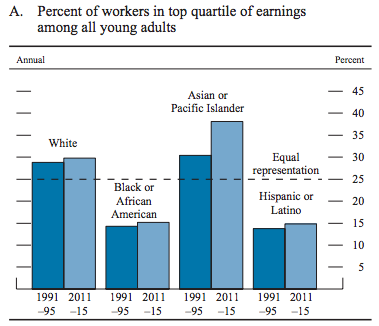
So it was relieving to see, tucked in the US central bank’s latest semi-annual report to Congress on monetary policy, an analysis of recent inequality research that refutes the idea that education is the only factor behind income inequality. Race, unsurprisingly, also plays a major role, as do social and economic measures, including taxation, interest rates, and labor policies. The Fed states:

“The persistent gaps in economic outcomes by race and ethnicity in the United States raise important questions about how people ascend the economic ladder. Education, particularly a college degree, is often seen as a path to improved economic opportunities.
“However, while education continues to be an important determinant of whether one can climb the economic ladder, sizable differences in economic outcomes across race and ethnicity remain even after controlling for educational attainment. Data on earnings for two cohorts of young adult workers (aged 25 to 34) approximately a generation apart confirm both the gaps in economic outcomes and the lack of substantial upward progress for disadvantaged groups over the past quarter-century.”

FeducationA
Foto: source Federal Reserve 
“Overall, the representation of black and Hispanic workers in the top earnings quartile continues to lag in the later period,” the report adds.

For the complete detailed report click here: There's a large group of Americans missing out on the American dream

EU Wellfare states: How Do European Welfare States Perform? "are there any left ?" - by M.A. Antonelli and V.De Bonis

The European Union is characterized by different national social polices (although they are less clearly demarcated than in the past).

The Nordic countries present high levels of social expenditure (around 30% of GDP in Denmark, Finland and Sweden), while the continental ones (Austria, Belgium, France, Germany and Luxembourg) have an intermediate level of expenditure (on average 27% of GDP in 2016) and the

Mediterranean countries (Italy, Spain, Greece and Portugal), allocate – on average- a quarter of GDP to social policies (2016). Finally, Anglo-Saxon (Ireland and the United Kingdom) and Eastern countries devote, on average, just 20% of GDP (2016) to welfare.

Based on these indicators, we construct a Performance Index (See here for details) which varies between zero and one where zero indicates the worst-performing and one the best.

For the complete detailed report click here: How Do European Welfare States Perform?

7/18/17

Germany - Alternative Energy: Combustion engine ban puts 600,000 German jobs at risk says controversial Ifo report

Alternative Enery Car Industry - a win-win situation
More than 600,000 jobs could be at risk in Germany from a potential ban on combustion engine cars by 2030, the Ifo economic institute said in a study commissioned by Germany's VDA car industry lobby.

Pollution from cars, including those with diesel engines, has become a sensitive subject in Germany since Volkswagen admitted to systematic cheating of emissions tests to mask levels of health threatening nitrogen oxides.

Cities such as Munich and Stuttgart are looking at banning older diesel cars, whose emissions they blame for causing an increase in respiratory diseases.

The Ifo study, published on Tuesday, said a switch to sales of zero-emission cars would threaten 426,000 car manufacturing jobs, with the rest coming from related industries, such as suppliers.

Two months before Germany's national elections, the government faces growing pressure to reduce emissions or face complete bans on diesel cars in some cities. Representatives of federal and regional governments will meet with carmakers on Aug. 2 to find ways to curb diesel-related pollution

Note EU-Digest: the study by the IFO is somewhat controversial, and one could even call it questionable, specially when it comes to the potential employment loss. Switching from combustion cars to other environmentally friendly automobiles, like electric or hydrogen powered cars, will certainly not cause a drop in the production of cars. To the contrary,it might even increase employment in the automobile industry, and most of all be a win-win when it comes to cleaning up the environment. 

Read more: Combustion engine ban puts 600,000 German jobs at risk: Ifo

USA - Health Care Disaster: Trump owns plenty of blame for health care defeat - by John Harwood


President Donald Trump's remarks conceding defeat on repealing and replacing Obamacare demonstrated why his first big effort failed in the first place.

To begin with, the president remains only loosely attached to his own team. He referred to his Republican allies in Congress as "they," while casting himself passively as "sitting in the Oval Office ... pen in hand, waiting to sign something."

"For seven years, I've been hearing 'repeal and replace' from Congress, and I've been hearing it loud and strong," Trump told reporters at a photo op. "And then when we finally get a chance to repeal and replace, they don't take advantage of it. So, that's disappointing."

Second, Trump continued to display no understanding of health-care issues themselves. He again touted an alternative to Obamacare "with much lower premiums, much lower costs, much better protections."

If such a plan existed, congressional Republicans would have figured it out over the last seven years and passed it this year. Trump's summary assessment — "something will happen, and it will be very good" — showed that he doesn't have one either.

Third, his thinly staffed administration lacks an effective team to develop, push through Congress and implement a new system. As Trump dined at the White House to plot strategy with Senate leaders, he and his aides had no idea that GOP Sens. Mike Lee of Utah and Jerry Moran of Kansas at that moment were sinking their plans.


Read more: Trump owns plenty of blame for health care defeat

Middle East: EU puts sanctions on Syrian scientists, military officials

The European Union imposed sanctions on 16 Syrian scientists and military officials Monday for their suspected involvement in a chemical attack in northern Syria in April that killed scores of civilians.

The U.N.’s chemical watchdog, the OPCW, last month concluded that the nerve agent sarin was used as a chemical weapon in the April 4 attack in the Syrian town of Khan Sheikhoun that killed at least 87 people including children.

Western intelligence agencies accuse the government of Bashar Assad of carrying out the attack, arguing that rebels in the area would not have had the capabilities.

Read more: EU puts sanctions on Syrian scientists, military officials | News , Middle East | THE DAILY STAR

7/17/17

The Netherlands: Dutch nationals taking UK citizenship 'will lose Netherlands passports' - byDaniel Boffey

Dutch nationals who take British citizenship to avoid having to leave the UK after Brexit will be stripped of their Netherlands passports due to existing limits on dual nationality, the Dutch prime minister has said.

About 100,000 Dutch nationals living in Britain face an uncertain future after March 2019. The UK and EU are yet to reconcile their differences on the citizens’ rights issue, with Brussels describing the British government’s initial offer as vague and inadequate.

Mark Rutte told Dutch citizens in the UK who have considered becoming British to avoid residency problems once Britain leaves the EU that applying for dual nationality was not an option.

“Countering dual nationality remains one of this cabinet’s policies,” the prime minister said on Monday, in response to a petition with 22,000 signatures calling for a government rethink.

Read more: Dutch nationals taking UK citizenship 'will lose Netherlands passports' | World news | The Guardian

Social Media and Government: Facebook says it shouldn’t have to stay mum when government seeks user data - by A.E. Marimow

Major technology companies and civil liberties groups have joined Facebook in a closed courtroom battle over secret government access to social media records.

Facebook is fighting a court order that prohibits it from letting users know when law enforcement investigators ask to search their political communications — a ban that Facebook contends tramples First Amendment protections of the company and individuals.

Most of the details of the case in the nation’s capital are under wraps, but the timing of the investigation, and references in public court documents, suggest the search warrants relate to demonstrations during President Trump’s inauguration.

More than 200 people were detained and many have been charged with felony rioting in the Jan. 20 protests that injured police and damaged property in an area of downtown Washington.

Read more: Facebook says it shouldn’t have to stay mum when government seeks user data - The Washington Post

European Social Democracy: Is Social Democracy Facing Extinction In Europe? - by Davide Vittori

The last French presidential election and the recent legislative elections confirmed a seemingly unstoppable declining trend in the electoral support of social democratic parties. For the second time in the last fifteen years, the official candidate of the French Socialist Party (PS) was excluded from the second round; in both cases, the “outsider” was represented by the candidate of the Front National (FN).

The legislative election confirmed this trend: the PS and its allies received only 9.5% of the vote. Before the French elections, the Labour Party (PvdA) in the Netherlands (5.7%) received a similarly cataclysmic result. This built on other high profile losses for social democratic parties in recent years, notably PASOK’s decline in Greece in 2012 (13.2%), which represented a turning point for the Greek political system. Between these results, other social democratic parties have suffered heavy losses, either as incumbents or as parties in opposition. 

For the complete report click here: Is Social Democracy Facing Extinction In Europe?

7/16/17

US Politics: How Did Democrats Become the Party of Elites? - by Leonard Steinhorn

How did it come to pass that of the two political parties, the Democrats — who have long fought for the underdog, civil rights, consumer protections, universal health care, the minimum wage and for unions against powerful interests that try to crush them — have now been branded in large swaths of the country as the party of the establishment and the elites?

And how did it come to pass that Republicans — whose policies, regardless of stated intent, benefit polluters, entrenched interests and the upper brackets of American wealth — are now seen by many as the anti-establishment populist party which delights in flipping off elites on behalf of the Everyman?

If Democrats want to regain their electoral stride and recapture defiant voters who once saw the party as their advocate and voice — the same voters they need to establish a sustained governing majority throughout the land — they must think less about policies per se than about how those policies translate to messaging and brand

For the complete report click here : How Did Democrats Become the Party of Elites? | Alternet

Brexit: German politicians tell Irish counterparts ‘British are a disgrace’ - Lucy Pasha-Robinson

 Senior German politicians reportedly launched a scathing attack on their British counterparts, calling them a “disgrace” and labelling their response to Brexit “farcical” during a meeting in the Bundestag.

Irish and German figures gathered at an Oireachtas delegation held by the German Parliament’s finance committee to discuss Brexit.

Fine Gael senator Ray Butler, who attended the meeting, said the German politicians were speaking after a recent visit to Westminster.

“They said they were making it up as they went along and were very poorly prepared for Brexit.

“It was actually farcical, is what they said. They came out of the meeting very bemused and annoyed.”

Independent senator Gerard Craughwell said the group raised “deep concerns” over how prepared the UK was for Brexit.

“They found the British finance committee unprepared for Brexit and said they didn't seem to have considered the impact leaving the EU would have on Britain's economy,” Mr Craughwell said.

A report documenting the Bundestag visit recorded both German and Irish politicians as being disappointed by Britain’s decision to leave the EU.

Brexit: German politicians tell Irish counterparts ‘British are a disgrace’ | The Independent

Technology:Europe struggles to attract tech talent even as US closes doors – by J.Plucinska and S.Saeed

U.S. President Donald Trump’s moves on immigration are bad news for ambitious tech workers. That should be good news for Europe’s talent-hungry digital hubs.

That sets the stage for Amsterdam, Berlin or Paris to become the next global magnet for engineers, coders and entrepreneurs.

Yet Europe is struggling to surmount multiple barriers. It’s considered one of the least-tolerant continents toward migrants as populist movements continue to sway public opinion, said Eugenio Ambrosi, the regional director of the EU, Norway and Switzerland office of the International Organization for Migration.

Meanwhile, the Continent’s reputation for tech investment remains weak, and its inability to grow the next European Google or Facebook makes it a less desirable place for ambitious workers, politicians, civil society and the industry agree.

On top of that, EU lawmakers and members of the tech community say the Continent hasn’t embraced a 2009 Blue Card directive, intended to establish an easy-to-use, universal visa program for highly skilled workers. A revamp proposed by the European Commission last year is stuck in interinstitutional infighting.

Note EU-Digest: The EU is getting a great opportunity here to benefit from the "Trump Administration immigrant fear" to move this highly qualified stream of tech experts, which is now being blocked by the US, into the EU's rapidly expanding technology market, which has a lack of skilled experts.  Come on EU Parliament and Commission,  don't keep sitting on your hands, put your money where your mouth is. Get the 2009 Blue Card directive fully activated and functional. It is beneficial to the EU economy.and even to you as EU politicians.   

Read more: Europe struggles to attract tech talent even as US closes doors – POLITICO

7/15/17

Middle East: Syria talks conclude in Geneva with no breakthrough

The seventh round of intra-Syria talks aimed at helping to end the country's six-year-old war wrapped up with "no breakthrough, no breakdown".

UN Syria envoy Staffan de Mistura said on Friday the Syrian government has not budged in its unwillingness to discuss political transition at the talks in Geneva while President Bashar al-Assad's representatives have pursued an almost incessant theme of the fight against "terrorism"..

Read more: Syria talks conclude in Geneva with no breakthrough | Syria News | Al Jazeera

TERRORISM: Saudi terrorism support 'dwarfs' Qatar's says US Rep. Senator Bob Corker

An influential US Republican senator has criticised the Saudi Crown Prince, Mohammed bin Salman, over a blockade on Qatar by the kingdom and three other Arab states.

The comments by Bob Corker, chairman of the US Senate Foreign Relations Committee, came as tensions in the region continue over the crisis, with US Secretary of State Rex Tillerson expected to make an unscheduled stop in Doha on Thursday.

"The amount of support for terrorism by Saudi Arabia dwarfs what Qatar is doing," Corker said on Wednesday.

Saudi Arabia, the United Arab Emirates (UAE), Bahrain and Egypt cut ties with Qatar on June 5 and imposed a land, air and sea blockade on the country.

Read more: Bob Corker: Saudi terrorism support 'dwarfs' Qatar's | News | Al Jazeera

Cuba: Raul Castro denounces Donald Trump's Cuba policy -

The president of Cuba has spoken publicly for the first time against US President Donald Trump's rollback of a thaw between the two countries a month ago.

President Raul Castro said "attempts to destroy the revolution" would fail.

Mr Trump has tightened restrictions on US travel to and business with the communist island.

But the US embassy in Havana, re-opened by former President Barack Obama, is still operating.

Read more: Raul Castro denounces Donald Trump's Cuba policy - BBC News

Ireland: Dublin is streets ahead of EU rivals as City firms plan for Brexit relocation - by Lisa O'Carroll

In boardrooms across London, bank executives are deciding where to move tens of thousands of jobs in the event of a hard Brexit. Rival European financial centres, including Paris, Frankfurt and Luxembourg, are vying for the business – but Dublin is emerging as the most popular destination.

 Hundreds of banks, insurers, fund managers and other major City firms had until Friday to tell the Bank of England how they intend to cope in the event of a hard Brexit.

Accountants at EY last week said 59 out of the 222 biggest financial services companies in the UK have made public statements about moving staff from Britain to the EU because of Brexit. Dublin, which is still scarred by Ireland’s financial crisis, is the top destination with 19 firms mentioning a possible move to the Irish capital.

Jes Staley, the chief executive of Barclays, which already has significant operations in Ireland, flew there last week to meet taoiseach Leo Varadkar and discuss further expansion across the Irish Sea. “Barclays Bank Ireland, which has a banking licence and which we have operated for almost 40 years, provides a natural base and we are engaging with our regulators in discussions to extend its activities,” the bank said.

Read more: Dublin is streets ahead of EU rivals as City firms plan for Brexit relocation | Business | The Guardian

7/14/17

Turkey: Free the Human Rights Defenders

Amnesty Turkey Director İdil Eser was among 10 human rights defenders detained while attending a human rights workshop on 5 July. For over 24 hours the authorities refused to reveal their whereabouts and they were denied the right to call their loved ones.

Their detention follows the arrest of Amnesty Turkey Chair Taner Kiliç, who has been imprisoned since 6 June. They all face criminal investigations on the absurd suspicion of being members of an ‘armed terrorist organization’.

The Turkish government is abusing its power, deliberately making the country a dangerous place for people who speak out for human rights.

These brave activists have been detained for no reason except for their belief in human rights. While they are behind bars, we will march for them. While they are gagged, we will speak out for them and you should also.

Read more: Turkey: Free the Human Rights Defenders | Amnesty International

Germany: Turkey blocks German lawmakers from visiting NATO base at Konya

Ankara has denied German lawmakers permission to visit Bundeswehr troops stationed at a NATO base near the Turkish town of Konya. Similar incidents at Incirlik prompted Berlin to relocate some 250 troops to Jordan.

Germany's parliamentary defense committee was told on Friday that its trip to a NATO military base in south-western Turkey will be postponed, at the request of the Turkish government.

Committee chairman Wolfgang Hellmich told local media that Ankara had blocked the committee's trip to Konya, scheduled for Monday, on the back of worsening bilateral relations between the two countries.

This latest move from Ankara will only mark a further escalation in tensions between the two NATO allies. Turkey sparked a months-long row after it twice blocked German lawmakers from visiting the 250 Bundeswehr troops that were stationed at the southern Turkish base at Incirlik.

German parliamentarians were then again barred from visiting Incirlik in May of this year after Berlin refusal to extradite Turkish asylum seekers who find themselves on Ankara's post-coup "purge" lists.

In 2016, Turkey denied German lawmakers access in response to a resolution passed by the Bundestag declaring the 1915 massacre of Armenians by Ottoman forces was a "genocide."

"Under these conditions, I see no way to extend the mandate," said Hellmich, adding that Turkey's decision had been conveyed to the German Foreign Ministry a day earlier on Thursday.

Read more: Turkey blocks German lawmakers from visiting NATO base at Konya | News | DW | 14.07.2017

Dutch earthquakes: Oil giants facing more legal action

Oil giants Shell and Exxon Mobil are facing a new legal battle with residents of a province in the Netherlands.

Earthquakes, said to be caused by drilling for gas, have wrecked hundreds of homes.

The people of Groningen are demanding the government take more action to limit gas production.

Read more: Dutch earthquakes: Oil giants facing more legal action | Netherlands 2017 News | Al Jazeera

Brexit: British Labor Party Leader Corbyn says: UK should pay EU what it owes - Eric Mauric

The UK should pay the EU what it is "legally obliged to pay" when it leaves the bloc, and a judicial dispute resolution system should be put in place to replace the European Court of Justice's authority over the UK, the British opposition leader has said.

Jeremy Corbyn, the Labour party leader, was in Brussels on Thursday (13 July), where he met with EU Brexit negotiator Michel Barnier, European Commission vice-president Frans Timmermans and the UK's EU ambassador, Tim Barrow.

Read more: Corbyn: UK should pay EU what it owes

France: Bastille Day: France gives big nod to US at annual parade - by Philippe Sotto

France’s annual Bastille Day parade turned into an event high on American patriotism this year, marked by a warm embrace between President Donald Trump and his French counterpart on Friday.

French President Emmanuel Macron invited Trump as the guest of honor for the celebration to commemorate the 100th anniversary of the U.S. entry into World War I. The two men sat side by side with their wives, speaking animatedly as American and French warplanes roared above the Champs-Elysees.

The parade coupled traditional displays of military might with a look at wars past and present — and a nod to the U.S. role in both.

Macron, in a speech near the end of the event, thanked the U.S. for intervening in World War I and said the fact that Trump was at his side “is the sign of a friendship across the ages.

“And that is why I wish to thank them, thank the United States for the choice it made 100 years ago,” he said.

Macron also said that the U.S. and France are firm friends and “this is why nothing will ever separate us.”

Five of the 145 U.S. troops marching in Friday’s parade wore period World War I uniforms. Trump saluted the detachment as it passed. The U.S. president didn’t make any remarks.

Read more: Bastille Day: France gives big nod to US at annual parade - The Washington Post

7/13/17

Antarctica Iceberg Will Not Be Last Glacier to Go - by Justin Worland

The stunning visual of an Antarctic ice shelf the size of Delaware breaking off into the ocean has struck wonder and worry in those all across the world who have the seen image.

Scientists mostly attribute the occurrence to cleaving, the process in which a large portion of ice separates from the larger shelf, but disagree about the extent to which climate change contributedScientists say Larsen C will not directly contribute much to devastating sea-level rise — the ice shelf was already floating, so when it melts, waters will not rise significantly — but nonetheless the image of a trillion-ton iceberg floating away from Antarctica has raised new concerns over climate change. And rightfully so. If the entire Antarctic ice sheet melted, sea levels would rise by 200 feet globally, according to National Snow and Ice Data Center data.

Read more: Antarctica Iceberg Will Not Be Last Glacier to Go | Time.com

Sustainable Energy: Netherlands One Of Least Sustainable EU Countries. How Did The Dutch Get Their fake Green Image?

The Netherlands is the country where all passenger trains are powered by wind energy, where your groceries can be delivered by all-electric vans, and where people cycle over solar bike lanes, so the Dutch must be sustainability champions, right? Absolutely not.

The fact of the matter is that the Dutch are not, not even close. Compared to its fellow EU member states, the Netherlands comes in at an embarrassingly low 26th position in terms of the share of renewables in the energy mix. In 2014, 5.5% of the Netherlands’ energy was generated sustainably.

Out of the 28 EU countries, only Malta (4.7%) and Luxembourg (4.5%) performed worse. But those have very few inhabitants and small territories, Luxembourg being a landlocked city-state and Malta a densely populated island with a much lower per capita income than the Dutch.

By other measures, the Netherlands is not doing any better. In a 2015 report by the European Energy Agency, the Netherlands was found to be the only EU member state who was not on track for reaching the EU-wide targets set under the Renewable Energy Directive (RED), which is the European Commission’s program for ensuring the EU as a whole will reach 20% renewable energy by 2020 and 27% by 2030. According to the same report, the Netherlands is falling increasingly behind, as a year before there were still several other countries that were below their trajectory for reaching the RED targets.

The targets themselves are different for each member state, depending on what can “realistically” be achieved from the nation’s starting position. As depicted below, the Dutch target is already substantially under the 20% average.

Read more: Netherlands One Of Least Sustainable EU Countries. How Did The Dutch Get Their Green Image? | CleanTechnica

Turkish Economy: Turkey’s current account deficit widens in May

Turkey’s current account deficit was $5.24 billion in May 2017, up $2.13 billion year-on-year, official data revealed on July 13. 
     
“The current account deficit recorded $5.24 billion, indicating an increase of $2.13 billion compared to May of the previous year, bringing the 12-month rolling deficit to $35.3 billion,” the Turkish Central Bank said.
      
The bank stated this development in the current account was mainly attributable to the increase in the deficit in goods items by $1.82 billion to $5.64 billion, followed by a $521 million rise in the primary income deficit to $956 million in May.   
  
Travel items, which are a major part under services, recorded a net inflow of $1.21 billion in May, increasing by $181 million compared to the same month of 2016, the bank added.   
   
Meanwhile, the country’s current-account deficit in the first five months of this year stood at $16.85 billion, up from some $14 billion compared to the January-May 2016 period.     

Turkey’s annual current account deficit last year was around $32.5 billion, relatively stable compared to the 2015 figure of $32.1 billion.        

Read more: Turkey’s current account deficit widens in May - ECONOMICS