Advertise On EU-Digest

Annual Advertising Rates

7/15/15

European parliament pushes commission to close the loop on circular economy - by Ariadna Rodrigo

After the European commission controversially shelved its flagship piece of waste and resource legislation – the circular economy package – last year, first vice-president Frans Timmermans promised to re-table it in a "more ambitious" form.

Recently, the European parliament laid down a marker on what such an ambition should look like - and all eyes will now be on the commission to make sure it pays attention.

MEPs voted 394 to 197 in favour of a report formalising their expectations for the revised package, calling for legally-binding targets on a broad array of waste, recycling and resource use issues.

Ahead of the vote, the worry had been that the package would be watered down and stripped of much of its legally-binding language, or even rejected outright by the centre-right EPP bloc.

Given the well-known challenges ahead, the transition to a circular economy is crucial. The EU is highly dependent on the import of raw materials and a significant number of natural resources face rapid depletion.

In addition, every EU citizen produces five tonnes of waste per year on average, of which only one third is recycled. This underlines the urgent need to use the strategic stock of resources in a more sustainable and efficient way.


Flanders,an EU parliamentarian said; "the nation I represent in the European parliament, has a strong track record on waste management. 65 per cent of our household waste is recycled, making us the top performer in Europe.

Flanders also has some successful pioneers in the broader field of circular economy. Building on that expertise, I have engaged constructively in the ongoing discussions to make real progress. My contribution has centred around economics, scientific data and subsidiarity.

Apart from the important intrinsic environmental benefits, making our economy more circular essentially boils down to economics and competitiveness. It concerns access to - or the sustainable availability of - raw materials, the re-industrialisation and further digitalisation of Europe, the creation of new jobs and challenges linked to climate, energy and scarce resources.

I still consider this to be the most powerful argument to convince non-believers. If we want the circular economy to work in practice, we need competitive businesses which act as a driving force towards systemic change.

I am convinced that there is now a genuine window of opportunity to achieve this, but we need smart policy which reduces burdens and barriers, stimulates innovation as well as new business models which create long-term legal certainty.

Furthermore, effective policies should always be underpinned by sound and scientifically-founded data. The feasibility of new proposals should be subject to comprehensive impact assessments. A circular economy requires a mix of instruments, at various policy levels taking full account of subsidiarity.

The report adopted in parliament's environment, public health and food safety committee explicitly refers to subsidiarity, but I remain cautious. I fully support the key messages of the resolution adopted in its recent strategic report, and three of these stand out to me.

We must have the means to effectively measure and reduce the overall use of resources, we require a well thought-out product policy, and we must incentivise smarter waste management.

However, I believe that parliament could send out an even stronger signal if it focused on the important political messages and avoid the detail and prescription that risk overshadowing these essential points.

Given what is at stake, we must be ambitious. At the same time, if we want to ensure substantial progress in the real world - rather than just on paper - we need to reconcile ambition with realism.

Our proposals need to work and be achievable. I represent a top-performing nation, therefore my level of ambition is high. But something European environment agency Hans Bruyninckx said often crosses my mind:

"if you think you are leading, but nobody is following, you are just taking a walk".

Reconciling ambition with realism does not equal lowering our level of ambition. On the contrary, it is a strong commitment to make the circular economy happen in practice.

EU-Digest


Greek crisis: Deputy finance minister resigns before bailout vote

It’s official. Nadia Valavani, deputy finance minister, has resigned from Alexis Tsipras’s government just hours before the parliament votes on the bailout package.
 
As flagged earlier, Valavani has told Tsipras that it is “impossible” for her to keep serving in his government, given the austerity measures he had agreed to.

In a letter released by the finance ministry, Valavani warned that Greece faced a “crushing” capitulation at the hands of its creditors in Brussels.

The bailout terms were not a “viable solution” to Greece’s problems, she insisted, warning:
The solution imposed today in such a depressing way is not sustainable for the Greek people and for the country.
Greek crisis: Deputy finance minister resigns before bailout vote - live | Business | The Guardian

Preventive Healthcare: Pro-business lobbying giant US Chamber of Commerce waging global lobbying campaign against anti-smoking laws

CVS Health Corporation (CVS) made big news recently when it cancelled its membership in the U.S.
Chamber of Commerce, the pro-corporate,Washington lobbying giant that was recently revealed to have been waging a global lobbying campaign against anti-smoking laws.

Given its stated commitment to health promotion, CVS did the right thing. But six major health care companies, four of which sit on the Chamber's board – and all of which have anti-smoking programs – haven't done anything. It's time to hold them accountable.

These companies should not be allowed to profit from the US Chamber's corporate lobbying and then stick their heads in the sand when it's caught working directly against public health and safety.

Sen. Elizabeth Warren and a group of fellow Democratic senators have just sent a letter to all 108 companies on the Chamber's board, demanding that they state their positions on the Chamber's pro-smoking lobbying.

But six major health care companies who are Chamber members – Aetna, Cigna, Anthem, the Health Care Service Corporation, the Steward Health Care System of Boston, and the Indiana University Health system – also have a responsibility. All of them support anti-smoking programs, but the Chamber’s efforts undercut that mission.

Today, tobacco use remains the leading cause of preventable deaths in the U.S. and around the world. Cigarette smoking accounts for almost half a million deaths a year in the U.S. alone. Smoking causes cancer, heart disease, stroke, lung diseases, diabetes, emphysema, and chronic bronchitis.3

Tell these health care companies: Drop your affiliation with the pro-smoking U.S. Chamber of Commerce. Click here to sign the petition.

EU-Digest

Greece: Workers walk out in Greece in protest over austerity measures before parliament

Strikers at rush hour in Greece. That was how many decided to hold their own vote on the austerity measures before parliament.

The metro shut down at peak time and suburban trains will not run for 24 hours.

Some public service workers have walked out while pharmacists are also on strike angered at plans to de-regulate their profession.

“Unfortunately it is no longer in our hands anymore – that is it’s no longer in the people’s hands. Through necessity we, or they will pass the reforms in parliament and we will bear the burden,” said one woman while another added:

“We will wait. Just one person can not fix a country in five months which has been destroyed for years. We had defaults again and again, this didn’t just happen yesterday.”

Wednesday brought the now familiar scenes with queues outside cash machines across the country while the banks remain closed.

Later on Wednesday it’s expected pensioners will stage a protest while public workers are set to hold a separate demonstration.

Read more: Workers walk out in Greece in protest over austerity measures before parliament | euronews, world news

7/14/15

Banking Industry: Banks face new legal action over forex manipulation -

After fines totalling many billions of pounds from UK and US regulators, a new threat is about to hit the major banks found guilty of manipulating the foreign exchange market.

US lawyers are preparing multi-million-pound legal action - to be lodged in the autumn - against up to 12 banks.

The targets include HSBC, the Royal Bank of Scotland, Barclays and US banks JP Morgan and Citigroup.
The action will be led by the US law firm Scott and Scott.

It will be of particular concern for the banks and their investors.

Why? Because many of the banks named have already paid out hundreds of millions of pounds in compensation payments following similar legal moves by Scott and Scott in the US.

Managing partner David Scott told the BBC he is confident of a similar outcome here.

He is in London before travelling to Paris and Berlin to meet complainants that are likely to include multi-national businesses, pension funds and even, he says, central banks.

"It is very safe to say that the damages suffered by the clients are in the tens of billions of dollars," he told me.

"We've been over [here] meeting with central banks, pension schemes, large multinationals who have asked us to determine if they have been harmed as a result of the conspiracy.

Banks face new legal action over forex manipulation - BBC News

Iran Nuclear Deal: Israel Condemns Agreement as 'Bad Mistake'- by Paul Goldman and F. Brinley Bruton

Israeli officials came out swinging against a nuclear deal with Iran even before any official announcement on Tuesday.

"Iran is going to receive a sure path to nuclear weapons," Israeli Prime Minister Benjamin Netanyahu said before a meeting in Jerusalem. "Iran will get a jackpot, a cash bonanza of hundreds of billions of dollars, which will enable it to continue to pursue its aggression and terror in the region and in the world. This is a bad mistake of historic proportions."

On Twitter, he added that Israel remained determined to stop Iran from developing a nuclear arsenal.

Read more: Iran Nuclear Deal: Israel Condemns Agreement as 'Bad Mistake' - NBC News

7/13/15

Greece debt crisis: Eurozone summit strikes deal

Eurozone leaders have agreed to offer Greece a third bailout, after marathon talks in Brussels.

Amid one of the worst crises in the EU's history, the head of the European Commission said the risk of Greece leaving the eurozone had been averted.

Greek Prime Minister Alexis Tsipras said that after a "tough battle", Greece had secured debt restructuring and a "growth package".

The bailout is conditional on Greece passing agreed reforms by Wednesday.

These include measures to streamline pensions, raise tax revenue and liberalize the labour market.
An EU statement spoke of up to €86bn (£61bn) of financing for Greece over three years.

Though it included an offer to reschedule Greek debt repayments "if necessary", there was no provision for the reduction in Greek debt - or so-called "haircut" - that the Greek government had sought.

Read more: Greece debt crisis: Eurozone summit strikes deal - BBC News

7/12/15

NSA Spying on EU: Report: Evidence of 2011 US cyberattack on EU defense giant EADS in Germany

"Bild am Sonntag" said on today Sunday July 12 that it inspected a "confidential letter" provided by Germany's foreign intelligence services - the BND - to the domestic intelligence agency - the Verfassungsschutz - outlining a "suspected" attack on European arms manufacturer European Aeronautic Defence and Space Company (EADS) from American soil.

"From a foreign intelligence service, the BND received information about a suspected data tap at EADS Germany," the letter is reported to have said.

The German news outlet claimed that it was the first shred of evidence of a 2011 cyberattack on the French-German manufacturer, headquartered in Munich, since the onset of collaboration between the US National Security Agency (NSA) and the BND.

"Bild am Sonntag" reported that on November 2, 2011, hackers planted a spy program on the computers of EADS, during which 5,116 "connections" were said to have been found between the company's computers and the US-based "aggressors."

Germany's Protection of the Constitution committee informed EADS - now known as the Airbus Group - that their networks may have been compromised by the apparent attack, which had been initially traced to a server in Los Angeles.

Read more: Report: Evidence of 2011 US cyberattack on defense giant EADS in Germany | News | DW.COM | 12.07.2015

Greece: Eurozone sets Greece tough terms as euro exit looms

Eurozone leaders set Greece brutal take-it-or-leave-it conditions for a desperately needed bailout deal at a summit on Sunday as an exit from the single currency loomed ever larger.

Hawkish Germany pushed for a Greek "time out" from the euro if leftist Prime Minister Alexis Tsipras fails to agree terms for a three-year rescue plan worth up to 86 billion euros ($96 billion).

Athens faces demands to push through new reform laws next week to win a third bailout since 2010, with the government in a tight corner as the cash-starved country's banks look set to run dry in days. 

"There will be no agreement at any price," Merkel said as she arrived for the summit of 19 eurozone leaders, complaining of a loss of trust in Athens and warning of "tough negotiations" ahead.

Read nore: Eurozone sets Greece tough terms as euro exit looms - Yahoo News

7/11/15

America is ready for socialism! Massive majorities back Bernie Sanders on the issues — and disdain Donald Trump - by Paul Rosenberg

Donald Trump is throwing the GOP primary into chaos by channeling the GOP’s id, spinning out wild fantasies of the Mexican government deliberately sending a flood of rapists and murderers across the border.

But Bernie Sanders is disrupting Hillary Clinton’s coronation on the Democratic side by channeling the party’s soul, with a specifically issue-based focus.

In a way, both men are vividly illustrating a basic asymmetry that runs through American politics—between left and right, liberal and conservative, Democrat and Republican—which was first comprehensively described by public opinion researchers Lloyd Free and Hadley Cantril in their landmark 1967 book, “The Political Beliefs of Americans: A Study of Public Opinion,” and which political scientist Matt Grossman discussed in a recent Salon interview. Free and Cantril found that half the population was ideologically conservative, in the sense of preferring a smaller, more limited government, while about two-thirds was operationally liberal, in the sense of wanting to spend more on specifically identified government programs.

Subsequent research has intensified this division. Conservatives win by making broad, sweeping appeals, which can often have little relationship with the facts (Iraq’s WMDs, “voter fraud,” global warming denialism, etc.). Liberals win by focusing on how to fix specific problems. Thus “government spending” in general is seen as a negative, but spending on most specific programs is strongly supported. The pattern is clear: The more practical the question, the more liberal the answers. That’s just how U.S. politics works.

Trump takes the conservative side of this formula to an extreme, making broad, ludicrous false claims in his narcissistically self-confident manner. What’s grabbing headlines now are his false claims about illegal immigrant crime, but he remains completely detached from reality regarding Obama’s citizenship as well—an act of broad stigmatization that also typifies conservative thought. When NBC’s Katy Tur brought up his birtherism, Trump treated her with disdain: “Well, I don’t know. According to you it’s not true.” When she responded straightforwardly, “He released his birth certificate,” Trump doubled down on the disdain, “You know, if you believe that, that’s fine. I don’t care. It’s an old subject.”

Bernie Sanders is the exact opposite of Trump. As a proud self-described democratic socialist, he willingly makes himself a target for the kind of demonization that Trump hands out like candy, and he responds to attacks—actual and potential—by doubling down on policy specifics, where he correctly feels he’s on very firm ground. In a recent interview with John Nichols in the Nation, Sanders sketched out his response to such attacks, which are now routinely leveled indiscriminately.

Mitch McConnell, the Republican leader in the Senate, often criticizes President Obama, incorrectly, for trying to push “European-style socialism,” and McConnell says the American people don’t want it.

First of all, of course, Obama is not trying to push European-style socialism. Second of all, I happen to believe that, if the American people understood the significant accomplishments that have taken place under social-democratic governments, democratic-socialist governments, labor governments throughout Europe, they would be shocked to know about those accomplishments. One of the goals of this campaign is to advance that understanding….

How many Americans know that in virtually every European country, when you have a baby, you get guaranteed time off and, depending on the country, significant financial benefits as well. Do the American people know that? I doubt it.

Do the American people even know that we’re the only major Western industrialized country that doesn’t guarantee healthcare for all? Most people don’t know that. Do the American people know that in many countries throughout Europe, public colleges and universities are either tuition-free or very inexpensive?

Read more: America is ready for socialism! Massive majorities back Bernie Sanders on the issues — and disdain Donald Trump - Salon.com

Should We Worry About China's Stock Market Slowdown? - by Matt Schiavenza

http://media.cagle.com/95/2012/03/21/108545_600.jpgDays since a referendum in Greece helped push the country closer to a painful exit from the eurozone, another financial crisis is competing for the world’s attention in China, where stock markets have tumbled in the last month.

“Instead of focusing on Athens, investors should be much more worried about what’s going on in China,” warned CNN Money. Writing in the Wall Street Journal, meanwhile, Ruchir Sharma of Morgan Stanley Investment Management wrote that “if ... the Chinese economy spirals downward, it will make the drama surrounding Greece feel like a sideshow.”

This point of view is naturally supported by a range of eye-popping numbers. Over a period of four weeks, Chinese companies lost some $3.9 trillion in value—a number more than 15 times the size of the entire Greek economy.

The Chinese government has employed a range of strategies to halt the slide. Beijing relaxed restrictions on how much investors could borrow to buy stocks, and China’s largest brokerage firms announced a $19.4 billion plan to purchase shares in major companies.

The government has restricted new company IPOs—lest they prevent investors from putting their money into companies already selling shares on the stock market—and have meanwhile suspended trading on thousands of other struggling firms.

Read more: Should We Worry About China's Stock Market Slowdown? - The Atlantic

Euro zone ministers demand more from Greece for loan talks - by Andreas Rinke and Francesco Guarascio

Skeptical euro zone finance ministers demanded on Saturday that Greece go beyond painful austerity measures accepted by Prime Minister Alexis Tsipras if he wants them to open negotiations on a third bailout for his bankrupt country to keep it in the euro.

Ministers lined up to vent their anger at Tsipras on arrival at their umpteenth emergency weekend meeting on Greece's acute debt crisis, with Athens staring into an economic abyss when financial markets reopen on Monday unless it wins fresh aid.

EU officials forecast a deal would be reached by the end of the weekend to keep Greece afloat, but two sources said there was consensus among the other 18 ministers that the leftist government in Athens must take further steps to convince them it would honor any new debts.

Tsipras won parliamentary backing early on Saturday for a tough reform package that largely mirrored measures previously demanded by its international creditors but rejected by Greek voters at his behest in a referendum last Sunday.

Wolfgang Schaeuble, finance minister of its biggest creditor Germany and a stickler for the EU's fiscal rules, said negotiations would be "exceptionally difficult".

Emerging optimism about Greece had been "destroyed in an incredible way in the last few months" since Tsipras won power, Schaeuble said.

A German newspaper reported that his ministry was suggesting that Greece either improve its proposals quickly and transfer state assets worth 50 billion euros into a fund to pay down debt, or take a five-year "time-out" from the euro zone.

Read more: Euro zone ministers demand more from Greece for loan talks | Reuters

Srebrenica Genocide: Srebrenica crowds drive Serbian prime minister from anniversary event - by

Serbia’s prime minister has been chased out of a ceremony marking the 20th anniversary of the Srebrenica massacre by a huge crowd throwing stones and bottles.

Tens of thousands of people turned out for the event to remember the 8,000 Bosnian Muslims who were killed by Bosnian Serb forces in a UN refuge in 1995. But the crowd turned on Aleksandar Vučić, who was whisked away by bodyguards. The delegation were seen running for their cars and a Bosnian government source later said they had left the site.

“This is a scandalous attack and I can say it can be seen as an assassination attempt,” the Serbian interior minister, Nebojša Stefanović, said on Serbian Pink television. “Bosnia has failed to create even the minimal conditions for the safety of the prime minister.”

The Srebrenica massacre was the worst in Europe since the Holocaust and was later defined as a genocide by two international courts. This week, Russia vetoed a proposed UN resolution that called the event a genocide, sparking a diplomatic row with Bosnia-Herzegovina.

Dozens of foreign dignitaries, including Britain’s Princess Anne, the former US president Bill Clinton, Turkey’s prime minister, Ahmet Davutoğlu, and Jordan’s Queen Noor, were due to attend the event.

Serbia, which backed Bosnian Serb forces with soldiers and funding during the war, last week enlisted its ally Russia to veto the British-backed UN resolution that would have condemned the denial of Srebrenica as genocide, as a UN court had ruled it was.

Saturday’s ceremony was set to include the funeral of 136 newly found victims, who were to be buried at a memorial centre alongside a mass grave of more than 6,000.

Read more: Srebrenica crowds drive Serbian prime minister from anniversary event | World news | The Guardian

Gaza: Children of the Gaza War, BBC2, review: This was not an episode of 'Homeland', but our world now - by Sally Newall

The BBC's chief international correspondent, Lyse Doucet, has said that her role in conflicts is to tell human stories; that it is right "to be on the side of the children." 

It was innocent kids' whose stories we heard in Children of the Gaza War, an uncompromising, balanced film focusing on the impact of last year's 51-day battle. 

Doucet’s team was on the ground when fighting escalated last year resulting in the deaths of 500 children (all but one Palestinian). Footage was bleak in its vividness.

We saw people in the direct aftermath of a school bombing;  bloodied and shaking. “What does all this have to do with us?“ cried 12-year-old Samar as she was treated after the attack that killed her father. Doucet had no answers but, unlike a transient news bulletin, the format meant she was able to revisit the family.

She had unparalleled access on both sides, with the children her guides to their dystopia. One gave a blast-by-blast account of the attack that killed the only Israeli victim of the conflict. Another pointed out a sibling’s discarded sandal amid the rubble of the family home with frightening composure.

To watch clips of the documentary on YouTube go to https://www.youtube.com/watch?v=TitydQ1waoA - also see https://www.youtube.com/watch?v=mSiwsk1pVBI

Read more: Children of the Gaza War, BBC2, review: This was not an episode of 'Homeland', but our world now - Reviews - TV & Radio - The Independent

7/10/15

Middle East: Iran deal 'done,' Israeli report says, after major US concessions

A deal has been reached between the world powers and Iran over the latter’s nuclear program after a series of major American concessions, Ehud Yaari, the Middle East affairs commentator for Israel’s Channel 2 television, said Friday night. “It is done. It is done,” he said, and will be signed “early next week.”

According to Yaari, Israel’s most respected Middle East analyst, the deal was reached because the Americans “have made a series of capitulations over the past two to three weeks in almost every key aspect that was being debated.”

Yaari said that even those in the US who had supported the agreement with Iran “admit that it is worse than they thought.

” Now, he said, the ball is in the court of Democratic lawmakers who have to decide whether to support their president as he seeks to secure Congressional approval, or to join the vocal Republican opposition to an agreement.

Read more: Iran deal 'done,' Israeli report says, after major US concessions | The Times of Israel

Greece debt crisis (2): Greek MPs debate controversial reforms plan

Greek MPs are debating new proposals sent to the country's creditors with the aim of getting a third bailout and averting a possible exit from the euro.

The plans contain elements, including pension reforms and tax rises, that were rejected in a referendum called by Prime Minister Alexis Tsipras.

The EU and other creditors are studying the plans before a summit on Sunday.

France and Italy welcomed the proposals but Germany, Greece's biggest creditor, warned of little room for compromise.

Read more: Greece debt crisis: Greek MPs debate controversial reforms plan - BBC News

The United States of Europe: Inspiration from India? - by Stephen Green

There are powerful voices who suggest that the United States of Europe could have had no future. They say it is an overly ambitious design.

But what about India? This, after all, is indeed a country with a vibrant democracy, a rich and colorful cultural diversity, 29 states and seven union territories and over 40 official languages.

If India can manage such a Union successfully, why can’t the wealthy Europeans, with all their means, do so as well?

The answer to this provocative question is clear: First, the new India was not born in peace and consensus, but in bitter and violent strife. That strife resulted in the breakaway of a huge area of historic India into Pakistan (and what subsequently became Bangladesh).

What we have instead is a European Union that is on a unique journey. It has progressed from an economic starting point, from a coal and steel community through a common market and the European Economic Community to what is now the European Union, through a series of treaties, which have continually increased the degree of integration.

But now it is subject to the real risk of fragmentation for the first time in its relatively short history.

Whether or not the Greeks are able to find a new modus vivendi in the eurozone, there is no turning back from this journey. From a technical point of view, the increasing integration of the eurozone is effectively a one-way street.

Even more fundamentally, it would be existentially impossible — particularly for Germany — to withdraw from a project whose collapse would unravel the whole tissue of European integration that has been woven since 1949.

And what is true for Germany is true just as much at least for the founding members of the original European project – the signatories of the original Treaty of Rome. And none of the other members want to see it unravel either.

There is an inevitable price to pay for this: painful adjustments in weaker economies and financial support from the stronger ones – both of which are of course deeply unpopular.

But it is a price that will be paid. Equally inevitably, it poses a serious challenge for the British, many of whom have always been lukewarm about the European project and do not relish the “ever closer union,” which is envisaged in the foundational treaties of the EU.

Read more: The United States of Europe: Inspiration from India? - The Globalist

Global Economy: China's Casino Moment - by Holger Schmieding

First boom, now bust: The Chinese equity market may soon serve as a standard case of what can go wrong in the financial sphere.

But seen from afar, do we have to worry? Not much, at least not about China. The Chinese equity market does not have much to do with the real economy. It plays no major role in financing Chinese investment.
China’s equity market is also not a leading indicator for the country’s business cycle. It follows its own dynamics driven by liquidity, regulation and the usual panics and manias to which young financial markets are even more prone than established ones.

The 150% surge which the Shanghai Composite Index registered from mid-2014 to its peak on June 12, 2015 did not lead to a major surge in business investment and Chinese GDP growth.

The fact that the market erased roughly half of these gains until yesterday will not herald a major decline in Chinese investment. However, there will be some impact on corners of the private sector — especially on consumption of luxury goods.

Read more: China's Casino Moment - The Globalist

Europe's Future Is Federal - by Jean Tirole

Numerous Europeans view Europe as a one-way street: they appreciate its advantages but are little inclined to accept common rules. An increasing number throughout the Union are handing their vote to populist parties – Front National, Syriza, Podemos – that surf on this Eurosceptic wave and rise up against “foreign”- imported constraints.

Embroiled with the Greek crisis, European policymakers will soon have to step back and reflect on the broader issue of the Eurozone’s future. Before envisaging an exit or, on the contrary, more sustained integration, it’s right to reflect upon the consequences of each option.

Oversimplifying, there are three strategies for the Eurozone: a minimalist approach that would see a return to national currencies, while keeping Europe perhaps as a free trade area and retaining a few institutions that have made a real difference such as common competition laws; the current approach based on the Maastricht Treaty of 1992 and its fiscal compact update in 2012; and, finally, the more ambitious version of federalism. My own clear preference is for the federalist version but I’m not at all convinced that Europeans are ready to make it work successfully.

Note EU-Digest:  Federalism is probably the only way to go if Europe does not want to become subservient to the presently ruling superpowers, China, the US, and even Russia. Populism and nationalism is not the way to go, as it has always turned sour in Europe's history. True federalism would certainly require finding another historic shining political star like Mustafa Kemal Ataturk, who has the ability to get the EU reorganized, and all the EU member states moving in the same direction. Let's hope we get blessed soon in finding that "needle in the political haystack" to rescue the EU out of the iron grip of the Wall Steet dominated financial community.

Read more: Europe's Future Is Federal » Social Europe

7/9/15

China’s stock market meltdown continues

The meltdown continued on China’s stock markets on Wednesday with the two main bourses falling around 6 percent each.

The CSI300 index of Shangai and Shenzhen closed down 6.8 percent, while the Shanghai Composite Index fell 5.9 percent.

That means China’s top shares have lost around a third of their value since the end of June.

China’s financial regulator has warned of “panic sentiment” gripping investors as another 500 firms called a trading halt in their shares.

That means almost half of the markets’ listed firms are no longer being trad

China’s stock market meltdown continues | euronews, economy

Ukraine Privatization: Ukraine offers huge state firms to foreign investors

Ukraine said Thursday it would offer nearly 350 state firms for sale to foreign investors at an upcoming US conference aimed at saving the war-shattered country's imploding economy.

The huge privatisation effort -- due to kick off in October -- hopes to raise billions of dollars that could be used to plug a leaking budget and deal with the consequences of neighbouring Russia's effective economic blockade.

But foreigners have been wary of ploughing cash into a country still torn by a pro-Moscow separatist crisis that has claimed the lives of more than 6,500 people and brought swathes of Ukraine's devastated industrial heartland under rebel control.

The privatisation plan has also been hurt by some ministers' refusal to hand over companies under their jurisdiction into private -- and possibly foreign -- hands.

Ukrainian Economy Minister Aivaras Abromavicius said a total of 345 government-run properties would be presented to major US and European investors Monday.

Read more: Ukraine offers huge state firms to foreign investors - Yahoo News

Global Economy: Sluggish U.S. Economy Weakens Global Growth

he International Monetary Fund on Thursday trimmed its forecast for global economic growth for this year to take into account the impact of recent weakness in the United States.
But the global financial institution said growth prospects for next year remain undimmed, despite Greece's debt crisis and recent volatility in Chinese financial markets.
In an update to its World Economic Outlook report, the IMF said the global economy should expand 3.3 percent this year, 0.2 percentage point below what it predicted in April. Growth should speed up to 3.8 percent next year, it said, unchanged from earlier forecasts.
The IMF pinned much of the blame for the lower growth forecast on the United States. The U.S. economy contracted in the first quarter, hurt by unusually heavy snowfalls, a resurgent dollar and disruptions at West Coast ports.
The IMF said it expected the U.S. economy to grow 2.5 percent this year - it lowered the U.S. growth forecast last month from 3.1 percent in April. The IMF also said U.S. economic sluggishness had spilled over to Canada and Mexico.
"(But) the unexpected weakness in North America ... is likely to prove a temporary setback," the IMF wrote in the report.
The IMF also maintained its forecasts for a pickup in growth in the euro zone, despite Greece moving ever closer to the edge of default and an exit from the currency bloc as it races to find a last-minute third bailout.
"Developments in Greece have, so far, not resulted in any significant contagion," the IMF said. "Timely policy action should help manage such risks if they were to materialize."
- See more at: http://www.thefiscaltimes.com/2015/07/09/Sluggish-US-Economy-Weakens-Global-Growth#sthash.qd2BIjl7.dpuf
he International Monetary Fund on Thursday trimmed its forecast for global economic growth for this year to take into account the impact of recent weakness in the United States.
But the global financial institution said growth prospects for next year remain undimmed, despite Greece's debt crisis and recent volatility in Chinese financial markets.
In an update to its World Economic Outlook report, the IMF said the global economy should expand 3.3 percent this year, 0.2 percentage point below what it predicted in April. Growth should speed up to 3.8 percent next year, it said, unchanged from earlier forecasts.
The IMF pinned much of the blame for the lower growth forecast on the United States. The U.S. economy contracted in the first quarter, hurt by unusually heavy snowfalls, a resurgent dollar and disruptions at West Coast ports.
The IMF said it expected the U.S. economy to grow 2.5 percent this year - it lowered the U.S. growth forecast last month from 3.1 percent in April. The IMF also said U.S. economic sluggishness had spilled over to Canada and Mexico.
"(But) the unexpected weakness in North America ... is likely to prove a temporary setback," the IMF wrote in the report.
The IMF also maintained its forecasts for a pickup in growth in the euro zone, despite Greece moving ever closer to the edge of default and an exit from the currency bloc as it races to find a last-minute third bailout.
"Developments in Greece have, so far, not resulted in any significant contagion," the IMF said. "Timely policy action should help manage such risks if they were to materialize."
- See more at: http://www.thefiscaltimes.com/2015/07/09/Sluggish-US-Economy-Weakens-Global-Growth#sthash.qd2BIjl7.dpuf
he International Monetary Fund on Thursday trimmed its forecast for global economic growth for this year to take into account the impact of recent weakness in the United States.
But the global financial institution said growth prospects for next year remain undimmed, despite Greece's debt crisis and recent volatility in Chinese financial markets.
In an update to its World Economic Outlook report, the IMF said the global economy should expand 3.3 percent this year, 0.2 percentage point below what it predicted in April. Growth should speed up to 3.8 percent next year, it said, unchanged from earlier forecasts.
The IMF pinned much of the blame for the lower growth forecast on the United States. The U.S. economy contracted in the first quarter, hurt by unusually heavy snowfalls, a resurgent dollar and disruptions at West Coast ports.
The IMF said it expected the U.S. economy to grow 2.5 percent this year - it lowered the U.S. growth forecast last month from 3.1 percent in April. The IMF also said U.S. economic sluggishness had spilled over to Canada and Mexico.
"(But) the unexpected weakness in North America ... is likely to prove a temporary setback," the IMF wrote in the report.
The IMF also maintained its forecasts for a pickup in growth in the euro zone, despite Greece moving ever closer to the edge of default and an exit from the currency bloc as it races to find a last-minute third bailout.
"Developments in Greece have, so far, not resulted in any significant contagion," the IMF said. "Timely policy action should help manage such risks if they were to materialize."
- See more at: http://www.thefiscaltimes.com/2015/07/09/Sluggish-US-Economy-Weakens-Global-Growth#sthash.qd2BIjl7.dpuf
The International Monetary Fund on Thursday trimmed its forecast for global economic growth for this year to take into account the impact of recent weakness in the United States.

But the global financial institution said growth prospects for next year remain undimmed, despite Greece's debt crisis and recent volatility in Chinese financial markets.

In an update to its World Economic Outlook report, the IMF said the global economy should expand 3.3 percent this year, 0.2 percentage point below what it predicted in April. Growth should speed up to 3.8 percent next year, it said, unchanged from earlier forecasts.

The IMF pinned much of the blame for the lower growth forecast on the United States. The U.S. economy contracted in the first quarter, hurt by unusually heavy snowfalls, a resurgent dollar and disruptions at West Coast ports.

The IMF said it expected the U.S. economy to grow 2.5 percent this year - it lowered the U.S. growth forecast last month from 3.1 percent in April. The IMF also said U.S. economic sluggishness had spilled over to Canada and Mexico.

"(But) the unexpected weakness in North America ... is likely to prove a temporary setback," the IMF wrote in the report.

The IMF also maintained its forecasts for a pickup in growth in the euro zone, despite Greece moving ever closer to the edge of default and an exit from the currency bloc as it races to find a last-minute third bailout.

"Developments in Greece have, so far, not resulted in any significant contagion," the IMF said. "Timely policy action should help manage such risks if they were to materialize."

Read more: Sluggish U.S. Economy Weakens Global Growth | The Fiscal Times

Iran Nuclear Deal: As deadline looms, Kerry says U.S. in no rush to get Iran deal - by Louis Charbonneau and Parisa Hafezi

The United States and other major powers are not in a rush to reach a nuclear deal with Iran, U.S. Secretary of State John Kerry said on Thursday, suggesting an accord was unlikely hours ahead of a deadline set by the U.S. Congress for a quick review.

"We're here because we believe we are making real progress," Kerry told reporters in the Austrian capital. "We will not rush and we will not be rushed."

However, Kerry said Washington's patience was not unlimited. "We can’t wait forever," he said. "If the tough decisions don’t get made, we are absolutely prepared to call an end to this."

He did not say how much longer the talks could continue. Shortly after Kerry spoke, the White House said the talks would not likely drag on for "many more weeks."

Over the past two weeks, Iran, the United States, Britain, France, Germany, Russia and China have twice extended deadlines for completing a long-term deal under which Tehran would curb nuclear activities for more than a decade in exchange for sanctions relief.

Kerry's announcement echoed earlier remarks by Iranian Foreign Minister Mohammad Javad Zarif, who said Iran and major powers would not be hurried.

"We're working hard, but not rushed to get the job done," he said on his Twitter account. Speaking later, Zarif said "We will stay here as long as it is necessary."

France's Foreign Minister Laurent Fabius said the parties would continue negotiating overnight to try to resolve the "difficult issues" that remained in nuclear talks. He added that "things are ... going in the right direction."


Read more: As deadline looms, Kerry says U.S. in no rush to get Iran deal | Reuters

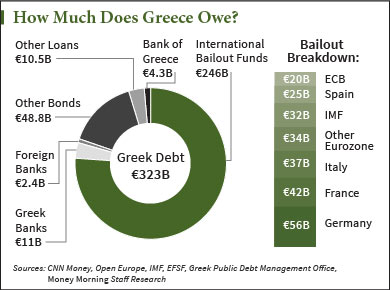
Greece crisis: Tsipras under pressure to submit reform blueprint to creditors - total foreign debt: € 246 billion

http://cdn.moneymorning.com/wp-content/blogs.dir/1/files/2015/03/How-much-does-Greece-owe-graph.jpg
Fforeign debt of €246b Greece and local debt € 32b 
Greece is under intense pressure to table a last-chance blueprint for radical economic reform, tax increases and spending cuts on Thursday in order to secure a future in the euro and stave off financial collapse.

The reform proposals are to be sent to Greece’s creditors with negotiations at the critical stage. The embattled Greek prime minister, Alexis Tsipras, accused his eurozone creditors on Wednesday of exploiting his country as an “austerity laboratory” for the past five years while formally asking Europe for three more years of rescue funds.

Note EU-Digest: Athens has accumulated a debt mountain of 175% of GDP amounting to € 246 billion. If you spread that over the population of 11.3 million Greeks, every Greek Citizens presently would owe approximately € 21 million to cover the debt. Very difficult to figure out how Greece would ever be able to pay this off unless a lot of the debt would be "forgiven".

EU-Digest


7/8/15

USA: 2016 Republican Candidate Promises To Wage War In Iran, Syria, Afghanistan, Iraq - by Alice Ollstein

Everywhere Sen. Lindsey Graham (R-SC) looks in the world, he sees a crisis, and believes these combined crises could soon “throw the world into chaos we haven’t seen since WWII.”

In his first major foreign policy speech as a presidential candidate, Graham told a packed room at the Atlantic Council think tank in D.C. what he would do if he became Commander in Chief, a list that tilted heavily to where he would use military force.

Though he rattled off a laundry list of threats to U.S. national security throughout his speech, Graham called the current diplomatic negotiations with Iran “the greatest existential threat to world order” and “North Korea in the making.”

“I don’t mind Iran or any other nation having a nuclear power program for peaceful reasons,” he said. But if the current negotiations produce a deal that doesn’t include the ability for the U.S. to inspect Iran’s nuclear reactors “anytime, anywhere,” Graham would resort to “overwhelming” military force.

“I don’t want a war, but if that’s what you want you’re going to lose it,” he said, pretending to address Iranian leaders directly. “We’re going to sink your navy and shoot your Air Force down.”

The inflammatory remarks come the same week top U.S. and Iranian officials are down to the wire on a historic agreement to restrict Iran’s nuclear capabilities in exchange for lifting harsh economic sanctions.

It’s not the first time Graham has attempted to undercut the negotiations. In March, he was one of 47 Republican senators to sign onto a letter to the Iranian government warning that a future president could undo any deal they come to on the country’s nuclear program after President Obama leaves office. Like Graham, the other authors of the letter have expressed eagerness for war with Iran.

Read more: 2016 Candidate Promises To Wage War In Iran, Syria, Afghanistan, Iraq | ThinkProgress

TTIP: US House of Reps says: "Europe Can't Boycott Israel"

The United States House of Representatives has fast-tracked a bill regarding a free trade agreement between the US and Europe which would include a section barring EU countries from any form of commercial boycott against Israel and Israeli goods.

According to the PNN, Israel’s Ynetnews indicated that two versions of the law had been presented to the House of Representatives and the Senate, clarifying that both versions included the section obligating EU countries to refrain from the boycott of Israeli products.

This section states that any affiliation and cooperation with the Boycott, Divestment and Sanctions (BDS) movement on the part of EU countries is in violation of the “principle of non-discrimination’ statute in the General Agreement on Tariffs and Trade (GATT).

According to Ynetnews, the second law did not pass at this stage due to disputes with respect to compensation for businesses in Europe. There was also severe opposition from Obama’s own Democrats, but it is expected that an agreement will be reached between the House of Representatives and the Senate during the coming days.

From the moment that an agreement is reached, a unified document will be presented to the American President, Barack Obama, for a review of the trade agreement as soon as possible. He will then sign the document and it will be put to the vote in the House of Representatives and the Senate.

Note EU-Digest: This is a "pipe dream" - US House of Representatives can't tell the EU what to do.

Read more: US House of Reps: Europe Can't Boycott Israel - International Middle East Media Center

Greece Exposes The Flaws Of A Wrong Europe - by Mehmet Ugur and Ozlem Onaran

The Greek people, their newly-elected government and many Europeans and non-Europeans with a sense of justice, history and solidarity, have been shouting loud: the “Greek problem” is a consequence of neo-liberal economic and financial policies that have become increasingly dysfunctional and dangerous. The problem has been made worse by the ascendance of sheer inter-governmentalism in Europe.

Both neo-liberalism and inter-governmentalism are the results of collusion between economic, financial and political elites in Europe, aided by economists, political scientists, lawyers, analysts and journalists with a conservative outlook. The symbiotic relationship between these two has been feeding on the spoils of increasingly unequal wealth accumulation. Their narrative about “Greeks living beyond their means” is nothing but an unashamed distortion of facts about both the present and the past.

The distortion of current facts takes the form of preaching to the Greek people on how they should show penance despite the facts on the ground. The origin of Greek debt, like subprime lending in the US and, given the general dysfunctionality of the financial system as laid bare by the Great Recession, is a result of reckless lending by private banks. Accommodating economic policies and perverse financial regulations have facilitated this – just as much as the symbiotic relations between the European arms industry and corrupt politicians in Greece, and tax evaders in Greece and tax havens in Luxembourg and elsewhere in Europe.

This distortion takes the form of misleading public opinion despite evidence that the ruling elite has secreted away. The conservative European elites and their henchmen have been pushing Greece towards destruction despite IMF documents showing that austerity is unlikely to make Greek debt either repayable or sustainable in the medium- to long-term.

The conservative rhetoric distorts the history of Europe too. Europe prospered and avoided repeated crises and wars only when it found collaborative solutions to collective problems. The leading proponent of austerity, Germany, was by far the biggest beneficiary of debt forgiveness. After World War I Keynes argued in the Economic Consequences of the Peace that the Versailles Treaty was a “Carthaginian peace” that would ruin Europe rather than set the conditions for economic recovery. This is very important not only because the demand for solidarity with the German people came from a scholar at the winning side, but also because the demand was made despite the fact reparations were meant to compensate for the human and material costs of more sinister German military actions in the form of war.

Note EU-Digest: Excellent report on the flaws of the European monetary and political structures which can be traced back to European Conservative Political forces copying and linking themselves to the "ruthless and corrupt" US financial system and the general dysfunctionality of that system, as laid bare by the 2007-2009 recession. This in addition to the reckless lending by private banks and accommodating economic policies and perverse financial regulations. When will Europe understand that the future of Europe must depend on our own needs and objectives and not be influenced by "surrogate" decisions on the other side of the Atlantic, as it unfortunately is today.

Read more: Greece Exposes The Flaws Of A Wrong Europe » Social Europe

7/7/15

Greece debt crisis: Eurozone sets deadline for new plan

The eurozone has given Greece until Thursday to present new proposals to secure a deal with creditors, and has called a full EU summit for Sunday.

The moves came after an emergency eurozone leaders' summit in Brussels.

European Council President Donald Tusk said this was now the "most critical moment in the history of the eurozone".

The eurozone had expected Greece to submit fresh plans on Tuesday after its voters rejected a deal in a referendum, but no new proposals were tabled.

On Sunday, a meeting of all 28 members of the European Union will be held.

Read more: Greece debt crisis: Eurozone sets deadline for new plan - BBC News

Europe’s unfinished business

Alongside the risk of Brexit, Greece's possible exit from the eurozone following Sunday's referendum should force a debate on how the single market might function better in the whole of the EU, not simply within the currency union
 
The upcoming British referendum on EU membership that may well bring Britain out of the union – combined with the increasingly likelihood of a Greek default and a partial exit from the euro raises in a suddenly acute form the question of the relationship of the EU and the eurozone. 

The new acute crisis demands some innovative thinking to preserve – and extend – the central benefits of European integration, while thinking about additional areas that demand a cooperative rather than a confrontational solution.

The Maastricht treaty basically assumes that all EU member countries will satisfy the membership criteria for the currency union and stipulates that they are then obliged to join.  The opt-outs only relate to the UK and Denmark. The UK has been in a paradoxical position of championing the rather abstract case (with which probably a majority of economists agree) that a currency union requires a greater measure of fiscal integration than the EU or the eurozone currently possesses. US policymakers made very similar points. But, on the other hand, the UK made it clear that it did not want to participate in that greater fiscal integration; and (with the Czech Republic) voted in January 2012 not to accept the fiscal compact treaty (on “legal grounds”).

Brexit may thus in theory make a move to greater fiscal integration easier. At the time of the Maastricht discussions, many European policymakers, like the influential commission president Jacques Delors, simply assumed that the EU budget’s share would rise to about three percent of GDP (by coincidence, that was about the share in peacetime of the US federal budget during the 19th century). 

Instead, the figure remained stuck at just over one percent (it has actually declined slightly since the 1990s). Denmark on its own is unlikely to want to remain an outlier, especially since the management of the currency since the global financial crisis of 2008 has been rather precarious. There is a similarly strong case why Sweden might want to end its anomalous “out” position – for the same kind of reasons as Norway and Switzerland are finding it very hard to live with an independent currency and to devise an appropriate set of monetary and exchange rate policies. But, at the same time, the contemporary Greek experience should be a warning against thinking that there might be a new political equilibrium that shifts towards an obvious acceptance of greater fiscal federalism.

In justifying the “no” in 2012, David Cameron explicitly played the idea of the common free market out against the eurozone, with its fiscal promises: "They must not take measures that in any way undermine the EU single market.  We'll be watching like a hawk." What is needed is a greater degree of flexibility and responsiveness in Europe. In this spirit, here are some suggestions for improving the functioning of the single market in the whole of the EU, and not just in the eurozone (whose definition is getting more precarious):

Read more: Policy Network - Europe’s unfinished business

7/6/15

Eurozone struggles to find joint response to Greek referendum - by Ian Traynor

Germany and France scrambled to avoid a major split over Greece on Monday evening as the eurozone delivered a damning verdict on Alexis Tsipras’s landslide referendum victory on Sunday and Angela Merkel demanded that the Greek prime minister put down new proposals to break the deadlock.

Read more: Eurozone struggles to find joint response to Greek referendum | Business | The Guardian

Greece: With Greek ‘No’ Vote, Tsipras Wins a Victory That Could Carry a Steep Price - by Liz Alderman

Prime Minister Alexis Tsipras may have won a victory at home on Sunday as the Greek people dealt a resounding “no” to European austerity policies.

But Greece risks paying a high price for that decision. While the vote sharply consolidated Mr. Tsipras’s popularity, that could fade quickly if he leads the country deeper into bankruptcy and financial chaos, creating a new round of instability with consequences for Greece and the broader European project.

If anything, Mr. Tsipras is likely to find it harder, rather than easier, to strike a new financing deal quickly with European creditors, heightening the risk that Greece will careen out of the eurozone unless Europe decides to give Mr. Tsipras and his defiant nation another chance.

“What we need now is more wisdom from both sides,” said Loukas Tsoukalis, the president of the Hellenic Foundation for European and Foreign Policy, an Athens-based think tank. “Greece can’t go on because we’re on the edge of cliff,” he said. “After all this, the question is whether our partners would be so unwise as to push Greece over the edge, because that would be damaging for everyone.”

Some European officials acknowledged Sunday that greater flexibility might now be needed from their camp. Just as the referendum vote divided Greece, so, too, did it reveal fault lines between those European countries that appear willing to bend to keep Greece in the eurozone, and others, including Germany and the Netherlands, whose policy makers have all but suggested that the eurozone would be better off without Greece.

Read more: With Greek ‘No’ Vote, Tsipras Wins a Victory That Could Carry a Steep Price - The New York Times

Insurance Industry: How the Internet of Things is transforming the insurance industry - by John Greenough

The ability to bring internet connection to nearly every type of consumer device will have huge implications for the insurance industry over the next five years. Insurers looking to cut costs, improve business practices, and better assess clients' risk levels, will increasingly invest in the Internet of Things (IoT)

Some auto and health insurers are already offering a new type of insurance — usage-based insurance (UBI) that uses IoT devices to track clients' activity and offer discounts or rewards for healthy and safe behavior. We expect 17 million people will have tried UBI auto insurance by the end of this year.

In a new report from BI Intelligence, we examine the impact of the IoT on the insurance industry. From free fitness trackers to track individuals' exercise habits to drones to assess damages in unsafe post-disaster conditions, we analyze current US insurance markets — including the auto, health, life, and property insurance markets — and look at ways insurers are integrating IoT devices.

Read more: How the Internet of Things is transforming the insurance industry - Business Insider

Personal Privacy: T-Mobile was asked to turn over more customer info to NSA than its larger rivals - by Roger Cheng

T-Mobile received nearly 351,940 government requests for data in 2014, the most out of any of the four national wireless carriers.

The nation's fourth-largest carrier by subscriber base disclosed in its transparency report on Wednesday that it had fielded 177,549 criminal and civil subpeonas, 17,316 warrants and more than 3,000 wiretap orders.

It marked the first time T-Mobile issued a transparency report, which have become increasingly popular over the past year as civil liberties groups, shareholder and consumer advocates have pressured companies to be more open about when they disclose customer information. T-Mobile was the last of the four national carriers to issue a report, which comes amid continued scrutiny of surveillance programs run by the US National Security Agency -- including the bulk collection of phone call data -- that were revealed when former NSA contractor Edward Snowden leaked classified government documents.

The requests kept T-Mobile busy last year -- the number of requests jumped nearly 11 percent from 2013.
 
Read more: T-Mobile was asked to turn over more customer info than its larger rivals - CNET

Travel: 8 Essential Apps for Traveling Abroad - by Sarah Pike

Travelers used to carry along guidebooks about each place they were visiting when exploring the world, but now you can find all the information you need in the palm of your hand. There's an app for virtually everything these days and many of them are designed to make traveling easier.

Click on the lin k below for eight of our favorite apps for traveling abroad. 

Read more: 8 Essential Apps for Traveling Abroad | Sarah Pike

Climate: Heat Wave: Germany Marks Hottest Day In History

Germany’s all-time heat record was shattered Sunday when temperatures climbed to 104.5 degrees Fahrenheit, making it the hottest day in Germany since recordkeeping began in 1881, BNO News reported.

The temperature was recorded at a weather station in Kitzingen, which is in the southern state of Bavaria, a meteorologist told the Stuttgarter Nachrichten newspaper.

BNO News reported the previous record for Germany was 104.3 degrees Fahrenheit, set in July 1983 and matched in August 2003. Europe has experienced extreme heat since last week, with hot temperatures affecting Spain, Portugal, France, England and Belgium, AccuWeather.com reported.

Read more: Heat Wave: Germany Marks Hottest Day In History

Legal Controversies: The obscure legal system that lets corporations sue countries - by Claire Provost and Matt Kennard

Luis Parada’s office is just four blocks from the White House, in the heart of K Street, Washington’s lobbying row – a stretch of steel and glass buildings once dubbed the “road to riches”, when influence-peddling became an American growth industry. Parada, a soft-spoken 55-year-old from El Salvador, is one of a handful of lawyers in the world who specialise in defending sovereign states against lawsuits lodged by multinational corporations. He is the lawyer for the defence in an obscure but increasingly powerful field of international law – where foreign investors can sue governments in a network of tribunals for billions of dollars.

Fifteen years ago, Parada’s work was a minor niche even within the legal business. But since 2000, hundreds of foreign investors have sued more than half of the world’s countries, claiming damages for a wide range of government actions that they say have threatened their profits. In 2006, Ecuador cancelled an oil-exploration contract with Houston-based Occidental Petroleum; in 2012, after Occidental filed a suit before an international investment tribunal, Ecuador was ordered to pay a record $1.8bn – roughly equal to the country’s health budget for a year. (Ecuador has logged a request for the decision to be annulled.)

Parada’s first case was defending Argentina in the late 1990s against the French conglomerate Vivendi, which sued after the Argentine province of Tucuman stepped in to limit the price it charged people for water and wastewater services. Argentina eventually lost, and was ordered to pay the company more than $100m. Now, in his most high-profile case yet, Parada is part of the team defending El Salvador as it tries to fend off a multimillion-dollar suit lodged by a multinational mining company after the tiny Central American country refused to allow it to dig for gold.

The suit was filed in 2009 by a Canadian company, Pacific Rim – later bought by an Australian mining firm, OceanaGold – which said it had been encouraged by the government of El Salvador to spend “tens of millions of dollars to undertake mineral exploration activities”. But, the company alleged that when valuable deposits of gold and silver were discovered, the government, for political reasons, withheld the permits it needed to begin digging. The company’s claim, which at one point exceeded $300m, has since been reduced to $284m – still more than the total amount of foreign aid El Salvador received last year. El Salvador countered that the company not only lacked environmental permits but also failed to prove it had obtained rights to much of the land covered by its request: many farmers in the northern Cabañas region, where the company wanted to dig, had refused to sell their land.

Read more: The obscure legal system that lets corporations sue countries | Claire Provost and Matt Kennard | Business | The Guardian

7/5/15

The Netherlands: A Look At The World’s High-Tech Startup Capital - by Conrad Egusa and Steven Cohen

Behind London and Berlin, the Dutch startup scene is already considered to be one of the most prominent in Europe. (If it feels unfair to weigh an entire country against individual cities, consider that the Netherlands has 17 million people crammed into an area half the size of South Carolina.

Startup Juncture reported 75 major deals in 2014, for a total of roughly $560 million in investment. Ten companies raised over $9 million. In the past few years, especially, each successive quarter has seemingly brought a new standard for sheer volume of activity. The road to this point has been long and deliberate, and Dutch entrepreneurs deserve credit for what they’ve managed to achieve thus far.

And yet, to herald Dutch innovation as it currently stands is to unveil a project that’s still only just underway.

The Dutch, on the whole, speak better English than probably any non-native population in continental Europe, one of the hallmarks of a consistently excellent education system that also scores among the highest worldwide in math and science metrics. Strong economic foundations in industry and commerce offer a dependable framework for continued growth.

And under the proven leadership of Neelie Kroes, the so-called “Internet-Tsar” of Europe, the government’s recent commitments to tech entrepreneurship may mark a bellwether of a new era in startup proliferation.

Read more: The Netherlands: A Look At The World’s High-Tech Startup Capital | TechCrunch

Insurance Industry: Ethics in the Insurance Industry rated poorly - by Marco Bendinelli

 Whether it is for legal, personal or humanitarian reasons, ethics can’t be ignored, and this is especially true for the insurance industry.

Unfortunately, the current system isn’t perfect, and newspapers are often rife with stories of people falling out with their providers for a range of issues. An annual ethics poll by Gallup, for instance, has always seen insurance companies fare poorly. In over 35 years, no more than 15 percent of the participants considered the insurance industry to have “high ethical standards.” Clearly, this is something that needs to change.

Much of the ethical issues in insurance are a case of utilitarianism and deontology. The former perspective focuses on the greater good or collective, while the latter believes in personal duties. Insurance businesses are arguably utilitarian, as they look at the larger picture.

An individual customer, on the other hand, is somewhat deontological; they consider their needs first and foremost, with no relevant interest outside their insurance policy. Many problems occur when insurance providers fail to understand these concerns, conducting practices that simply ignore personal objections.

Read more: Ethics in the Insurance Industry

USA: Wall Street banker pens sex and drugs tell-all book - by Sherryl Connelly

Blue-chip banker John LeFevre, after spilling Wall Street’s secrets 140 characters at a time, is back with a whole book about his cocaine-fueled days as a master of the universe.
“Straight to Hell” is shocking and sordid — and so much fun.

LeFevre was still working on Wall Street when he tweeted snippets of outrageous conversations supposedly overheard in the elevator at Goldman Sachs.

He’s given up the Twitter pseudonym @GS Elevator to spin the rest of his riveting tale in a tell-all that rivals “The Wolf of Wall Street” for dishing the insider dirt.

LeFevre bluntly sums up his approach: “No apologies, no f---s given.”

When LeFevre was transferred to Hong Kong in 2004, he soon discovered it was fantasy island for lions of Wall Street looking to shed their expensive suits and get nasty.

The hedge fund manager responsible for introducing him to powerful clients first handed him a phone number, advising LeFevre it was a priority: “It’s Joe’s cell number. You’re going to need it.”

“It’s not that bankers in New York or London are less deviant, they just can’t get away with what we can,” he writes of the no-holds barred events.

Read more: Wall Street banker pens sex and drugs tell-all book - NY Daily News

Insurance Industry: "SURE" takes close look at readjustments and consolidations taking place in the European insurance industry

The Summer issue of SURE published by Koster Insurances takes a special look at the readjustments and consolidations taking place in the European insurance industry .

Also in this issue additional information on the upheaval in the European Insurance industry which comes not only as a result of new EU regulations affecting the Insurance market, but also as a direct consequence of changing economic times, circumstances and influences. Among these outside influences, probably one of the most important being the low interest rates.

SURE notes that For multinational companies, including those in the insurance industry, another dark cloud on the horizon seems to be that there is a general consensus among governments around the world, including the EU, that something has to be done about the tax evasion practices by many multinational corporations. To combat this problem the EU is presently developing a common EU tax base.

This issue of SURE also reviews the EU's sustainable energy strategy and how it can positively influence the job market, and looks specifically at market developments in Britain, Poland, Sweden, and the Netherlands concerning the insurance industry.

Koster Insurances, the publisher of the publication also announced in this issue that this would be the last issue of SURE in its present format. The publication was first published in 2006. 

EU-Digest

Greece says NO to austerity demands by Wall Street dominated financial sector and their IMF brainchild

The Greek No Vote has shown the rest of the EU that democracy is what counts and not the dictatorial rule of the Wall Street dominated global financial markets and its brainchild the IMF.

It will hopefully only hasten Europe's need to take a more independent route on a variety of issues, presently controlled by Trans-Atlantic financial and political forces.

Europe must choose for Greece, after all, aren't they one of us?
EU-Digest

7/4/15

Greek referendum: how would top economists vote? - by Katie Allen

Greeks go to the polls on Sunday to vote on whether to accept the bailout programme proposed by international lenders that would restart financial aid in exchange for further austerity and economic reform.

The government is urging people to vote no, with the finance minister, Yanis Varoufakis, saying it is time to end years of rolling over Greece’s bailouts and “pretending” its debts can be repaid.

But Eurozone leaders have insisted that if Greece votes no, it will be saying goodbye to the euro. Two former Greek prime ministers, Kostas Karamanlis and Antonis Samaras, both of the centre-right New Democracy party, are urging a yes vote, saying that a return to the drachma would kill the Greek economy.

Read more: Greek referendum: how would top economists vote? | World news | The Guardian

7/3/15

European Weather: The Netherlands swelters as temperatures hit record levels

The temperature tipped 37.3 degrees in Maastricht on Thursday, making it the warmest July day ever recorded in the Netherlands, broadcaster Nos said. Last night was also the warmest evening since formal records began in 1901. In Arcen, in Limburg, the temperature did not dip below 24.1 degrees. In coastal regions, however, a sea breeze means the temperature is being kept below 28 degrees. In addition, there may be some localised thunderstorms on Thursday evening, weather forecasters say. The heatwave has led Dutch railway company NS to reduce services on some routes to head off the risk of the rails buckling. A number of events, such as fun runs and shows involving animals, have also been cancelled or brought forward this weekend because of the heat.

Read more at DutchNews.nl: The Netherlands swelters as temperatures hit record levels http://www.dutchnews.nl/news/archives/2015/07/the-netherlands-swelters-as-temperatures-hit-record-levels/
The temperature tipped 37.3 degrees in Maastricht on Thursday, making it the warmest July day ever recorded in the Netherlands, broadcaster Nos said. Last night was also the warmest evening since formal records began in 1901.

 In Arcen, in Limburg, the temperature did not dip below 24.1 degrees. In coastal regions, however, a sea breeze means the temperature is being kept below 28 degrees. In addition, there may be some localised thunderstorms on Thursday evening, weather forecasters say.

The heatwave has led Dutch railway company NS to reduce services on some routes to head off the risk of the rails buckling. A number of events, such as fun runs and shows involving animals, have also been cancelled or brought forward this weekend because of the heat.

Read more: The Netherlands swelters as temperatures hit record levels - DutchNews.nl

Democracy: Extremism and Censorship - by Samuel Westrop

  • There are obvious shortcomings in the British government's demand that all "beliefs" deserve "mutual respect." While it is important in a free society to tolerate beliefs we dislike, we should not be required to "respect" them.
  • If the government would stop funding and backing religious separatism, and start using existing laws to prosecute preachers who incite violence and promote terrorism, these measures would go a long way to preventing extremists from operating with impunity. Censorship, on the other hand, will harm everyone.
On May 27, a few weeks after the elections, Queen Elizabeth II addressed the British parliament with a speech that laid out a number of important proposed bills, including changes to immigration and the welfare system; a referendum on Britain's membership of the European Union, and, most importantly, a series of new measures to tackle Islamic extremism.

The "Extremism Bill," the government has announced, will "unite our country and keep you and your family safe by tackling all forms of extremism." It will also "combat groups and individuals who reject our values and promote messages of hate."

To achieve this, the government is attempting to establish a number of new proscriptive powers. "Banning Orders" would allow the Home Secretary to outlaw designated "extremist groups." "Extremism Disruption Orders" would restrict the activities of individual, designated "extremists." They would be prohibited from appearing on television, and would have to submit any publications, including social media posts, to the police for prior approval. "Closure Orders" would allow the government to shut down institutions, including mosques, used to promote extremism.

In addition, the government has announced plans to take "tough measures against [television] channels that broadcast extremist content."

Changes to background checks would also mean that companies could find out whether a potential employee is an extremist. If so, they would be barred from working with children.

Read more: Extremism and Censorship

7/2/15

Greek Referendum on Bailout Too Close to Call, Poll Shows - by Nikos Chrysoloras

Greek voters are almost evenly split heading into a referendum in three days that European leaders said could plunge the country into economic darkness.

A GPO poll cited by euro2day.gr said 47 percent leaned toward a “yes” vote, an endorsement of austerity and the international bailout.

The “no” camp, the government’s position rejecting those terms, was 43 percent. The margin of error in the survey of 1,000 people was 3.1 percentage points.

The battle lines ahead of the vote appeared immovable after a day of posturing in the wake of the expiry of Greece’s bailout deal and its missing a payment to the International Monetary Fund. Politicians across Europe poured scorn on Prime Minister Alexis Tsipras’s strategy; he said the “no” vote would improve his leverage.

Greece is facing a “terrifying” economic freefall, Spanish Finance Minister Luis de Guindos said.

“We can’t have an accord with someone who says ‘no,’” his French counterpart, Michel Sapin, said.

Read more: Greek Referendum on Bailout Too Close to Call, Poll Shows - Bloomberg Business

7/1/15

Greece debt crisis: IMF payment missed as bailout expires

Greece has missed the deadline for a €1.5bn (£1.1bn) payment to the International Monetary Fund (IMF), hours after eurozone ministers refused to extend its bailout.

But the ministers say they will discuss a last-minute request from Greece for a new two-year bailout on Wednesday.

Greece is the first European Union country to fail to repay a loan to the IMF and is now formally in arrears.

There are fears that this could put Greece at risk of leaving the euro.

The IMF confirmed that Greece had failed to make the payment, shortly after 22:00 GMT on Tuesday.
"We have informed our Executive Board that Greece is now in arrears and can only receive IMF financing once the arrears are cleared," said IMF spokesman Gerry Rice.

 Read more click here